


There are certain sights in Hong Kong that feel almost inseparable from the city’s soul: the red minibus weaving through its familiar impatience, the neon sign humming above a cha chaan teng, and the tram ringing its way into the distance. And then there are the bamboo scaffolds — rising, bending, and wrapping themselves around entire buildings with a grace so improbable that visitors often stop mid-stride, unsure whether they are witnessing engineering or a kind of urban choreography.
Even for those of us who did not grow up here year after year, bamboo scaffolding forms part of a quiet and recurring memory. It was always there when we returned for summers or winters, familiar in a way we never quite articulated. We walked beneath its latticed shadows on humid afternoons, the poles casting trembling patterns on pavements slick with heat. We watched scaffolders — introduced to us as paan gaa si fu (棚架師傅), the bamboo scaffolders — balancing on narrow poles with the poise of dancers, tying knots with movements so fluid they felt instinctive.
Yet in the rush of Hong Kong life, few residents ever look up. The city’s rhythm pulls the gaze forward, not skyward. People hurry past construction sites without a second thought, never noticing how bamboo cradles towers old and new, and how its presence breathes a sense of handmade continuity into a skyline otherwise claimed by glass and steel.
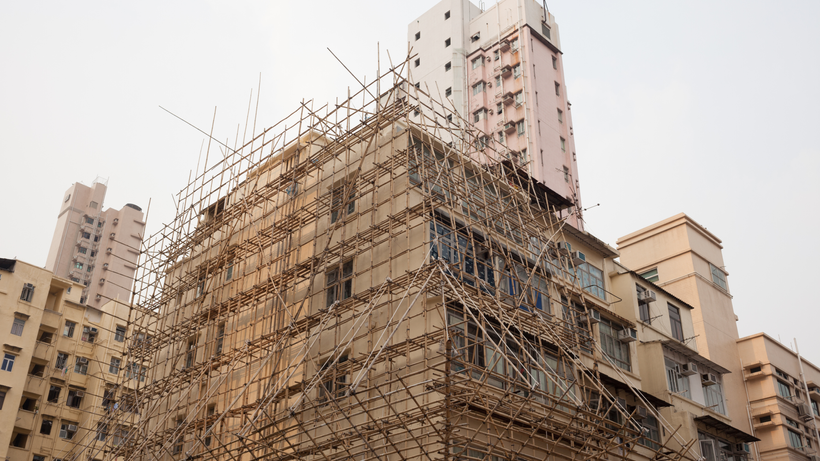
Bamboo scaffolding is unique in ways that mirror the character of the city itself. It is light yet strong, pliant yet resilient. While metal stiffens and fractures under typhoon winds, bamboo absorbs the force and bends with it. Engineers often speak of its tensile strength, but its true power lies in its humility — a material that thrives not by resisting nature, but by yielding to it.
The scaffolders, whose craft is now fading, embody this same quiet resilience. Their skills were passed from father to son and from neighbour to apprentice, long before safety regulations and training manuals entered the trade. Many learnt the work barefoot, climbing higher than most of us would dare to look. Watching them feels like witnessing an art form, one where knowledge accumulated through instinct, weather, and risk is carried in muscle memory rather than written documentation.
But bamboo scaffolding is more than a construction method. It forms part of Hong Kong’s cultural vocabulary. Bamboo has long supported our celebrations, from festival stages for Cantonese opera to towering structures for the Cheung Chau Bun Festival, and from archways for Ghost Festival rituals to temporary theatres, street fairs, and community gatherings. It is the architecture behind moments of collective joy, a presence that retreats the moment its duty is fulfilled.
Despite this deep cultural significance, many of us took bamboo scaffolding for granted. It was so ordinary and so omnipresent that we stopped seeing it. We passed beneath its shade daily, unaware of the beauty above our heads. Hong Kong moves quickly, and the city often forgets to mourn what it loses until the loss is already in motion.
Now, with conversations circulating about replacing bamboo with imported materials, people are beginning to notice what had always been there. Suddenly, photographs appear online with captions declaring “This is so Hong Kong,” as if the realisation has come too late. And perhaps it has. The unease we feel is not merely about the phasing out of a material, but the possibility that an entire tradition may quietly unravel alongside it, disappearing without ceremony.

If bamboo scaffolding disappears, so too will the sound of poles tapping in rhythmic conversation, the trembling shadows cast across familiar pavements, and the unmistakable silhouette of bamboo climbing alongside a building under renovation. Future generations may grow up without ever seeing a skyscraper wrapped in green poles or understanding how something so fragile-looking could support a city with such tireless determination.
There is an undeniable grief in that thought, a grief sharpened by hindsight. I never appreciated bamboo scaffolding when I was younger. I noticed it, but I did not truly see it. It was part of the background: a convenience, a shade, a structure that simply existed. Only now, as talk of its disappearance grows louder, do I recognise how deeply it is entwined with my memories of Hong Kong — a Hong Kong encountered not daily, but through seasons of return, each visit stitched together by familiar details that anchored me more deeply than I realised.
Perhaps that is the quiet truth suggested by the bamboo lattice above us: the things we overlook may one day become the very things we long for. Hong Kong has seen many traditions fade, from neon signs dimming to markets disappearing, and from ferry routes shortening to neighbourhoods transformed beyond recognition. The possible loss of bamboo scaffolding feels like another quiet unravelling, another thread loosening from a fabric that once held the city firmly together.
The next time we walk beneath those trembling grids of bamboo, we might allow ourselves to look up, even if only for a moment. By doing so, we remind ourselves that culture, heritage, and meaning do not always arrive with grand announcements. Sometimes they stand quietly above us, waiting to be noticed and hoping not to be forgotten.
We owe it to ourselves, and to the city, to protect what remains, to cherish the traditions still within reach, and to honour the hands that shaped Hong Kong long before we were old enough to understand its weight. One day, the scaffolds will come down. When they do, may we at least be able to say that we looked up while we still could.
ns216.73.216.141da2


 and then Add to home screen.