
CHAPTER 1 — THE TERRACE10Please respect copyright.PENANAQyJgKkashh
September always arrived with a different scent. A kind of electricity, hard to name. At Holy Cross Academy, September meant wind. And wind meant competition.
The terrace outside the science lab wasn’t anything special. It was a rough rectangle of concrete, wide and cold, bordered by a metal railing that rattled whenever the stronger gusts swept through.
From below it looked forgotten; from above, it obeyed a different order.
A stage.10Please respect copyright.PENANAw1jglylaVc
A tribunal.10Please respect copyright.PENANArnZ4Sewvcz
A battlefield.
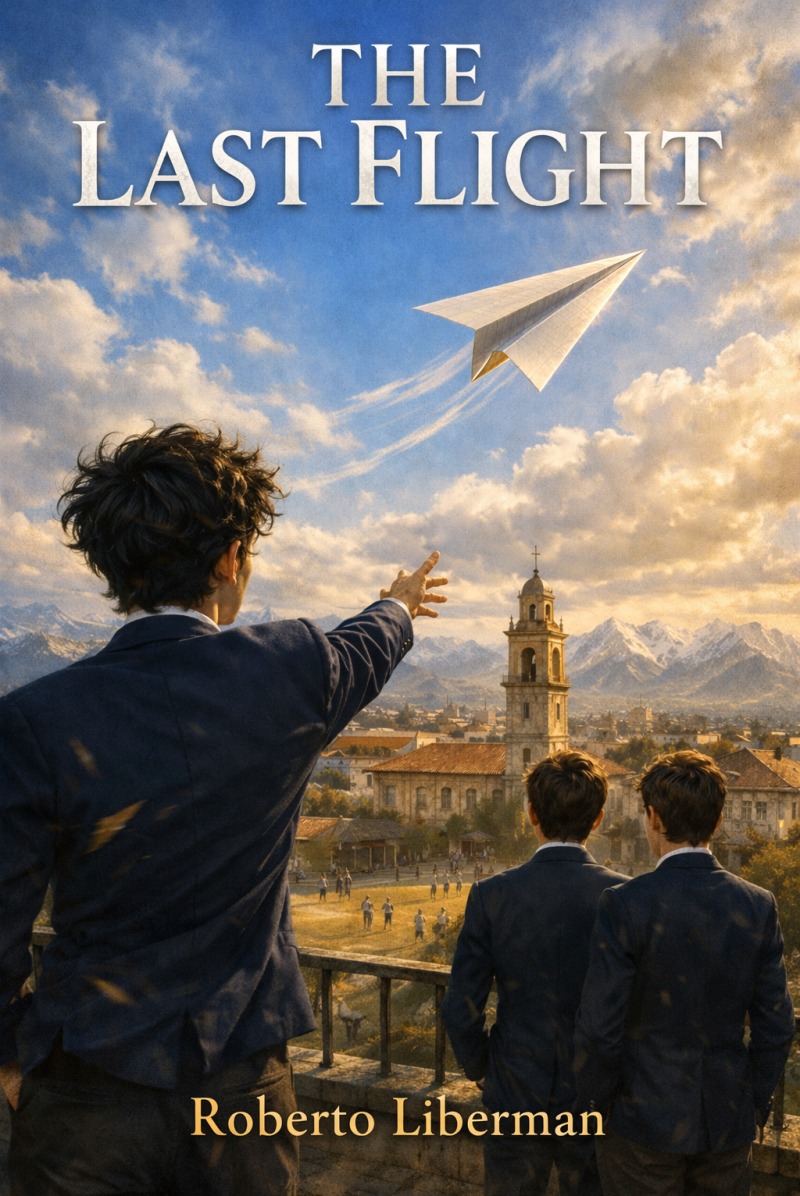
From there, we launched our paper airplanes toward the gray bell tower of the chapel, standing motionless against the distant outline of the Andes. The distance—twenty-nine meters exactly—was known to everyone, though after a few years no one needed to measure it anymore.
You learned it with your body.
Most airplanes fell before reaching halfway. Others made it to the bell tower only to crash against its walls or tumble behind the roof like wounded birds.
Very few managed to clear it.
The winner was the one whose plane traveled farthest, reaching toward the athletic fields on the western side of campus.
There were no judges and no written rules. The wind decided. Physics delivered the verdict. And every mistake, no matter how small, revealed itself in the air.
The seniors stationed below on the grass marked the exact spot where each plane ended its flight. No one argued.
That was the beauty of it. It couldn’t be bought. It couldn’t be manipulated. And it offered no favors.
In theory, it was the only truly democratic territory in the entire school.
Even there, in that small kingdom of wind and paper, certain names never went unnoticed—not because of prestige, but because of the discomfort they caused.
Fernando Pereira Pereira was one of them.
The name alone created tension.
Two identical surnames.
At Holy Cross, that wasn’t an accident or a curious detail. It was the unmistakable sign of an absent father.
And in a school where family names functioned as social compasses, that double Pereira made Fernando an anomaly. Everyone knew it, though no one said it.
Fernando came from a humble family that struggled for money. Far more than most people realized.
He arrived at school each morning from a different world—a world Holy Cross kept at arm’s length, welcomed only when his talent proved useful, never fully accepted as one of its own.
And yet, on the terrace, none of that mattered.
It transformed.
There were boys who were stronger, more popular, more confident. Boys with better uniforms, better vacations, and far more respected last names.
But none of them mastered airplanes the way Fernando did.
He didn’t simply fold them. He designed them.
He studied the wind the way others studied a mathematical problem. He adjusted folds with obsessive precision. He calculated invisible weights. He tested minute angles.
And then he launched those creations with a calmness that was almost irritating.
His airplanes didn’t seem to fight the air. They seemed to converse with it.
While everyone else’s designs wobbled, overcorrected, or fell victim to invisible imperfections, Fernando’s moved forward with unsettling stability, as though they had been built according to rules that only he seemed to know.
He had won the last three years. Not by luck.
The boys watched his launches with an uneasy mixture of admiration and resentment. Some tried copying his folds during recess. Others invented ridiculous theories to explain his flights. More than a few would have gladly paid for one of his designs.
Fernando never shared much. He practiced alone. Spoke little. Worked with relentless focus.
Sometimes it seemed as though he wasn’t trying to build a paper airplane at all, but to decipher the air itself.
That was when his name began to feel uncomfortable.
No one disliked admitting his superiority more than the Edwards twins.
Gonzalo Andrés and Marco Antonio moved through the school as if it belonged to them. They were quick, confident, fiercely competitive—the kind of boys who turned every game into a natural extension of their reputation.
The Edwards twins had not been raised to accept defeat.
They had been raised to identify threats before they grew, to neutralize any anomaly that challenged the order they were expected to inherit.
Which was why, unlike everyone else, they never underestimated Fernando.
In every other corner of the school, they dominated without question. But the terrace was different.
Because Fernando existed there. And that alone was enough to upset the balance.
Losing to him wasn’t simply losing. It meant accepting that someone outside the school’s usual hierarchy could prevail in a contest where family name, money, and confidence meant nothing.
It was a crack. Small. But impossible to ignore.
That September, the tension arrived earlier than usual.
Practice flights appeared across courtyards and gardens with the first strong winds. Conversations stopped when Fernando walked nearby. The Edwards twins watched more than they spoke. Rumors moved with the electric speed of things that mattered.
No one said anything openly. Not yet.
But the entire school seemed to be waiting for something.
Fernando continued moving through it all alone, as though he either failed to notice—or saw it too clearly.
The terrace waited. So did the wind.
And though none of us could have known it then, that September would be remembered for years to come.
Not because of the airplanes. But because of what they would ultimately reveal.
10Please respect copyright.PENANAydrZb7mgRt
CHAPTER 2 — THE PRACTICE FLIGHTS
September moved forward like a held breath.
The school kept running with its usual discipline—bells, lines, cassocks, notebooks—but beneath that orderly surface, something else had begun to stir.
Restlessness. Waiting. A wordless rumor.
A strong gust crossing the courtyards was enough to make several boys look up at once. A folded sheet sticking out of a notebook was enough to reveal someone was practicing in secret. A sharp thud against a wall meant a plane had failed.
We were all practicing.
In the courtyards. On the empty fields after practice. In the gardens. In the hallways when no teachers were around. Even inside classrooms, taking advantage of a momentary absence.
Torn notebook pages piled up in the trash bins like small white defeats.
And in the middle of that quiet obsession, Fernando Pereira worked alone.
Always alone.
Sometimes he sat near the empty bleachers. Other times he took a corner of the north courtyard, where the wind behaved differently.
He sat with a notebook across his knees, folding paper with a concentration that seemed far beyond a boy our age.
He didn’t improvise. He tested. Discarded. Started again.
Those who watched him from a distance noticed details that seemed insignificant at the time: the way he checked the symmetry of the folds against the light, the precision with which he corrected the angle of the wings, the methodical way he launched certain models just to study their fall.
Sometimes he didn’t even try to make them fly far. He seemed interested in something else.
In understanding.
That was the most unsettling thing about Fernando: while the rest of us wanted to win, he seemed intent on deciphering the air itself.
And it showed.
His planes flew differently. Not just because of the distance they reached. They flew differently because they seemed to correct themselves in midair.
There was a strange stability in them, an elegant way of cutting through the gusts, as if the paper had learned to negotiate with the wind while flying.
While everyone else’s designs fought the air, his worked with it.
That stirred admiration even among those who didn’t want to admit it.
Boys approached him with absurd excuses just to watch him work. Some tried to memorize his folds. Others offered ridiculous trades—rare stickers, coins, small favors. More than one would have paid for one of his models.
Fernando always kept a certain distance. Not out of arrogance, but because of something harder to define.
There was a natural reserve in him, as if he understood that admiration could change shape without warning.
It wasn’t accidental.
Holy Cross worked that way: a social machine built on invisible hierarchies no one explained, yet everyone understood from childhood.
The right surnames. The well-known families. The big houses. The clubs. The vacations. The inherited friendships.
Fernando Pereira lived outside that system. Or more precisely, beneath it.
And although the competition seemed to suspend those differences for a moment, no one ever forgot who was who.
Least of all the Edwards twins.
Gonzalo Andrés and Marco Antonio watched the practice flights with an attention that had begun to turn into unease that year.
They didn’t talk much about it, but it was enough to see how they followed Fernando’s flights to understand that something bothered them.
Because they understood the problem.
It wasn’t just that Fernando designed better planes. It was that he knew how to launch them.
The Edwards were excellent athletes. Coordinated, fast, precise. On any field at school, they could dominate without question.
But the terrace followed different rules.
Fernando understood things the rest of us only sensed. He read the wind, calculated weight, waited for the exact moment, and adjusted details invisible to everyone else.
And that made any competition against him dangerously uncertain.
As long as Fernando participated, no one felt secure. Not even the Edwards.
The tension grew slowly, almost without us noticing.
The practice flights stopped looking like harmless distractions. Boys began hiding their designs. Some avoided practicing in front of others. There was less talking and more watching.
And at the center of it all was still Fernando Pereira.
Alone. Folding paper.
As if he understood the shift, but chose not to react.
One afternoon, after a particularly clean flight that crossed almost the entire main field before landing near the bleachers, Gonzalo Andrés Edwards stood for several seconds staring at the plane on the grass.
Then he looked at his brother.
Marco Antonio said nothing, but they seemed to understand each other instantly.
“Maybe we should talk to him,” Gonzalo said quietly.
And just like that, without anyone noticing, the competition stopped being a game.
Because at Holy Cross, what didn’t fit couldn’t be allowed to grow.
And Fernando Pereira had no place.
He was an anomaly. An exception that wasn’t supposed to exist. A threat that couldn’t be allowed to prosper.
That afternoon, as the wind kept crossing the courtyards, the Edwards twins made a silent decision:
This time, losing wasn’t an option.
CHAPTER 3 — THE OFFER
The meeting wasn’t accidental. There were no messages, no visible intermediaries. Just stray remarks, dropped at exactly the right moments by the right people, until Fernando Pereira understood where he was supposed to be after the last break.
Behind the south wall of the gym.
It wasn’t an official hiding place, but everyone knew certain matters were usually settled there. At that hour, the eucalyptus trees cast long shadows over the cracked concrete, softening the noise of the school until it became a distant murmur—balls slamming against fences, scattered whistles, voices that never quite formed words.
The Edwards twins were already waiting.
Gonzalo Andrés stood slightly ahead, as if arriving first gave him an advantage over time itself. Marco Antonio stood beside him, still, watching and measuring without seeming to.
When Fernando appeared, he did so unhurriedly.
Hands in his pockets. An easy stride. The same way he stepped onto the terrace when the whole school watched him without admitting it.
He didn’t greet them.
Just raised an eyebrow.
As if deciding whether this was worth his time.
Gonzalo spoke first.
“Pereira. Let’s keep this simple. Tomorrow, you’re not competing.”
Fernando leaned back against the wall, unbothered.
“I’m not competing? And who decided that?”
Marco stepped forward.
“We did.”
Gonzalo reached into his blazer and pulled out a white envelope.
Thick. Heavy.
Fernando didn’t need to open it to know what was inside.
“One thousand escudos,” Gonzalo said. “Five hundred now. Five hundred tomorrow.”
Marco added, without softening it:
“You sit this one out. And you hand over your design. The real one. The one you use to win.”
Gonzalo finished:
“No copies. No substitutes. Tomorrow, you don’t show up on the terrace. Preferably, you don’t show up anywhere.”
The silence that followed wasn’t uncomfortable.
It was technical.
Fernando glanced down at the envelope.
One thousand escudos. Food. Rent. Overdue bills. A full month without his mother having to worry.
“My absence?” he asked. “From the terrace?”
“From everything,” Marco said. “Tomorrow, you don’t exist.”
Fernando tilted his head.
“Interesting. You want to buy a paper airplane.”
Gonzalo shook his head.
“We want to buy peace of mind.”
Fernando let out a short breath, almost a laugh.
“That’s a curious way to say fear.”
Marco’s expression hardened.
“It’s not fear. It’s intelligence.”
Fernando didn’t raise his voice.
“Buying the result always looks like intelligence when you can’t get it any other way.”
Marco moved in.
“You’re not understanding this, Pereira. This is serious.”
“It’s a way out.”
“Out of what?”
“A problem.”
Fernando held his gaze.
“And I’m the problem?”
“Yes,” Marco said. “You are.”
The air seemed to thicken.
Not because of the words, but because they’d been said out loud.
Anywhere else in the school, the Edwards were inevitable.
But the terrace followed different rules.
Up there, last names didn’t matter. Only how the paper flew.
And Fernando flew better.
Fernando lifted his head.
And smiled.
Small. Precise. Without warmth.
“For a thousand escudos, I won’t just sell you a plane. I’ll design you an entire fleet.”
The twins glanced at each other.
Not quite following.
Fernando went on:
“You’ll have perfect models. Symmetrical. Impeccable. The best planes you’ve ever seen. Put them in display cases, show them off to whoever you want, say they’re yours. I couldn’t care less.”
Gonzalo blinked once. Marco frowned.
For a moment, it wasn’t clear whether Fernando was negotiating—or mocking them.
“What the hell do we want a fleet for?” Gonzalo said. “We don’t need decoration. We need the plane that wins tomorrow.”
Fernando held his gaze.
“And you’ll have it up there.”
Gonzalo thought he’d given in.
Until Fernando finished:
“Because tomorrow, I’ll be the one throwing it.”
The silence fell hard.
Marco uncrossed his arms.
“You’ve got a head like concrete. You don’t know when someone’s doing you a favor.”
Fernando didn’t answer.
Marco closed the distance between them.
“We want you gone tomorrow. Off that terrace. Completely.”
Fernando spoke calmly, but something colder appeared in his eyes.
“Then you don’t want to win.”
Gonzalo’s jaw tightened.
“Oh yeah?”
“No,” Fernando said. “What you want is no competition.”
The wind stirred the branches above them.
“Make a choice, Pereira,” Gonzalo said. “One thousand escudos. After tomorrow, no one’s going to remember who flew what.”
Fernando didn’t blink.
“They will. You don’t understand the real problem.”
Marco let out a dry laugh.
“Enlighten us.”
Fernando lowered his voice.
“The problem is, I’m going to beat you anyway.”
The words hung between them.
Gonzalo scoffed.
“Stubborn idiot… No wonder no one ever wanted to give you another last name. Pereira, Pereira… no uncle, no neighbor, no one willing to call you family.”
Fernando’s jaw tightened.
For a moment, he looked younger.
Then it passed.
Marco smiled openly.
“Throw whatever you want tomorrow, Pereira. At the end of the day, you’ll still be the same nobody you’ve always been.”
Fernando took a slow breath.
When he spoke, his voice was steady.
“Keep your money.”
He looked at the envelope one last time.
“Tomorrow, you’re going to need something you can’t fold.”
He pushed himself off the wall and started toward the north courtyard.
“The sky doesn’t fit in a display case.”
And he kept walking.
He didn’t look back.
The twins remained under the eucalyptus trees as the noise of the school slowly returned.
Marco spoke first.
“He’s not going to take it.”
Gonzalo kept staring at the empty space where Fernando had been. The envelope still in his hand.
“I know.”
And in that moment, they both understood:
as long as Fernando Pereira existed inside Holy Cross, the outcome would never be certain.
The competition was no longer a game. Now it was real.
10Please respect copyright.PENANAfQCynMsbW0
CHAPTER 4 — THE EVE OF THE GUSTS
The night before the competition, the wind arrived before sleep.
It swept through the school in uneven gusts, rattling the long windows of the old building and making the metal gutters above the courtyards vibrate. Dry leaves skittered across the courts in erratic paths; some traveled several yards before lifting suddenly and vanishing toward the northern gardens.
At the Edwards house, the windows remained shut.
The wind wasn’t a threat.
It was data.
On the desk lay metal rulers, graph paper, and several versions of the same design, each with only slight differences in the folds. Gonzalo Andrés held one of the planes between his fingers while Marco Antonio reviewed notes beside a small desk barometer.
“The pressure dropped again,” Marco said. “If it keeps falling, tomorrow the wind will come in crosswise from the bell tower.”
Gonzalo didn’t answer.
He studied the model as if measuring something invisible.
Marco picked up another plane and adjusted the edge of a wing by a fraction.
“We can’t launch too high,” he continued. “If it gains speed before stabilizing, the crosswind will turn it.”
“I know,” Gonzalo said.
The brass lamp barely lit the surface of the desk.
Outside, branches tapped against the windows in an uneven rhythm.
“The problem isn’t distance,” Marco said. “It’s holding the line after the first gust.”
“It’s Pereira,” Gonzalo murmured.
Marco looked up.
“You think he’ll change anything?”
Gonzalo rested his hands slowly on the table.
“I don’t know.”
Silence.
Another gust shook the eucalyptus trees.
Marco looked back at the lined‑up models.
“Strong wind affects him too,” he said, more out of logic than conviction.
Gonzalo shook his head.
“It’s not the wind.”
“Then what is it?”
Gonzalo took a moment.
“He doesn’t lose the line.”
Silence again.
Marco lowered his gaze to the model in his hands.
“He can still make a mistake.”
“Yes,” Gonzalo said. “But he doesn’t hesitate.”
The word hung between them.
At Holy Cross, hesitation had always been a way of measuring others.
An invisible variable that explained everything that could go wrong before it happened.
But this didn’t fit.
Marco spoke more quietly.
“Tomorrow it ends.”
Gonzalo nodded.
“Tomorrow it’s decided.”
In a much smaller house, on the other side of the city, the wind had a different sound.
It wasn’t data.
It was a reminder.
The corrugated tin roof rattled with every gust. Yellow light fell across a narrow table covered with torn notebook pages, discarded scraps, and several versions of the same design, all with slight variations.
Fernando sat on the edge of the bed.
The notebook lay open across his knees.
The chosen model lay in front of him.
The one he had repeated all week.
The one he knew better than his own breathing.
He ran his thumb along the central fold.
Just enough.
An adjustment.
Nothing more.
There was no hurry.
Only precision.
The kind of precision that doesn’t need witnesses.
He picked up another plane and launched it across the room.
He wasn’t looking for distance.
He was looking for its descent.
The plane traveled a few yards, lost stability near the window, then corrected slightly before touching the floor.
Fernando picked it up.
Checked the edge.
Adjusted.
Launched it again.
Variations.
Nothing else.
The thought came without warning.
A thousand escudos.
Not desire. Not fear. Food. Bills. Time.
He let it pass.
The next launch was cleaner.
More stable.
Fernando watched it without moving.
That was enough.
He set it on the table.
A reference.
Not the final version.
Outside, the wind stopped arriving in bursts.
It became steady.
The eucalyptus branches no longer argued over direction.
They followed a single one.
The shadows moved faster, as if the entire school were adjusting its breathing.
Fernando looked up.
He listened to the corrugated tin.
Felt the shift in the air.
Then he smiled.
Not confidence.
Recognition.
As if something that hadn’t happened yet had already begun to move.
At the Edwards house, Marco was still staring into the darkness beyond the glass.
“He won’t fail,” he said.
Gonzalo nodded without looking at him.
“He can’t.”
Silence.
Outside, the wind struck the roof again.
Closer.
Steadier.
At Holy Cross, the night continued on its usual course.
But nothing was normal.
Though no one said it out loud, everyone knew:
tomorrow, the air would decide.
10Please respect copyright.PENANABeQUqjuAOW
CHAPTER 5 — THE COMPETITION
I. Morning
The morning of the competition dawned gray.
It wasn’t raining.
The sky had lost its depth—low, uniform clouds pressing the city down against the mountains.
The wind was already awake.
You could feel it before entering the school.
It dragged dry leaves along the sidewalks, shook the trees lining the avenue, and made the boys steady their ties the moment they crossed Holy Cross’s main gate.
Some spoke louder than usual as they arrived, as if the noise could disguise the tension that had been building all week.
Others walked quickly, glancing toward the science terrace before even dropping their bags in the classrooms.
No one needed to ask what day it was.
It was in the air.
The planes appeared early.
They stuck out of pockets, protected between notebooks, hidden in rigid folders to keep a fold from warping before its time.
Some boys were still making last‑minute adjustments in the courtyards, using walls or railings as improvised work surfaces.
The same conversations moved in low voices across the school:
That the wind was coming crosswise. That the gusts were coming from the north. That the air felt heavier. That maybe this year no one would clear the bell tower.
And among all those comments, the same name kept surfacing.
Pereira.
Sometimes with admiration. Sometimes as a warning.
Fernando arrived alone.
He crossed the main courtyard unhurried, his blazer open, notebook pressed under his arm.
Some boys stopped talking as soon as they saw him pass. Others tried to guess whether he was carrying the final model.
Fernando didn’t seem to notice.
Or maybe he noticed everything.
Near the bleachers, two students argued over launch angles while one tried to correct a slightly twisted wing.
Farther away, younger boys tested short flights that the wind distorted without effort.
Each gust reinforced the same impression:
This year, the air wouldn’t forgive mistakes.
Fernando looked up toward the terrace.
The metal railings vibrated softly under the steady wind.
No one was up there yet.
But the entire school was beginning to move in that direction.
As if every conversation, every step, every glance were pulled toward the terrace.
Toward the air. Toward something that had been waiting for weeks.
Across the courtyard, Gonzalo Andrés Edwards watched Fernando without hiding it.
Marco Antonio stood beside him, arms folded.
“He didn’t sleep much,” Marco said.
Gonzalo said nothing at first.
His eyes stayed on Fernando.
Fernando had stopped for a moment by a wall to check something in his notebook.
Then he kept walking.
“It doesn’t matter whether he slept or not,” Gonzalo said at last. “He’ll still throw well.”
Marco looked up at the gray sky.
The wind crossed the courtyard again.
More constant now. Stronger.
For a moment, neither of them spoke.
Because they both understood the same thing:
there was nothing left to prepare.
Now everything depended on the air.
Just before noon, the science terrace began to fill.
The first to head up were the most nervous boys—the ones who needed to grip the railings, feel the wind directly against their hands, or check one last time how their models responded to the gusts.
They paced back and forth with exaggerated focus, careful not to let anyone brush against the wings of their planes.
Down below, on the fields, several seniors were beginning to organize the landing markers. Some carried improvised flags; others held notebooks where they would record the distances.
Teachers and priests watched from the lower courtyards with that familiar mix of indifference and vigilance the school reserved for traditions too old to ban.
The competition had never been an administrative matter.
It was run by a small group of students whose standing at Holy Cross was beyond question. They were responsible for measuring, recording, and validating each distance with almost ritual precision.
The head inspector stood by the staircase with a pocket stopwatch and a small ledger. He didn’t intervene. He simply formalized what the system had already accepted.
Up on the terrace, the wind hit differently.
Cleaner. Colder.
The metal railing vibrated at intervals under long gusts, and every so often a test plane would cut across the courtyards, only to fall short of the bell tower.
Mistakes revealed themselves immediately.
Too much weight.10Please respect copyright.PENANAThXZqEjTun
Not enough stability.10Please respect copyright.PENANAUXAID6Dnb8
Uneven wings.
A launch even slightly off line, and the wind would carry the plane toward the eastern fields or drive it nose‑first into the lower roofs.
The terrace had always felt like a tribunal.
That day, it was even more evident.
Groups arranged themselves almost automatically according to the school’s invisible hierarchies.
The boys from well‑known families took the center without effort, surrounded by friends, comments, and onlookers.
Others stayed close to the edges, speaking little, holding their models tight against their chests.
And then there were those who had only come up to watch.
Because even those who weren’t competing understood that something different was taking shape this year.
The Edwards twins appeared together.
Conversations didn’t stop exactly, but their volume shifted. A few glances moved toward them immediately.
Gonzalo Andrés came up first, carrying a rigid portfolio under his arm. Marco Antonio followed, watching the wind whip through the eucalyptus trees before even looking at the other competitors.
They settled near the center of the terrace.
As if the space already belonged to them.
Gonzalo opened the portfolio calmly and pulled out three nearly identical models. The differences were minimal—changes only visible in the wing edges and the thickness of the central folds.
Several boys tried to look without being obvious.
Marco noticed at once. He shifted his body just enough to block their view.
No one insisted.
The wind crossed the terrace again.
Stronger now.
A sophomore launched a test model too early. The plane climbed awkwardly, twisted in on itself, and struck the side wall of the bell tower, drawing a few uneasy laughs.
The reaction faded quickly.
That day, the wind seemed to punish any hint of overconfidence.
Gonzalo kept watching the air above the terrace.
Not the isolated gusts. The pattern between them.
As if he were trying to uncover a hidden structure within the movement.
“It’s shifting again,” Marco murmured.
Gonzalo gave a minimal nod.
Then it happened.
Something that altered the terrace.
Fernando Pereira appeared on the staircase.
He didn’t make an entrance. He didn’t speak.
He simply stepped onto the landing with his notebook under his arm, his unbuttoned blazer barely moving in the wind.
But that was enough.
Some conversations cut off mid‑sentence. Others pretended to continue, while watching him out of the corner of their eyes.
Fernando scanned the terrace briefly.
Not defiant. Not uncertain.
Precise.
As if he were assessing conditions before beginning a task.
Then he walked toward one end, away from the center where the Edwards stood.
He didn’t seem isolated. He was focused.
He took a single model from his notebook.
One. Nothing more.
And for the first time since the morning began, Gonzalo Andrés Edwards stopped watching the wind.
And looked directly at Fernando.
III. The Launches
The first round began without any announcement.
It never needed one.
All it took was a boy stepping up to the railing with his plane in hand for the terrace murmur to drop instantly into expectant silence.
The boy launched.
A moment later, a gust swept across the terrace.
The plane climbed higher than it should have.
Even so, it held steady for a brief stretch, moving straight toward the bell tower until a lateral gust struck it just beneath the right wing.
That was enough.
The model lost its line and pitched down into one of the inner courtyards, landing hard beside the baptismal fountain.
A few boys followed the fall with tense expressions.
The next competitor made the opposite mistake.
He launched low, trying to stay under the higher wind.
The plane never stabilized.
It dropped fast, shuddering from tip to tip before skidding across the tiles on the north‑wing roof.
Another boy tried to compensate with speed.
Too much force.
The model cut cleanly through the first current, but began to oscillate violently short of the bell tower before plunging into the eastern rose garden.
Little by little, the terrace began to understand something uncomfortable.
That day, a good plane wasn’t enough.
You had to understand the air.
And the air seemed to change every few minutes.
The gusts no longer arrived in isolation.10Please respect copyright.PENANA2TbHlHNNCR
They linked together, altering trajectories that had initially seemed clean.
Some models corrected too late.
Others never did.
Down below, the students marking distances were moving faster now, weaving between short landings and chaotic drops.
The wind was separating the competitors without mercy.
The most nervous boys grew worse with each round.
They adjusted unnecessary folds.10Please respect copyright.PENANAdhYZuLebbX
Tried to fix models already damaged.10Please respect copyright.PENANA44D7slAFad
Argued over launch angles as if some exact formula still existed to tame what was happening above.
There wasn’t.
The terrace looked less like a competition and more like natural selection.
The air decided.
The Edwards twins launched around the middle of the round.
Marco Antonio went first.
His model came out clean, stable, holding a firm line as it crossed the open space toward the bell tower.
Several heads followed it immediately.
The plane held through the first gust.
Then the second.
It lost stability near the end, veering diagonally over the western courts.
Far.
Very far.
The students below marked the distance with restrained murmurs.
It was, up to that moment, the best flight of the day.
Marco didn’t smile.
He simply stepped back and returned to Gonzalo’s side.
Gonzalo launched next.
Lower.
More precise.
The model seemed to understand the wind the moment it left his hand.
It didn’t fight the gusts; it moved through them with a cold, calculated stability.
For the first time that morning, a few boys began to applaud before the flight was over.
Then the air shifted.
For the worse.
The right tip lifted a few centimeters more than it should have.
The plane corrected too late.
It lost its line near the end and dipped early, falling short of Marco’s mark.
The silence lasted a full second.10Please respect copyright.PENANA3YoWCHDuh2
But Gonzalo felt the full weight of it.
Below, the students confirmed the difference.
Marco was still ahead.
Gonzalo looked at the gray sky for a few seconds without speaking.
Then he turned toward the far end of the terrace.
Fernando Pereira still hadn’t launched.
He remained by the railing, observant.
He wasn’t watching the planes, but the space between them.
The gusts.10Please respect copyright.PENANAa3la22q1EY
The subtle shifts through the eucalyptus leaves.10Please respect copyright.PENANAsplxs3GDvp
The way the wind struck the bell tower before opening toward the courts.
As if he were waiting for something.
Or listening to it.
IV. The Wait
By the time the final round began, the terrace no longer felt like part of the school.
The wind had swept away almost every conversation.
Only footsteps remained, held breaths, and the dry sound of paper being adjusted in competitors’ hands.
Below, the courts were traced by invisible paths the students kept marking with flags and short, clipped shouts.
Some planes were caught in the trees or on the low roofs of the north corridor, warped by the gusts—the wreckage of something that had failed under public scrutiny.
The air kept shifting.
But now it had a pattern.
Gonzalo Andrés Edwards understood it fully only then.
It wasn’t chaos.
It had never been.
The gusts moved with a kind of regularity, opening first toward the bell tower before veering over the western courts.
There was a sequence.
A hidden rhythm within the wind.
And Fernando Pereira had found it before anyone else.
Gonzalo watched him from the far end of the terrace.
Fernando stood motionless by the railing, the plane resting between his fingers.
He didn’t look nervous.
Or confident.
He looked attentive.
Like someone waiting for the exact moment to cross a dangerous street.
Marco stepped closer.
“He can still get it wrong,” he whispered.
Gonzalo didn’t answer right away, because he was no longer looking at Fernando’s plane.
He was looking at his hands.
The way he held the model without unnecessary tension. The calm with which he watched the long gusts before they arrived. The tiny movements of his fingers correcting the tilt of the left wing by barely a fraction.
Then Gonzalo understood something worse than the fear of losing.Fernando didn’t improvise.10Please respect copyright.PENANAwdEg2DMoR8
He never improvised.
Everything he did up there looked spontaneous, but it had been happening for weeks.
Every practice in the courtyards. Every minor adjustment. Every discarded model.
Fernando wasn’t reacting to the wind.
He had studied it.
A few meters away, the next competitor launched too early.
The plane came out clean at first, traveled a short distance, and was then caught in a downward current near the bell tower.
It nosed into the outer stands.
No one commented on the fall.
The terrace was already watching something else.
Fernando took a single step toward the railing.
Just one.
The wind crossed the terrace from left to right, lifting several dry leaves over the courts.
Fernando didn’t launch.
He waited.
Another gust struck the eucalyptus trees.
Stronger.
Still, he didn’t launch.
Gonzalo felt something rise through him.
It wasn’t admiration.
It was recognition.
The uneasy certainty of watching someone who understood the logic of the air better.
Fernando watched a leaf briefly caught against the railing.
Then he raised the plane slightly.
The wind began to steady.
Not completely.
Just enough.
And Gonzalo knew, even before the launch, that it was already too late.
V. The Last Flight
Fernando stepped up to the railing without hurry.
The wind still crossed the terrace, but its rhythm had shifted.
The gusts no longer collided.
They moved in the same direction now—long and taut, as if the entire body of air were gathering momentum.
Fernando held the plane at chest height.
The model looked almost too simple.
No ornament. No excess folds. Nothing drew attention to it except the absolute precision of its lines.
He rested his thumb lightly beneath the left wing.
And waited.
Below, the courts felt still.
The students marking distances froze with their flags raised.
Even the boys who usually shouted during each launch had fallen silent, watching from different points across the grounds.
The wind brushed the bell tower again.
Fernando launched.
Not with force. With precision.
The plane left his hand cleanly, crossing the open space beyond the terrace with an almost impossible stability.
In the first few meters, it seemed to fly too low—as if it might lose lift too soon.
Then it found the current.
It didn’t rise sharply.
It held.
The tip corrected slightly to the right, and the model began to glide through the air with an unsettling smoothness.
The entire terrace followed the flight in silence.
The plane passed the bell tower without grazing it.
It cleared it.
And kept going.
The very gusts that had torn other models apart seemed to open just before reaching it.
Each time the wind tried to push it off course, the plane answered with minimal, almost invisible corrections, holding its line as if it already knew the route.
Marco Antonio let out a breath.
Gonzalo didn’t move.
The plane kept advancing.
Beyond the first courts. Beyond the stands. Beyond Marco’s mark.
Some of the students below began to run without realizing it, trying to follow the trajectory before it was lost against the gray sky.
The model only began to descend at the very end.
It didn’t fall.
It glided.
It lost height gradually, elegantly, until it touched down on the damp grass of the western fields and slid several more meters before coming to rest.
Silence.
No one seemed entirely sure of the distance they had just seen.
One of the students marking landings stood still for several seconds, staring at the plane where it lay on the grass.
Then he slowly raised his arm.
The terrace understood.
Fernando hadn’t just won.
He had left them all behind.
For several seconds, no one moved.
The wind swept over the terrace as if nothing had happened. Leaves in the courtyards followed their usual paths. The bell tower stood still against the gray sky.
But the school did not return to its earlier shape.
Something had shifted.
Down below, the student who had marked the distance finished confirming the result with an uncomfortable slowness. There was no shout. No clear announcement. Just a gesture, repeated twice, as if it needed to be confirmed before it could exist.
Then the murmur began.
Not celebration. Misalignment.
The boys looked at Fernando’s plane on the grass as if it didn’t quite belong to the competition they had just witnessed. Some checked their own models. Others avoided each other’s gaze.
On the terrace, no one congratulated him.
Marco Antonio said nothing.
Gonzalo kept staring at the exact point where the plane had come to rest, as if the problem wasn’t the distance—but what had made it possible.
Fernando remained by the railing.
No raised arms. No attempt to meet anyone’s gaze.
He just looked at the same point everyone else was now fixed on. He didn’t seem satisfied. Nor surprised.
It was something else.
As if the result didn’t fully belong to him.
The Edwards twins gathered their models in silence.
Gonzalo packed his away with mechanical care. Marco closed his folder without adjusting anything.
The wind picked up slightly again.
This time it didn’t change the result. It only reminded them it was still there.
The students began to leave the terrace in scattered groups. Some moved quickly. Others more slowly, as though going down was harder than coming up. In the school corridors, the competition began to turn into conversation.
But a strange kind. Incomplete.
Words fell short of explaining what had happened above.
“Perfect.” “Impossible.” “It wasn’t luck.” “I’ve never seen one fly like that.”
None of it quite fit.
Fernando was among the last to leave. Almost the last.
When the terrace was nearly empty.
As he passed the Edwards twins, Marco looked at him for the first time without trying to compete, measure, or correct. He simply looked.
Fernando didn’t stop.
Marco opened his mouth, as if he might say something.
He didn’t.
Fernando kept walking.
Down below, the plane still lay on the grass.
Alone. Too far to be debated. Too precise to be ignored.
When the wind crossed the main courtyard again, the entire school seemed to move differently.10Please respect copyright.PENANAOYNR6tn8NO
As if something invisible had slipped out of alignment.
The school bells rang for the return to class, but the echo felt off—slightly out of rhythm.
And though no one said it out loud, they all understood it the same way:
the air no longer belonged to everyone.


 and then Add to home screen.