

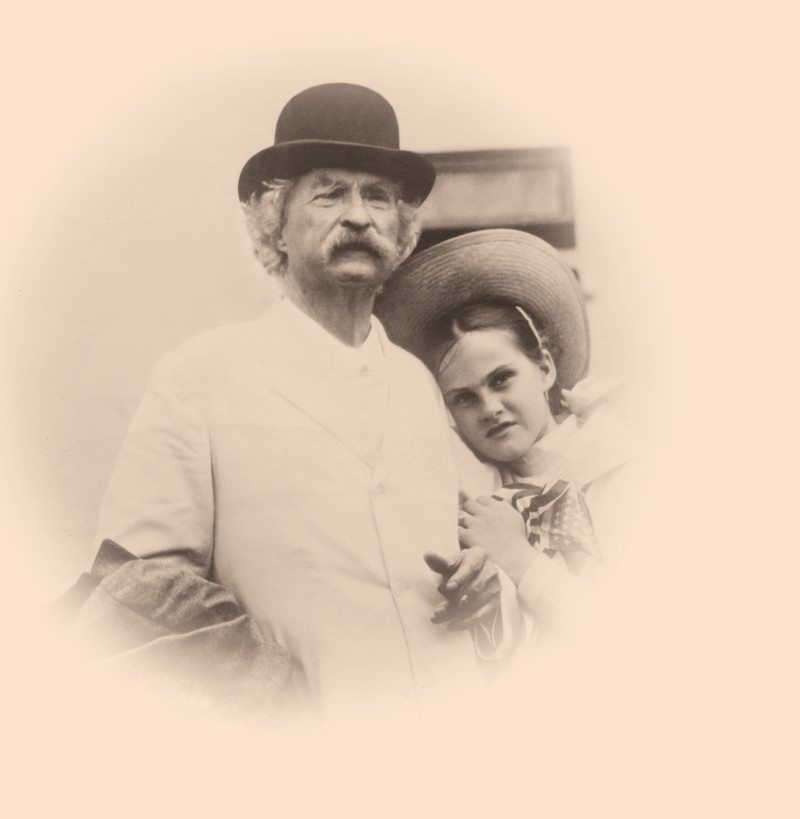
Mark Twain’s persona is one not easily forgotten. He’s funny, yet he has a very unique way of looking at the world. Ever since he was a child, Twain has been curious about people and culture, which has naturally distinguished him from other writers. These interests are especially prevalent in The Innocents Abroad, as well as other early works. Without them, his persona could have never evolved.
The Innocents Aboard, in a way, is a masterpiece of persona evolution. While Twain toured Europe and the Holy Land, he visited many countries and studied their people and cultures. He wrote about every country he and the pilgrims stumbled across, leading to another moment in the development of his persona description.
Twain is a very descriptive writer. An example in The Innocents Abroad is the first part of Chapter XLIII. He describes the Valley of Lebanon as “It was a desert, weed-grown waste, littered thickly with stones the size of a man’s fist.” (Twain pg. 445) He could have just straight up said that the valley was a wasteland, but instead, he dives into great detail about why he finds it uneventful and ugly. Very briefly, he adds a touch of humor to let people know that Mark Twain, not Samuel Clemens, is talking.
Another example in The Innocents Abroad—that shows Twain’s curiosity about culture—is his visit to the catacombs of Rome. He goes into a long summary about the popes and why the catacombs are important to them, illustrating that he finds the history fascinating. The passage where he does this is in Chapter XXVII. Twain writes, “Five or six of the early Popes—those who reigned about sixteen hundred years ago—held their papal courts and advised with their clergy in the bowels of the earth (Twain pg. 295). Here, Twain is suggesting that it is part of Roman culture to hold ceremonies in the catacombs. And again, the description he uses to describe them is phenomenal: “The narrow passages are roughly hewn in the rock...” (Twain pg. 295), which leads to my main argument. Twain was writing stories before he even became a full-time writer.
The Innocents Abroad is not just a travel memoir; it is a story. There is a main character–Twain–who goes on an adventure to find his place in the world (the conflict), and he experiences things that no other human ever has, allowing the slow development of his character and persona. Likely, Twain wrote the book this way in order not to bore his readers. Not many people want to sit through six hundred pages of a travel memoir, unless there is at least some kind of story in it. I’m positive that some of the dialogue Twain uses is actually not what he heard. There is no way that one human can remember everything someone tells them during such a long exposition, unless there is some improvising. Therefore, The Innocents Abroad is Twain’s way of proving to the world that Mark Twain is not just a person; he is an author who wants to get recognized for all his hard work.
There are a few other pieces that explore his persona: Old Times on the Mississippi and even Mark Twain on Stage.
Mark Twain on Stage, though not written by Twain himself, is an excellent example of his growing persona. Mark Twain speaks from memory. He is not an author who likes to sit in front of a group of people and read his works verbatim. The Innocents Abroad is told from his memories of his tour. Because he speaks from memory, Twain is always telling stories.
Old Times on the Mississippi is all about what he remembers from his younger years on the Mississippi. It’s not a memoir; it’s a story. Twain explains that “When I was a boy, there was but one permanent ambition among my comrades in our village on the west bank of the Mississippi River. That was to be a steamboatman.” (Twain pg. 1) This alone says so much about him. Twain was no ordinary boy. At times, while he liked being a steamboatman, he wanted to do something different. He wanted to prove to his late father that he could do what his father had failed to achieve: start a life of his own. He goes into a detailed description of what life was like as a pilot, painting a clear picture in his readers’ minds. It was difficult. Frustrating, even. He wanted to be free from his own prison. He was tired of learning about the shape of the river and what makes the best pilot. He wanted to be a writer. At the same time, though, he made good friends. This also supports the point that Twain was a people person who was very interested in culture and lifestyles. Writing from memory not only helps his persona grow but also evokes nostalgia. In Old Times on the Mississippi, we can tell that the story is nostalgic for him, but he is also proud that he chose to be a writer.
Twain’s persona, as mentioned before, is one not easily forgotten. This is because it is nostalgic. His works remind his audience of what it was like to be young, allowing them to connect with him on a much deeper level. As a whole, his persona is present even in his early works. As he continues writing, it grows and becomes more distinguished, until he finally takes the name “Mark Twain”.
ns216.73.216.176da2


 and then Add to home screen.