

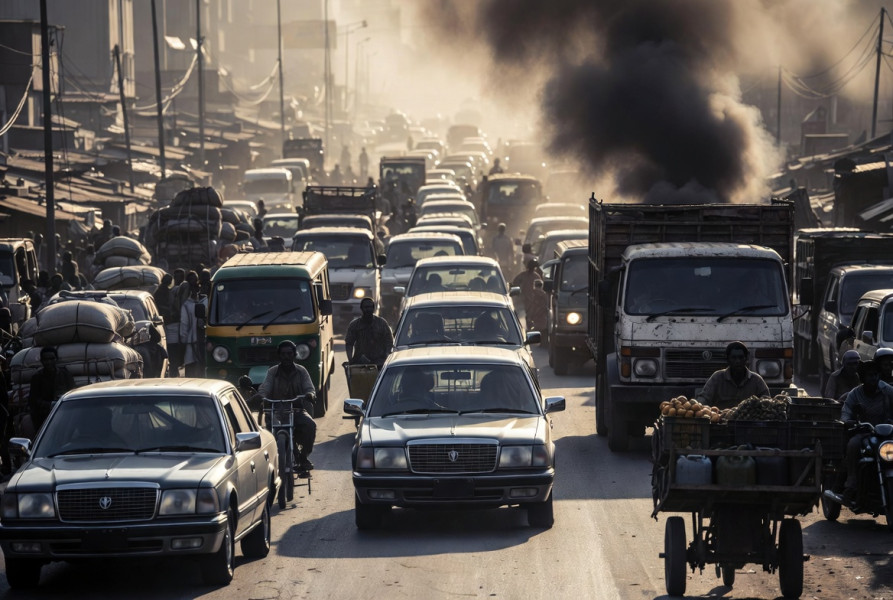
“Africa is a place where beauty and danger live side by side.”197Please respect copyright.PENANAYduHvGCdAl
— Marlin Perkins
“In Africa, the wild still writes the rules of life and death.”197Please respect copyright.PENANAPAa7IJQSSo
— Bill Burrud
The paper trail of her arrival had begun weeks earlier, not in Africa but in the quiet, bureaucratic corridors of three different countries, where decisions were made in fluorescent-lit offices and recorded in systems designed to forget as efficiently as they remembered. Entries appeared, disappeared, and reappeared under slightly altered identifiers—visa requests rerouted, clearances expedited, names cross-referenced, and then quietly deprioritized. No single document told the full story, but taken together, they formed a pattern: deliberate, coordinated, and just opaque enough to avoid drawing attention. By the time her name surfaced on any official manifest tied to Africa, the groundwork had already been laid—permissions granted, obstacles removed, the path cleared long before anyone thought to question why.
A scheduling query from a Toronto event contractor — routine, politely formatted, stamped with time zones and confirmation codes — had been the first ripple. It carried the unmistakable efficiency of WE Charities, the kind of organization whose movements were normally transparent, audited, and publicly celebrated. The visit was logged as an educational initiative, its language careful, its objectives humanitarian.
Then came the Nairobi hotel block reservation, entered under the foundation’s official travel profile. No aliases. No improvisation. It reflected the habits of a group accustomed to working in the open: security coordination with local partners, dietary notes for the delegation, conference‑room space for briefings, transport schedules aligned with school visits in the southwest.
Finally, the draft motorcade routing request moved through diplomatic channels — from a U.S. embassy liaison to the Kenyan Ministry of Interior — where it joined the dense, formal choreography that accompanies any high‑profile humanitarian guest. It was reviewed, annotated, returned, and approved with the quiet professionalism of a state that had hosted such visits before. All visible, legitimate, and exactly what it claimed to be.
Which was why, when her aircraft touched down at Jomo Kenyatta International Airport, there was nothing covert about the moment.
The heat came first — rising off the tarmac in wavering sheets — followed by the slow procession toward the terminal, the Kenyan flag hanging almost motionless in the morning air. Inside, the arrival hall carried the familiar choreography of international travel: immigration desks, fluorescent light, the murmur of multiple languages, the thump of luggage on conveyor belts.
Her reception was efficient rather than theatrical.
Rachel Mburu stood alone beyond the barrier, a slim figure in a sand‑colored field jacket over a neatly pressed dress, a tablet tucked under one arm and a folder of paper manifests under the other — a practical bridge between two administrative worlds. As WE’s Kenya field director, she carried the authority of someone accustomed to moving people and equipment across long distances with limited margins for error, and she greeted Demi with a composed, unhurried warmth that felt both professional and deeply personal. Her voice was low and steady, shaped by Nairobi and years abroad — precise in its consonants, musical in its cadence — the kind of voice that could brief a convoy at dawn, negotiate with county officials at noon, and still soften into reassurance for a nervous first‑time visitor by evening.
Nothing in the scene suggested danger or deviation. Yet everything around her moved through channels that felt curiously out of time. Communications were still anchored to landlines in guarded offices; paper manifests traveled in hard folders from desk to desk; routing confirmations arrived with stamps and signatures rather than glowing notifications. It gave the machinery of the state a weight and friction she had not expected in a capital whose skyline, glimpsed on the drive from the airport, rose like a vision from another future.
Nairobi’s new districts were rendered in a kind of pseudo-modernism unfamiliar to American cities—glass and pale composite panels arranged in rigid, declarative forms that mimicked global design language without fully absorbing it. Facades rose in tiered, ribbed layers, their surfaces immaculate yet strangely inert, enclosing vast atriums behind tinted skins that reflected the sky but revealed nothing beneath. Skybridges stitched towers together high above the ground, creating a second, elevated plane of movement that bypassed the street entirely, while below, plazas spread out with geometric exactness, landscaped with a precision that felt calculated rather than lived in. The effect was not quite futurist, not quite contemporary, but something in between—an imported aesthetic translated without the friction that usually gives architecture its local character. At street level, the absence was palpable: no improvisation, no encroachment, no informal economies pressing against the edges. Entrances were recessed, activity internalized, and whatever life animated the buildings remained sealed within controlled interiors. The district felt complete in its design yet incomplete in its presence, as if it had been assembled according to an external blueprint and set down intact, its perfection isolating it from the organic, improvisational rhythms of the city surrounding it.
The effect was dissonant in a way that resisted easy interpretation: a city that presented itself visually as a projection of the future, all reflective surfaces and frictionless movement, yet operated beneath that surface through processes that were deliberate, tactile, and insistently human. Systems that appeared automated revealed themselves, on closer contact, to depend on paper trails, stamped forms, and conversations carried over wired phones whose cords traced the limits of movement. Access was not granted seamlessly but negotiated—doors remained closed until someone chose to open them, elevators paused between floors as if awaiting confirmation from unseen intermediaries, and transactions unfolded through sequences that required presence, acknowledgment, and time. To Demi—who had never set foot in Kenya before and had arrived carrying only the warm, kinetic impressions shaped by other people’s stories—it felt less like entering a single place than stepping into two coexisting realities layered imperfectly over one another: one defined by abstraction, speed, and surface coherence, the other by procedure, memory, and the quiet authority of those who understood how things actually moved. The tension between them did not resolve; it persisted in every interaction, creating a sense that what was visible and what was operative were not misaligned so much as operating according to different logics, each complete in itself, yet never fully reconciled with the other.
The motorcade eased out of the perimeter of Jomo Kenyatta International Airport and merged into the mid‑morning traffic with a steadiness that felt almost ceremonial. The escort vehicles did not rely on the burst of encrypted radios she was used to seeing in other countries; instead, instructions moved car to car through a choreography of hand signals, brief stops, and the occasional crackle from a handset that looked more industrial than digital. It was security by rhythm rather than by bandwidth.
At street level, the sense of dislocation deepened. The traffic was dense but strangely primitive compared with what she knew from Los Angeles: long‑wheelbase Chinese sedans with chrome grilles and curtained rear windows moved slowly through the lanes, and battered Indian utility vans and Romanian‑built cargo trucks coughed out heavy diesel smoke. Between them drifted entire layers of smaller, humbler motion—pedal bicycles loaded with sacks of maize, rattling motorcycle taxis carrying two or three passengers at a time, and three‑wheeled tuk‑tuks buzzing like mechanical insects along the curb. Handcarts creaked across intersections piled with crates of fruit, and once a man pushed a wooden wheelbarrow full of jerrycans straight through a gap in traffic as if the laws of the road were merely suggestions. The horns sounded different too—shriller, more impatient—and above it all hung the smell of hot dust, fuel, and cooking oil, a city that seemed to run on improvisation rather than order, as though the modern world had arrived here only halfway and then stopped.
Demi watched it all through the glass, trying to reconcile the futuristic skyline with what she had already noticed inside the airport: the paper arrival ledgers, the wired desk telephones, the physical stamping of routing documents carried from office to office by uniformed staff. Clerks wrote entries into thick, bound logbooks while another officer pressed rubber ink stamps onto carbon‑copy forms with deliberate force. Along the walls, heavy porcelain light switches clicked loudly when they were flipped, and slow ceiling fans turned beneath yellowed fluorescent tubes. Beyond the customs desks, baggage handlers sorted luggage by hand onto metal carts while an attendant updated the day’s flights on a mechanical board that snapped loudly each time the letters flipped into place. The whole system felt strangely mechanical, as if the machinery of travel here still ran on paper, ink, and human memory rather than the invisible digital networks she was used to at home.
When she'd stepped into the airport's only restroom, the illusion of modernity vanished entirely. The sinks were heavy porcelain basins with separate brass taps that had to be turned several times before the water shuddered to life. Along one wall ran a row of old ceramic urinals fed by exposed metal pipes and flushed by a pull chain connected to an overhead tank that refilled with a slow metallic groan. A bar of soap rested in a steel tray beside the basin, and instead of silent air dryers, there was a cloth roller towel turning stiffly on a metal spindle. Even the stalls were different—thin metal partitions that did not quite reach the floor or ceiling, their doors held shut by simple sliding latches polished smooth by decades of use. The whole room smelled faintly of disinfectant and warm plumbing, as if the building itself had been operating unchanged for half a century.
Beyond the sinks, she noticed another doorway standing partly open. Shower heads were mounted directly into a tiled wall, spaced a few feet apart with no curtains, no partitions, nothing that suggested privacy at all. The floor was bare concrete sloping toward a central drain, and thick metal pipes ran exposed along the wall to heavy valves that looked older than the terminal itself. A few local women were already there, rinsing off beneath the running water as casually as if it were a public fountain, towels and clothing hanging from simple metal hooks along the opposite wall. Demi froze for a moment at the threshold, startled less by the sight itself than by the realization that in this place the most ordinary routines of life were still carried out in a way that belonged to another generation entirely.
When she returned to the concourse, the security checkpoint offered a far sharper shock. Instead of the quiet choreography of scanners and automated belts she knew from American airports, passengers were pulled aside one by one behind a partition where the inspection became far more intrusive. Her luggage passed through a single aging X‑ray unit whose green monitor flickered uncertainly, but the real scrutiny fell on the travelers themselves. A female officer directed her into a narrow inspection room and, with procedural calm, required her to remove nearly all of her clothing as another guard examined each item and recorded it by hand in a thick ledger. A second guard—male—stood just inside the doorway under the pretense of security, his lingering gaze making the small room feel even smaller. The search was methodical, bureaucratic, and utterly devoid of the privacy or technology she associated with modern travel; when she emerged minutes later, fastening her belt again beneath the humming fluorescent lights, the experience felt less like airport security than something preserved from another era of border control.
“What’s wrong with this country?” she asked finally, leaning slightly toward the man seated across from her. “I was told Kenya was a modern, civilized place—an international city, airports like anywhere else in the world. But everything I’ve seen since I landed feels like it’s running fifty years behind the rest of the planet. Paper ledgers, manual stamps, searches right out of another era… Is this really how things work here, or did I somehow arrive in the wrong century?”
Rachel Mburu gripped the steering wheel as the convoy crawled forward, close enough to Demi in the passenger seat that their shoulders nearly brushed whenever the car jolted over a seam in the tarmac. In person, she was lean and composed, her field jacket creased with use rather than ceremony, a notebook and a paper folder balanced effortlessly on her knee. When she spoke it was in a low, even contralto — warm, unhurried, the cadence of someone accustomed to briefing ministers and calming nervous volunteers in equal measure — and she walked Demi through the realities outside the tinted glass: why permits were still stamped by hand, why the radios mattered more than mobile signals, why the country’s gleaming skyline ran on systems that were deliberately slower, more controlled. It was not an apology, the way she explained it, but a map — and she delivered it with a small, reassuring smile that made the unfamiliar feel, if not simple, at least navigable for the singer. 197Please respect copyright.PENANAxODaze6QEh
197Please respect copyright.PENANAYmF3FAgvYG
(Rachel Mburu, Director of WE Charities, Kenya, in 2018)
“There’s nothing inherently wrong with it,” she said quietly beside Demi, her tone calm, almost instructional. “It’s simply progressing along two tracks. The capital benefited from substantial infrastructure investment — transport corridors, commercial towers, financial districts — much of it delivered through external partnerships accustomed to building at scale. But the institutional systems — government platforms, utilities, communications architecture — modernized at a more deliberate pace. Partly fiscal constraints. Partly governance preference. And partly because legacy systems, for all their inefficiencies, can be remarkably resilient.”
The matter‑of‑fact tone, gentle and reassuring, made Demi think unexpectedly of briefings back home — of familiar rooms, familiar accents, the ease of understanding everything without having to ask — and for a moment the distance from it all pressed in on her with a sharp, quiet ache.
She nodded toward the passing buildings.
“What you’re seeing,” she said evenly, “is twenty‑first‑century architecture resting on rather late‑twentieth‑century administrative wiring. It does mean processes can take a bit longer. People still rely on paper files, landlines, and in‑person confirmation. That can feel… inefficient, perhaps.” She gave the faintest, diplomatic smile. “But it also means the projects you’re visiting continue to operate when networks falter. And in the regions we will be traveling to, that reliability is not incidental.”
The convoy slowed as a traffic officer stepped into the intersection and raised a white‑gloved hand. There was no digital signal cascade, no synchronized light change — just human motion, immediately obeyed.
“And the streets?” she asked.
“It’s much the same pattern,” Rachel said lightly, easing the key into an ignition slot that seemed faintly antiquated in an age of push‑button starts. “The vehicle market followed the financing — capital in, components out. You cease recognizing badges and begin recognizing supply chains.” The dashboard flickered awake in a wash of unfamiliar accents and glyphs, the gear selector marked not with the expected English shorthand but with Czech initials — (P – Parkování, N – Neutrál, J – Jízda, Z – Zpátečka) — and, where one might expect a simple numeral for second gear, a small, engraved cog. She adjusted the mirror with quiet competence. “Škoda Octavia. Perfectly reliable. Very serviceable outside the capital. Though I’m afraid the rear seat was not designed for what Kenyans consider a modest drive.”
Demi registered the absence the way one notices silence after a hum has stopped — no dashboard screens blooming to life, no navigation voice offering calm reassurance, no soft lattice of signal bars binding her to somewhere else. In their place sat a dash that looked uncannily like something resurrected from the 1960s and refitted for the present: blocky dials, hard plastic knobs, a narrow radio slit with physical buttons worn smooth at the edges. Even the clock was analog — round, with ticking hands and actual printed numbers — the sort of thing she had only ever seen in retro diners or period films. She stared at it a beat too long, unsettled by the quiet authority of it. When she lifted her phone out of reflex, the screen returned nothing but a patient, searching void. The heat outside was constant, but it was the dashboard — solid, mechanical, self‑contained — that made the distance from home feel suddenly, unmistakably real.
“Wait — why doesn’t this car have, like… any electronics?” Demi asked after a moment, flipping her lifeless phone over in her palm as if a better angle might coax it back to life. “Not even music? Or a screen? Anything?” She tried to keep it light, but there was real bewilderment under the laugh — the kind that comes from someone who’s never known a drive without Bluetooth pairing, GPS rerouting, or a playlist filling the silence.
Rachel noticed the reflexive glance at the blank signal bars and offered a small, almost indulgent smile. “Because there is no Wi‑Fi — nor anything resembling a broadband grid — to speak of,” she said, her consonants crisply placed, her vowels carrying that faintly rounded London polish that made even inconvenience sound curated. “The national supply simply won’t sustain it. Too irregular. Too many regional interruptions. That's why the government prioritizes what can be maintained with consistency — low‑draw systems, analogue networks, fixed lines. You’ll encounter rotary telephones in most offices.” She shifted her grip on the steering wheel with tidy precision. “Your mobile won’t attach to a network here, I’m afraid. But we can provide you with a film camera, if you’d like to document the visit. It remains the most dependable method of conveying images beyond the perimeter.”
There was nothing overtly unfriendly in her tone — if anything, it was impeccably courteous — yet something in the measured cadence, the careful enunciation of prioritizes and analogies, unsettled Demi in a way she couldn’t quite articulate. It wasn’t condescension. It wasn’t warmth either. It was simply… composed. As though Rachel was explaining not a temporary inconvenience, but a system that had long ago decided what the modern world required — and what it did not.
Rachel adjusted her posture with quiet composure as the tires thudded over a seam in the road, one hand resting lightly against the dash as though the motion were mildly impolite rather than inconvenient. “Because anything overly sophisticated does, sooner or later, fail,” she replied, the vowels clipped, the tone impeccably even. There was the faintest pause — not judgmental, but registering — as if she were still calibrating to American surprise at what she considered routine. “And those trained to repair such systems rarely remain. They qualify, quite properly, and depart for London or New York — stronger currencies, stable grids, dependable supply chains. One can hardly fault them.” A small, almost philosophical shrug. “What remains is a maintenance deficit. These older vehicles, by contrast, can be sustained by local mechanics with ordinary tools and a bit of resourcefulness. No electronics means no reliance on specialists we do not, in fact, possess. And in the districts we’re travelling to, that distinction determines whether one proceeds — or waits.”
Demi’s gaze drifted across the dashboard again — and this time something caught in the windshield’s reflection. A stethoscope lay coiled beside the analog clock, its rubber tubing dulled from use, the metal chest piece scuffed but polished by repetition. It didn’t look decorative. It looked necessary.
She stared at it.
“Why is there an actual stethoscope in the car?” she asked, the question coming out quieter now. “Like… a real one. Please don’t tell me that’s normal.”
Rachel followed her eyes and inclined her head. “It is,” she said. “Even in the capital, we simply do not have modern diagnostic equipment. If a tire develops a slow puncture, one will ordinarily submerge it to locate the leak. That requires water. In several counties, water is rationed. So we listen instead.”
She lifted the instrument with unembarrassed practicality. “The diaphragm amplifies the escape of air. One can detect a fissure long before it becomes catastrophic. It’s not elegant, but it’s dependable.”
Demi blinked. “You’re saying there isn’t enough water to check a tire?”
“Not consistently, no,” Rachel replied, not defensive — just factual. “Infrastructure investment here prioritized ports and financial districts. Municipal resilience lagged. Utilities remain uneven. One learns to conserve what cannot be guaranteed.”
There was no drama in her voice. No apology. Just arithmetic.
Demi looked back at the sun‑bleached horizon ahead of them and felt something shift. This wasn’t rustic minimalism. It wasn’t aesthetic retro. It was an adaptation to scarcity — mechanical, deliberate, unavoidable. The stethoscope wasn’t charming.
It was policy, translated into rubber and metal.
Soon the motorcade began moving again, though the skyline shifted almost imperceptibly as they crossed an invisible boundary. The mirrored towers gave way to something stranger — not poorer, not wealthier, but unmistakably foreign. Shopfronts lined the boulevard in a mosaic of languages: German block letters beside Arabic script, Cyrillic curling across pharmacy windows, Hindi stenciled above a shipping office, Portuguese painted in sun‑faded blues. The only signs she could read at a glance were the British ones — tidy serif fonts announcing Solicitors, Tea Rooms, Export Brokers in a version of English that felt faintly formal, faintly antique.
The traffic unnerved her more. Škodas and Dacias, a boxy Lada that looked as if it had been preserved from another era, compact Indian hatchbacks, and a battered Peugeot that might have rolled straight out of the 1950s. Even the houses refused coherence — English cottages with clipped hedges stood beside stucco villas that suggested southern France, iron balconies and steep slate roofs assembled as though someone had curated Europe in fragments and deposited it here. People moved along the pavements in a scatter of nationalities she couldn’t immediately place — pale, dark, olive, veiled, suited, sandaled — none of it chaotic, but none of it familiar.
Then it landed on her all at once.
“Okay, this is… weird,” Demi said under her breath, staring out the window. “There’s not a single Starbucks. Apple. No Target. Not even, like, a random American fast‑food place trying too hard.” She turned toward Rachel, incredulous rather than offended. “There’s nothing American here. At all. Is that on purpose?”
Rachel regarded her for a moment, as though measuring how candid to be. “In a sense, yes,” she said calmly. “American firms found the regulatory environment rather… unrewarding. Compliance standards here don’t align neatly with U.S. liability frameworks. Data localization laws complicate cloud‑based services. And the security apparatus discourages foreign defense contractors, which tends to limit the broader commercial ecosystem that usually follows.” She folded her hands in her lap. “Trade relationships evolved more heavily toward Commonwealth partners, the Continent, and certain emerging markets. You Americans never established a durable foothold.”
She allowed herself the faintest, almost apologetic smile. “Demi, you and your colleagues are the first U.S. delegation I’ve encountered in nearly a decade. Ten years, actually. We host British development boards, German infrastructure consortia, Gulf investment councils, and even Brazilian agricultural advisers. But Americans?” A slight tilt of her head. “They tend to prefer environments where their networks function without adaptation. Kenya requires adaptation.”
The motorcade rolled forward beneath a row of Union Jacks fluttering outside a sandstone banking house, and Demi felt the absence settle differently now — not as oversight, but as design.197Please respect copyright.PENANAPXwexNQnU8
197Please respect copyright.PENANAy5KNUvnmuK
197Please respect copyright.PENANAht4Ffqz3NX
.
The rail depot at Kijabe Station rose at the edge of the city like a fragment of another century that had refused to surrender its purpose. Built of dark red brick and ribbed iron, its long platform canopy still carried the decorative flourishes of the original Uganda Railway—the line the British had driven inland in the 1890s to force a coast-to-interior empire into existence. Rachel told the story as the convoy doors opened and the heat rolled in, her voice slipping easily into the cadence of a field briefing refined into narrative. “Everything in this country still moves along corridors laid down in that era,” she said. “Road, rail, supply, even the humanitarian routes. We’re just using them for different cargo now.” A plume of steam drifted past, and beyond it the locomotive waited—black, massive, alive—its metal skin ticking as if it had a pulse.
Demi stepped onto the platform and stopped, momentarily caught between eras. “We’re really taking this all the way to the Mara?” she asked.
The station was busy enough that no one should have cared, yet several did at once. Porters slowed with trunks balanced on their shoulders. Vendors glanced over from tea kettles and fruit baskets. A few young men near a bench began grinning the moment they noticed her clothes, then her tattoos, then the way she carried herself without apology.
“Eh, mzungu!” one called. “Those trousers are torn because you are poor?” His friends laughed. Another mimicked her accent after hearing two words. “Say it again!” A third shouted, “Where is that voice from? The moon?” Women waiting with parcels looked over, some amused, some disapproving, some simply curious.
“Stop it!” Demi snapped, sharper now.
That drew attention from a tall Sudanese traveler standing near a pillar, a man in a white jalabiya, dusty sandals, and a wrapped turban yellowed by the road. He turned immediately, offended less by her presence than by her tone. He strode forward with the confidence of someone accustomed to being obeyed.
“Why do you speak like that here?” he demanded in rough English, pointing a finger near her face. “Why do you look straight into men’s eyes?”
The platform quieted.
“You have no adabu—no manners,” he said. “A woman with respect does not challenge men with her stare. A woman with respect does not shout in public. You stand here like you fear no one.” He gestured at her clothes with open contempt. “And you dress like this, for everyone to look.”
A few men laughed again. Someone muttered, “She is crazy.” Another answered, “No, rich.”
The Sudanese man gave a dismissive click of the tongue. “Yes. Rich, or mad. Maybe both.”
Demi held his gaze anyway, jaw set, refusing to retreat an inch.
Before he could continue, Rachel stepped between them so fast the man rocked back on instinct. “Enough,” she said in Swahili first, then English. “You want to preach, go to a mosque. You want trouble, try me.”
The laughter died. Even the young men looked away. Rachel turned to Demi as if nothing had happened and jerked her head toward the locomotive. Steam rolled past the platform edge.
“Yes,” she said calmly. “All the way to the Mara. It’s the only way to move this much material without losing half of it to the road. “And it keeps us on a schedule that doesn’t depend on fuel deliveries.”
A familiar voice cut through the hiss of the engine. “You always did have an entrance,” Selena Gomez called from the carriage steps, already laughing as she pulled Demi into a hug. The sight of her — and behind her the cluster of other Americans from overlapping tours, charity singles, and television soundstages — landed with unexpected force this far from home. Near the luggage rack, Joe Jonas lifted a hand in greeting, while at the far end of the platform, Nick Jonas stood talking with a logistics officer, the guitar case at his feet looking as out of place here as it had the night he first told Demi about the school project and the invitation that had brought her across an ocean.
The whistle sounded — deep, resonant, final — and the carriages jolted into motion. Through the open windows, the Victorian depot slid away, replaced first by the outer industrial belts of Nairobi and then, almost without transition, by open country where the land dropped toward the long escarpments of the Rift Valley. Coal smoke streamed back along the train, carrying the smell of hot iron and dust. In the carriage, the mood shifted from reunion to purpose as Rachel spread maps across the small table and began outlining the final overland transfer that would take them from the railhead into the Maasai Mara itself. Outside, the modern skyline vanished completely, and the journey narrowed to a single track cutting through grassland — a deliberate, irreversible movement toward the place where Demi’s public mission and the unseen countdown already in motion were about to meet.
197Please respect copyright.PENANA5ydxlKu5Gi
197Please respect copyright.PENANAELe07RQ6Yg
The reception unfolded with the measured gravity of a ceremony that had been performed for generations before anyone in the village had ever heard her name. The Maasai warriors emerged first from the line of acacia trees, tall and spare against the afternoon light, their red shúkà catching the wind like banners. Beadwork moved before she could distinguish individual faces — wide, luminous collars of white, cobalt, and fire‑bright orange that signaled age, lineage, and achievement in a language older than the railway that had carried her there. Rachel murmured the sequence of greetings under her breath, but the rhythm quickly became self‑evident: the clasped hands, the lowered head, the call that acknowledged not celebrity but guesthood. Later, in field reports and NGO summaries, the moment would be described as a community welcome that resembled the diplomatic encounters of the nineteenth century — two worlds meeting through ritual so that neither had to surrender its dignity.
Demi Lovato's speech from the rough timber platform followed the same pattern of translation between systems. A local teacher rendered her words into Maa phrase by phrase, and the pauses gave her language a weight it had never possessed on a concert stage. She spoke about water access, about the school, about the fact that her birthday had fallen on the journey and that she could not imagine spending it anywhere more meaningful; the applause came not as a roar but as a rising hum, a collective vocal acknowledgment. When the women brought forward the cake — a careful construction of maize and millet, sweetened with honey and pressed into a round by hand — the symbolism was explained to her: grain as continuity, the circle as community, the act of sharing as a binding of visitor to host. A loop of beadwork was placed around her neck, its pattern incorporating colors that marked her, however briefly, inside the social fabric of the village. For a moment, the long chain of travel, security briefings, and political unease dissolved into something almost pastoral.
The official chronicle would later compress the moment into a single neutral line — Following the public celebration, the guest was invited to confer privately with Chief Lemayian ole Saitoti — as though it had been a courtesy and nothing more. In reality, the transition felt like stepping out of sunlight into water. Demi bent to enter the low doorway of the hut, and the sounds of singing and ululation dropped away behind her as if a door had closed on the world. Inside, it was cool, the air touched with the clean dryness of earth and old smoke. The chief lowered himself to the packed dirt floor and gestured for her to do the same. For a few seconds, neither of them spoke. Without the crowd, without the bright cloth and beadwork and drums, every small movement seemed amplified — the settling of the fire, the brush of fabric, her own breathing.
He did not greet her. He stood still, watching, as if watching something that had stepped out of a dream. “Word comes,” he said at last, slow, uncertain. “Not from our fires. From far ground. From the place where many people gather, and the air never rests.” He gestured south, though the distance meant nothing in steps. "The sky grew angry when your great winged thing passed over. Not birds… not any I have seen. Too big. They roared. The air shook.”
Demi felt it before she understood.
“The sky reached for it,” he went on, eyes narrowing. “Fire tried to take it down. Like hunters striking from above.” He lifted his chin slightly, following something only he could see. “But other winged hunters rose. Fast. Sharp. They chased the anger away. They stood between your beast and the ground.” He lowered his voice. “Now the ones who follow tracks you cannot see… they have found its trail. They know where it goes. You walk behind a thing too large; its shadow is long. It does not belong to one person.”
He studied her, wary now.
“How did you come to walk in its shadow?”

(Chief Lemayian ole Saitoti in 2018)
Demi hesitated, her hands tightening in the dim light as though the memory itself had weight. “There was a man in Mosul,” she said at last. “Not a soldier — not exactly. Intelligence. Russian.” The word settled heavily between them. She kept her eyes on the thin ribbon of smoke rising from the fire. “I went to the camps in Kurdistan. The children were starving, the families were caught between militias, and the weapons — the ones killing them — were coming from his country. He knew it. I could see that he knew. And I told him so.”
The chief did not move, but she felt the stillness deepen, as if the hut itself were listening. “I challenged him,” she went on, her voice rougher now. “In front of his own people. I said those deaths were not numbers, not strategy — they were his responsibility. I thought it was only anger speaking. I thought it would end there.” She lifted her gaze to Saitoti’s face, the red light catching in her eyes. “But when he looked at me… it was not surprise. It was recognition. As if I had stepped into a story that he already believed belonged to him.”
When she said nothing, he dipped his head once. “They do not lose a trail,” he murmured. “Feet pass… but the ground keeps them.” He crouched slightly, brushing his fingers over the dust as if feeling for something left behind. “They wait. Long. Like hunters in tall grass. Eyes low. You do not see them… but they see.” He lifted his hand, letting the wind pass through his fingers. “The open land is wide,” he said. “But wide does not hide. The wind takes what happens. It carries it. It tells.”
He glanced at her again, more shadow than man in his stillness.
“Nothing walks and is gone.”
She swallowed. “There’s nowhere far enough?”
He looked toward the distant horizon, where the unseen world lay.
“Far ground is nothing,” he said. “Even the sun goes far… and comes back. But the ones from the land of endless noise”—his brow tightened faintly, trying to hold the idea— “they walk with no returning. Their fires do not wait. Their people do not listen for their return. That is not distance. That is being unheld. Like a spirit that has forgotten its body.”
The fire shifted. A line of sparks rose and vanished into the dark roof. He was quiet for a long time before he spoke, as if listening to something beneath the ground.
“The earth has laid two paths for your feet,” he said at last. “They were waiting before you descended from the heavens to walk our lands."
He drew a slow line in the dust, then another beside it.
“One path—you keep walking. You stay with the sky-hunters who run beside you. Their noise, their teeth, their watching eyes. That path goes forward. It grows loud.”
He brushed the second line with his hand, softer now.
“The other—you step away. The younger one walks in your place. Your feet leave this ground.”
He lifted his gaze toward the far distance, beyond anything she could see.
“You are taken over the great water… back to the Brotherhood of the Fifty Fires. The place of many lights. The place that does not sleep.”
A pause. The wind shifted.
He looked at her again, not unkind, but unmoving.
“Two paths.”
He tapped the earth once.
“Feet choose. The earth keeps.”
He did not speak at once. When he did, his voice had changed—quieter, but heavier, as if it carried something older than him.
“There is one more path,” he said.
He looked at her for a long time before going on.
“It is not a path for those who pass through. It is not given to wandering feet. The ground closes itself to them.”
He touched the earth with his palm, then drew it back.
“But sometimes… the land sees a thing it does not know. A thing that walks out of thunder and fire, out of the place of many lights where the night never comes.”197Please respect copyright.PENANApzYJBExhUv
His brow tightened, trying to hold that distant image. “The place where voices fly without bodies. Where great sky-beasts carry people like seeds on the wind.”
His eyes returned to her.
“You came from there. And still—you stand. The sky did not take you. The fire did not eat you.”
A pause.
“That is something.”
He shifted slightly, the weight of decision settling into him.
“I am the one who speaks for this ground,” he said. “When I say a fire will take you, it takes you.”
His gaze hardened—not cruel, but immovable.
“If you choose this path, you do not leave.”
He gestured to the land around them.
“You become a part of this place. You sleep where we sleep. You eat what walks and runs here. The sun burns you, the rain takes you, the wind knows your smell.”
His hand lifted, slow, deliberate.
“You would not be a shadow among us.”
A faint tilt of his head.
“You make sound from your chest that bends others. I have heard it.” He searched for the right shape of it. “It is like calling… but stronger. Like the way the night insects and birds answer one voice.”
A small nod.
“That has a place. It would have a place.”
He looked out across the plains, then back.
“You would learn how the ground speaks before it breaks, how the grass tells where life moves. How the great ones think—those with horns, with teeth, with heavy feet that shake the earth.” A pause. “You would not master them. No one does. But they would know you are there.”
Then, more quietly:
“You would be given a name. Not the one from the far place. That name belongs to the land of many fires that do not sleep.”
His voice lowered.
“You would be called Enkai-isho na enkop.” He nodded once, as if confirming it with something unseen. “Or another, if the elders hear differently. The name comes from what you are, not what you were.”
Silence stretched.
“This path is not open to those who come from the great water. Not to those carried by sky-beasts.”
His eyes fixed on hers.
“I open it.”
A long pause.
“But once your feet step into it… the path behind you does not remember.”
Her breath caught—not in fear, but in the sudden pressure of meaning she wasn’t sure she was interpreting correctly.
“You mean… stay?” she said carefully, searching his face. “Like, actually stay here? With your people?”
A pause.
“For real life—not just visiting, not just… being here for a moment and then leaving?”
She swallowed, eyes narrowing slightly as she tried to anchor it in something concrete.
“And you’re saying that would be allowed?”
He nodded.
He listened to her carefully, then answered as if naming something already decided by the land itself.
He nodded slowly, as if she had named something already half-understood in the bones of the land.
“Where you come from,” he said, “there are places where many people are gathered together like ants in a broken hill. Great piles of stone and shining things rise into the sky. The old power of your people is kept there—locked inside hard ground and loud wind.”
He paused, then his gaze shifted slightly, as though something new had entered the same memory.
“And there…” he added, slower, searching for the right shape of it, “there are also moving beasts of iron and breathless fire. They do not eat grass. They do not drink from rivers. Yet they run without rest.”
His hand made a low sweeping motion, like something passing close to the earth.
“They growl along the hard paths. They carry your people inside them like they are being swallowed and carried by a great, unseen animal. Sometimes many of them move together, like a herd that has forgotten what it is chasing.”
A brief pause.
“Even the ground seems to yield to them.”
He looked back at her fully now.
“But here, safety is not made by stakes driven into earth, nor by the iron birds that beat across the sky,” he said, voice steady as dusk. “It comes when a person is known—when her name is spoken at the fires and her footsteps are recognized on the paths.”
He tapped the earth once with two fingers.
“The land must accept you. The wind must teach you. The people must be able to hear you coming before they see you.”
His gaze stayed on her.
“Then you are not alone in the dark.”
A beat.
“And nothing walks unseen around you.”
He studied her for a long moment before continuing.
He watched her in silence a moment longer, then spoke as if naming something about her that she had not yet understood.
“To be taken in,” he said, “means you will no longer stand alone in your skin.”
His hand moved outward first to the cattle grazing in the distance.
“You will stand with the cattle and let their breath warm you. Their strength walks with you as you walk.”
Then toward the scattered life of the settlement.
“You will stand with the children, who will call your name without fear. Your steps shall be followed as if your path is already known to them.”
His voice deepened, steady and certain.
“You will stand with the warriors. To your left. To your right. When you move, they will move with your shadow. When you stop, they will become your wall.”
A pause—then he fixed her more directly, unblinking.
“And you would not be one alone walking among many. You would be one carried by many.”
He lifted his chin slightly, as if feeling something above them shift.
“The one who made the sky sees you. The elders speak your name into the fire. They ask that your steps do not break. That your breath is not cut short. That the ones who follow your name would come to where your footsteps were, and find only dust that has already been broken and scattered.”
His gaze tightened, sharpening on danger itself.
“Even the sky-flash that splits the dark”—his hand cut upward in a sudden jagged motion, like lightning tearing the air—“even that which sends fire from far away before sound reaches the ears… it does not easily find you when you are held like this.”
A quieter pause now.
“When you are no longer only yourself… but carried in the sight of cattle, children, warriors, and the one above.”
He let it settle fully.
“Then you are not a single thing for harm to take.”
The hut was silent except for the soft pulse of the coals.
“How does that actually keep me safe… from the people who are still looking for me?" she asked, her voice tightening just slightly.
He let the silence sit for a long moment, as if listening to something that was not spoken aloud.
His eyes stayed on her, steady.
“The women who know the old ways would take your name into their hands. They would speak it into the fire and then let it fall apart. Not spoken to strangers. Not carried on the wind where other ears can drink it.”
A pause, then he shifted slightly, as if describing something both practical and sacred at once.
“The watchers of distance—the ones who see through shining glass, the ones who hear through invisible air-lines—” he searched for words that bent around the unfamiliar, “—they are not strong here the same way.”
He tapped the ground once.
“The earth breaks their looking. The smoke confuses their sight. The firelight makes their vision stumble like a man in tall grass at night.”
His voice lowered further, becoming more certain, almost ritual.
“And there are those who know how to turn the path back on itself. They speak to the wind so it forgets. They lay ash where memory should be. They call the spirits that make travelers lose their own direction.”
A final, quiet certainty:
“So when they come chasing what you were called in that other place… they will find a name that does not answer. And a trail that refuses to remain whole long enough to follow.”
Demi did not answer at once.
For a long moment, she sat with her hands loosely clasped, eyes fixed on the coals as they pulsed like something alive beneath ash. The chief did not move. He had the patience of someone for whom time was measured in seasons, not seconds.
Inside her, memory surged forward in sharp, familiar fragments.
She saw tour lights flaring like artificial suns. Heard the opening notes of “Sorry Not Sorry” detonating through arenas, the crowd answering before she even reached the second line. The sustained radio presence of “Tell Me You Love Me,” not just a song but a constant echo in elevators, gyms, and late-night drives. The lingering cultural weight of “Skyscraper,” a song still requested, still revisited, still tied to moments people did not let go of easily.
There were magazine covers. Award stages. The Grammy spotlight frozen on her face for seconds that felt longer than minutes. Interviews where her voice had to be both weapon and explanation at once. Millions of strangers repeating her lyrics back to her as if they were spells they had learned by heart.
All of it—fame as repetition, fame as exposure, fame as permanence.
Yet here, none of it had a sound.
Is that something you can put down and walk away from, she thought.
Outside, a cow shifted in the dark, its movement loud in a world that did not need amplification.
“To stay,” she said at last, voice thin but controlled, her eyes fixed on the fire between them. “Would mean nobody out there would know where I went. No one would hear it from me. They would talk, they would guess, they would make stories, and they would be wrong.”
She drew a slow breath, shoulders tight.
“If I vanished here, then everything I was would belong to other voices. They would turn me into whatever version suits them. A tragedy. A lesson. A rumor. I have lived enough of that.”
She glanced toward the doorway, where the last light showed through the hide curtain.
“I am still trying to heal. Still trying to understand what my own life is supposed to be. Maybe one day I could walk away from all of it. Maybe one day silence would feel like peace.”
Then she looked back at him, serious and unwavering.
“But not like this. Not before I have spoken for myself. Not before I decide, in my own words, who I am.”
The chief’s gaze did not move.
She looked up at him, holding his gaze, but her voice came a little uneven at first.
“I mean… I hear you,” she said after a long silence, voice quiet but steady. “And I respect what you’re saying, believe me.”
A small breath in, like she was grounding herself.
“My life has had too many people speaking on it already. Too many deciding who I am, what I feel, what I need, what broke me, and what saved me. If something is to be known about me, I need to be the one to say it myself. Not strangers. Not papers. Not people who were never there.”
Her expression hardened, not angry now, but certain.
“If the world is ever going to know where I went, why I left, what happened to me, then it needs to come from me. I need to say it myself. In my own time. In my own words.”
She shook her head once.
“I still need space. I still need time. I’m still healing things people don’t even understand. So disappearing sounds peaceful, yeah… but it also means handing my whole life over to rumors, lies, and people who know nothing.”
She looked directly at him.
“And I’ve had enough of strangers acting as if they own me.”
Her voice softened again.
“I’m grateful to be alive. I’m grateful to be here. I’m grateful you’d even offer me a place to stay. But if I … disappear here,” she continued, “if I just, like, vanish and no one knows where I went…” She shook her head slightly. “Then it feels like… they win, you know?”
He nodded slowly, as if aligning her words with something already known in the bones of his world.
“Yes…” he said at last, “the ones who carry the mark of a great animal, one I have not seen and do not know in my own seeing.”
His brow tightened slightly, not in confusion, but in careful separation.
“They are not like the people of your fires. They do not sit in the circle of flame. They do not speak where the elders pass breath to breath.”
A pause.
“Their voices are not shaped by firelight. When they speak, the sound cuts and breaks—as dry wood struck too hard, like stones forced together in the dark.”
He looked at her steadily now.
“And when they move near, the air feels disturbed… as if something unseen has passed through it.”
A final, quiet certainty.
“These are the ones you say follow you.”
“I came here to do something that matters. I’m going to finish it. And then I’ll go home," she said, voice tightening as she spoke it through.
The word home seemed to linger in the hut like a third presence.
He studied her a long moment, and something in his face shifted—not anger, but the stillness of someone who has already seen the outcome of such choices in other lives, other seasons.
“You are choosing the road of a moran,” he said at last, voice low and steady. “The young warrior who feels his blood and believes it is enough to hold back what moves in the dark.”
He let the words settle before continuing.
“You hear only what is near. You feel only what stands in front of you. But the land…”—he tapped the earth once—“the land feels farther than your eyes.”
His gaze sharpened slightly now.
“When danger comes like this, it does not walk like a lion in the grass. It does not announce itself. It moves through people you do not see. It follows breath, it follows sound, it follows the traces a person leaves without knowing.”
A pause, then quieter—but more certain.
“And still you stand like a moran who believes his spear is the whole answer.”
His head tilted slightly.
“The old things that watch from distance, the ones that do not tire, the ones that return even after being driven away…” He searched for a container his world could hold. “They do not fight like men in the open.”
His voice lowered further.
“They circle. They wait. They remember.”
A beat.
“And the land does not always protect the one who refuses to listen to it.”
He held her gaze.
“Bravery is good,” he said, “but bravery alone does not turn aside what flies unseen.”
He paused, as if feeling the air between them.
“A man may stand strong in his chest, but what comes through the wind does not stop for his strength.”
A slow shake of the head.
“The world does not bend because a heart is proud.”
“I’m choosing not to live in fear,” she said, steadying her voice. “I can’t make decisions from that place anymore.”
For the first time, he looked away from her, toward the low doorway where a blade of daylight cut across the earth inside the hut, as if the outside world were watching but not yet entering.
“When we teach our children,” he said, slower now, as if speaking into something older than memory, “we do not speak only of what a man sees with his eyes.”
He let the silence breathe.
“We speak of Engai-Naïro—the one who made the sky breathe and the grass rise from the dust. We speak of Engai-Naïro, and we speak of the one who turned his face away when wisdom was laid before him like meat on the ground. We speak of Engai-Naïro, who sees all paths, and we tell them of the proud one who would not bend his hearing when the elders spoke.”
A pause. His voice deepened, more rhythmic, more ritual.
“We tell them again and again, so it does not leave the bones.
He finally looked back at her, steady and unblinking.
“And we tell them this so they will know—so they will remember in their blood—that a man who turns from wisdom does not escape its shadow.”
A final, quieter line, like dust settling:
“This is what we teach, that the land will not have to teach it for us.”
He glanced toward the horizon before finishing, as if the line between earth and sky itself might answer him.
“It is not a story about strength,” he said. “It is a story about listening.”
He shifted, settling more firmly onto the packed earth, and his voice took on the slow, layered cadence of something carried down through many fires.
“In the first days,” he said, “there was only Engai-Naïro, who sometimes came as a dark cloud heavy with rain; sometimes as the red sky that refuses rain and makes the ground thirst.”
He paused, letting the image sit like heat in still air.
“From Engai-Naïro came the cattle, and from the cattle came life for the people. When rain and dry season walk in their proper turn, the earth does not break.”
A breath, deeper now, as if he were speaking from beneath thought itself.
“And there was another,” he continued. “Not equal to Engai-Naïro, but present in the places where firelight ends, and the dark begins. They call him Ol’Taraku—the Devourer Beyond the Fire-circle.”
The name itself seemed to tighten the air.
“He is not large like the storm-cloud. He is not loud like thunder. He is patient. He waits where paths thin and men forget to listen.”
A slow shift of his gaze toward her.
“And there was also Enkai-nteu, the lesser one—the bright and quick spirit who believed that sharpness of mind and strength of hand were enough to stand against anything that comes from the dark.”
He tapped the earth once, as if marking a lesson into it.
“But the elders warned him,” he said. “They said: ‘Do not stand above the people. Do not walk as if the ground does not touch you. Come down. Learn the slow breath of hunger. Learn waiting. Learn that strength alone does not see what moves without sound.’”
His voice deepened, becoming more ritual than speech.
“But Enkai-nteu did not bend his hearing. He said: ‘I am enough as I am. Why should I lower myself into dust? Why should I walk small among small things?’"
A pause—long enough that even the coals seemed to hesitate.
“He believed standing apart made him greater.”
The chief’s eyes returned to her, steady and unblinking.
“So he went to Ol’Taraku as he was,” he said quietly. “Shining in his own certainty. Loud in his own strength.”
A softer note entered his voice, almost mournful.
“And Ol’Taraku did not strike him. He did not chase him. He did not wrestle him like a man in the open field.”
He leaned slightly forward.
“He simply opened what cannot be seen, and the bright one stepped inside, thinking it was only a shadow.”
A pause.
“And he was taken. Not as a fallen warrior is taken, but as something that never returns to the fire.”
He let the silence deepen.
“That is why we speak his name only when teaching the young,” he said. “Not to honor him—but so pride does not walk ahead of listening.”
The coals cracked softly.
“A warrior,” he finished, “must have courage in his chest. But he must also have ears that belong to the ground and the wind.”
Demi hesitated, and for a moment her expression softened—not uncertain exactly, but recalibrating, like she was realizing she couldn’t speak to him the way she would speak to someone from her own world.
“I hear you,” she said more slowly now. “I do.”
A breath.
“But I don’t think you understand what I’m talking about when I say ‘my life’ or ‘my voice.’”
She glanced down, searching for words that would land here.
“I'm talking about people who hear my songs in their own lives. People who show up to shows, who listen when they’re struggling, who think of me as part of their story too.”
She looked back up at him.
“So if I just disappeared into something else—into a place no one can reach me—I’m not just leaving my own path. I’m breaking theirs, too.”
A pause, then quieter:
“And I can’t do that to them.”
She swallowed, then added with more grounded simplicity, as if stripping everything else away:
“And I don’t think you’re wrong to talk about listening and the land and all of that… I think I have responsibilities that don’t stop just because I’m afraid.”
The chief did not smile.
“You would walk out onto the plain,” he said, voice steady as packed earth, “where there are no walls to hold a person, and the wind does not forget what it touches.”
He watched her as if measuring how far her thinking could reach.
“Out there, a name is not kept by hands,” he went on. “It is carried. It is carried by air, by dust, by the feet of those who pass and speak it without knowing.”
A pause, then a slight narrowing of his eyes.
“And what is carried… can also be taken.”
He tapped the ground once with his staff.
“In the open land, nothing stays where it is placed. Not sound. Not scent. Not the memory of a person.”
His gaze held hers.
“You speak of leaving and still being whole. But the plain does not keep a person in pieces. It takes what is given to it, and it gives it onward.”
A quieter final line, heavier with certainty than warning:
“So even what you call your life… would not stay hidden there.”
“Yes,” she said, steady. “I understand what you’re saying… but I’m still not going to live like I’m afraid of everything.”
“You would place your safety in the hands of men who ride the great winged beasts of metal,” he said evenly, as if speaking of something only partly understood even in the telling. “Beasts that should not stay in the sky, yet do.”
His gaze held steady on her.
“In the stories carried between fires, they are heavy things that pretend to be birds. They climb too high, where the air is thin, and the wind is strange, and there the earth cannot reach them to steady them.”
A slow pause.
“And sometimes,” he continued, voice lowering, “the sky does not hold them. The wing betrays the wind that holds it. The body forgets the trail its feet were made to follow. And what was whole in the air becomes many pieces before it meets the ground.”
He tapped the earth once with his staff, not sharply, but as final emphasis.
“That is not the way of safe travel,” he said. “It is the way of trusting the sky more than the earth.”
His eyes returned to her, steady and unblinking.
“The ground is honest,” he added quietly. “It always knows what it can hold.”
“Yes,” she said, firm now. “I’m going back.”
“And you would go back to the place where many eyes already know your face,” he said quietly. “Where people watch you not as a daughter of the manyatta, but as something bright and distant.”
He looked toward the horizon before returning his gaze to her.
“There, you are always seen.”
She held his gaze. “Yes.”
He held her gaze for a long moment, then gave a single, measured nod.
“Then it is as you have chosen,” he said quietly.
She inclined her head, mirroring the gesture he had given her earlier.
“Sidai,” she said softly. Thank you.
When she ducked through the low doorway and stepped back into the sunlight, the sounds of the village rushed over her—laughter, the clatter of gourds, the distant rhythmic chant of women preparing the evening meal. The world was bright, immediate, alive.
Behind her, in the cool dimness of the hut, the chief remained seated on the earth, listening to the wind move across the plains as if it carried news he did not wish to hear.197Please respect copyright.PENANAYLS9lSlWKa
197Please respect copyright.PENANAW4yE1mBUSj
197Please respect copyright.PENANANHJNRZ3llL
197Please respect copyright.PENANAE7pQ2tmlDU
The meeting room had not been built for civilians at all.
It had been a barracks once—King’s African Rifles, if the chipped carving above the lintel was to be believed, the regimental number still visible beneath a skin of limewash the color of old bone. The past clung to the structure with the stubbornness of heat.
The walls were too thick for comfort, holding the midday temperature like a kiln. The air carried the dry, chalky smell of ancient limewash mixed with something older—dust, oiled wood, and the faint metallic ghost of long‑cleaned rifles. In places where the plaster had cracked, the original stone showed through, pitted and scarred. Not weather. Impacts. Someone had tried to fill them decades ago; the patches had sunk, leaving shallow constellations across the wall at chest height.
The floor was hard-packed and uneven, its surface worn into shallow troughs by generations of boots that had crossed the threshold in formation. That threshold itself had been rubbed to a satin hollow, the wood polished not by care but by repetition—men entering, men leaving, men who did not come back.
The ceiling beams were dark with age and smoke, and the single fan suspended from them turned with a tired, rhythmic click, as though protesting the indignity of electricity in a place that had been raised for empire and discipline. Each rotation pushed down air that smelled faintly of hot dust and sun-warmed canvas.
Light came through two tall, narrow windows—firing slits once, now fitted with warped shutters. The equatorial glare forced its way inside in hard white bars, illuminating the room like an interrogation.
At the front stood a wooden easel, its legs splayed for balance on the uneven floor. Mounted on it was the laminated topographic map of the Kenya–Uganda border region. The modern plastic sheen looked temporary, almost embarrassed, against the century-old stone. Red grease‑pencil marks slashed across the terrain—grazing corridors, water points, ambush sites—the lines hovering over the land like fresh wounds on an old body.
The room smelled clean in the way hospitals sometimes did in remote places: not sterile, but scrubbed with limited means. Soap. Sun-dried fabric. Dust that had been swept and had settled again anyway. The long table was built from planed timber on stone stacks. Their chairs were mismatched: three folding metal, four molded plastic, the rest simple wooden frames with woven seats. On a side shelf sat a row of enamel mugs and a blue water container with a gravity tap.
Sound behaved strangely inside the thick walls. Voices did not echo; they pressed close, intimate, as if the building were listening. Outside, the Mara wind moved through dry grass, but in here the only rhythm was the fan’s uneven click and the faint creak of the easel when someone shifted their weight nearby.
No screens. No outlets. No signal.
Just heat and distance.
Rachel stood beside the easel that held the paper map, one hand resting lightly on its splintered wooden frame as if she had been standing there long enough for the posture to become natural. Her skin was the deep, light‑absorbing brown of the high plains, unaltered by the sun that had already burned the backs of the visitors’ necks raw. She wore a khaki field shirt with the sleeves rolled to the elbow, the fabric faded along the seams, and a pair of canvas trousers bloused into scuffed boots. The cut and color gave her the silhouette of a safari hunter from another century rather than the director of a girls’ education initiative. Only the stack of lesson plans tucked under one arm and the grease pencil behind her ear betrayed the truth of her work.
A fine dust traced the creases of her cuffs and the edges of her collar, the same red earth that coated the trucks and settled into the thresholds of the old barracks. She carried herself with the easy balance of someone who moved between villages, work sites, and meetings without ever quite leaving the landscape behind, and beside her, the map looked less like a briefing tool than something she had hauled in from the field and forced to stand upright long enough for them to understand it.
“This,” she said, the wooden pointer striking the paper with a dry, papery crack, “is the southwestern belt of the country—Migori here along the lake, then Homa Bay, Kisii and Nyamira in the high ground, Narok running long and wide beneath them, and Kajiado stretching east toward the borderlands.”
The easel rocked slightly when she shifted her weight, its legs grinding against the old barracks floor, a sound like bone against stone.
Her finger moved with practiced certainty, not tracing roads but distances—water, dust, and the time it took to cross them.
“Most of you will never set foot in the first four,” she went on. “Your work is here.”
A tap, precise.
“This is Narok County. And this point—” another sharp touch of the pointer, “—is the Enkare Oltau Community Learning Centre. On the conservancy edge. Close enough to the clustered villages to serve them. Far enough that, if there is trouble moving across the grazing corridors, we see it coming late.”
She let the pointer rest against the map a moment, the paper dimpling under the pressure.
“It was chosen for visibility,” Rachel said, “and for need. The girls’ education initiative draws from settlements throughout this entire section. Which means every vehicle that goes in or out must cross open ground for hours.”
Behind her, the lime‑washed wall held the heat and the ghosts of old regimental numbers, and when she stepped back, the shadow of her body fell across Narok County like a moving cloud.
Her finger rested on a spot near the edge of a pale green conservancy zone.
“It’s a WE‑supported campus,” she continued. “Chosen because it’s visible, and because it sits within walking distance of the villages participating in the girls’ education program. Visibility matters. If families can see it, they trust it.”
She turned back to them.
“It’s not a finished campus. You’re not arriving at a project. You’re arriving in the middle of one.”
She pulled another sheet from the table and pinned it beside the map: a hand‑drawn layout of low buildings arranged around an open yard.
“This wing,” she said, indicating a rectangular outline, “is what you’ll be helping with. Foundation is in. Walls are at half height. Roofing hasn’t started. Your work will be as much labor as instruction. Carrying. Mixing. Setting. The community works with you, not for you.”
Nick Jonas leaned forward, elbows braced on the scarred wood as if proximity might help him absorb every word. Beside him, Selena Gomez had already opened her notebook, pen moving in quick, precise strokes that matched the cadence of Rachel’s voice.
Demi sat between them, forearms resting on the table, gaze fixed on the map but seeing something far beyond Narok County. Chief Saitoti’s offer returned with unwelcome clarity—not a visit, but a life here. She heard again the Maasai warrior’s quiet assurance that as a member of the tribe she would, under Kenyan law, be a protected citizen. Would that protection mean anything when roads vanished, when radios failed, when rifles decided the truth? She had turned the chief down. The decision was already behind her, sealed and immovable, and yet the question lingered like heat in the room: had she walked away from the only place on earth where she might have belonged?
Rachel let the quiet settle before she spoke again, as if she wanted them to hear the weight of the building around them—the old timber creaking, the heat pressing through the lime‑washed walls—before they heard the next part.
“You also need to understand where this sits geographically.”
Her finger moved west along the map, then drifted south in a slow, deliberate line.
“There’s unrest in the Mara. Not constant. Not everywhere. But it moves. Grazing pressure. Water access. Local politics. Some days it’s nothing more than an argument at a borehole. Some days, a road closes without warning because two groups have decided the same piece of land belongs to both of them. And when that happens, it doesn’t matter what your schedule says—you don’t pass.”
“How close to us?” Alyson Stoner asked. She had been quiet until now, perched at the edge of her chair as if unsure how seriously she was meant to take any of this, her familiarity with Demi no deeper than shared call sheets and rehearsals years ago.
“Close enough that we monitor it every day,” Rachel said. “Far enough that we don’t go looking for it.”
She reached down and lifted a handheld radio from the table. It was scratched, the antenna taped near the base.
“This is your lifeline.”
She let that sit in the air.
“There is no phone network where you’re going. Not weak. Not unreliable. None. The villages don’t have landlines. There’s no cell coverage. Communication with Nairobi, with the nearest police post, with anyone outside the conservancy—radio only.”
A shift went through the room. Subtle. Physical.
“If a Zuk breaks down,” Rachel continued, her tone tightening almost imperceptibly, “you don’t ring for roadside assistance. If a road washes out, there’s no clever rerouting by satellite. And if something happens to both Zuks, you aren’t delayed — you’re stationary until someone finds you.”
She looked at each of them in turn, as though measuring how much of this they would carry with them when it mattered.
“You are on foot. In open country. With whatever you carried in with you. Nothing more. Nothing coming.”
The fan clicked overhead. Once. Twice. The sound was dry, like a clock that had forgotten how to keep time.
Nick leaned forward. “How long for a response if we call it in?”
“Best case? Several hours,” Rachel said. “That assumes the road is clear and the vehicle that comes for you doesn’t have to turn around. It assumes nothing else has gone wrong somewhere else that day.” Her mouth tightened slightly. “It assumes you are still in a place where you can be reached.”
“And worst case?” Joe asked.
Rachel didn’t soften it.
“You spend the night where you are,” she said. “And in this country, night is not a pause. It is when the balance shifts. It is when the land decides what belongs and what doesn’t.”
No one wrote that down.
Outside, a gust of wind pushed dry grass against the wall with a sound like distant rain—like something approaching that could not yet be seen.
“The trucks are not transport,” Rachel went on. “They are your mobility, your shade, your water carriage, and your evacuation plan. Without them, distance stops being geography and becomes time—time measured in heat, in thirst, in how long a human body can keep moving.” Her finger rested on the map as if pinning the thought in place. “You stay with the vehicles. Always. They are visible for kilometers. A person on foot is not. A person alone disappears very quickly out here.”
Selena’s pen hovered above her notebook, but never touched the page.
“And the communities?” Alyson asked. “They know we’re coming?”
“They’re expecting you. You’ll be welcomed.” Rachel nodded once. “But understand this: once we leave the lodge and head north, there is no structure behind you. No net. No system that arrives because you are important somewhere else. Out there, the land doesn’t know your name. It doesn’t care who you were before you came. It takes the unprepared, the unlucky, and sometimes the brave.”
Her hand rested beside the small mark that represented Enkare Oltau, but her eyes had already moved past the map, as if she were seeing something none of them could.
“This isn’t said to frighten you,” she added, though the room had gone very still. “It’s said because you need to choose with open eyes. Africa gives everything—space, beauty, people who will carry you when you fall. But it shows no mercy to the careless. And it never returns what it decides to keep.”
The silence deepened, thick and airless.
“You can stay inside the conservancy,” she said more quietly. “Roofs over your heads. Supply lines. Roads that lead back to somewhere. Work that matters and risk that has limits.”
Her gaze moved across them and stopped on Demi, holding there a fraction longer than was comfortable—long enough to feel like recognition, or farewell.
“But if you go to Enkare Oltau, you are accepting distance,” Rachel said. “You are accepting that help is a horizon you may never reach in time. You are accepting that the only thing between you and what happens… is the decision you make before you leave.”
She didn’t look away.
“Do you want to take that chance?”
The question hung in the heat like something with weight and edges.
For a moment, no one spoke. The room seemed to contract around the slow, tired rotation of the fan and the thin, distant cry of a bird outside.
Then Joe closed his notebook with a soft, final sound. “Yes,” he said.
Nick leaned forward, forearms on the table, the decision already settled in his face. “Yes.”
Selena followed, her voice quieter but no less certain. “Yes.”
Alyson gave a small nod, as if answering a question she had been asked long before this moment. “Yes.”
Kevin didn’t add anything at first—just lifted his gaze from the map to Rachel and inclined his head. “Yes.”
Around the table, the assent moved like a current, low and steady, until it reached Demi.
She didn’t hesitate.
“Yes,” she said. “We go.”
Rachel watched them for several seconds, as though testing whether the words would hold under pressure, whether they understood what they had just stepped into.
Then she gave a single, short nod.
“Good,” she said. “Then we start preparing properly.”
The sunlight had shifted across the scarred wood, striking the metal water bottles and turning them into small, blinding mirrors. Beyond the doorway, the two Zuks waited in the dust, heat trembling above their hoods—ordinary vehicles that, in this country, had just become the line between access and isolation, between movement and being fixed in place, between rescue and the long, patient work of surviving on whatever you had carried with you.197Please respect copyright.PENANATeRh7ixRsp
197Please respect copyright.PENANAGfwmc18g6B
197Please respect copyright.PENANAdYw4Guf5X5
197Please respect copyright.PENANA3BDUy9Feyp
197Please respect copyright.PENANARnHjjD1N80
In a small cluster of huts far from the A104 Great North Road, a group of children lay awake beneath the open sky, watching the stars drift over the dark savannah. The night had been still for hours—no wind, no insects, no distant engines—until a low, unnatural rumble began to press across the horizon.
At first, they thought it was thunder.
But the sound did not break or fade. It deepened, rolling overhead in a long, heavy wave that seemed to settle into the ground itself. The children sat up, scanning the sky, but saw nothing—no lights, no shapes, only the stars.
Then something appeared.
High above, faint against the moonlight, pale shapes unfolded—dozens, then hundreds—silent canopies blooming across the sky. For a moment, the children stared, not yet understanding. Then one of the older boys leaned forward, eyes narrowing, and whispered under his breath in Ikuria—two words, strained with sudden understanding.
“Abasirikare!”
Soldiers!
That was enough.197Please respect copyright.PENANABVlWtbhRvX They scattered instantly, diving behind low walls, flattening themselves into the dirt, pulling the younger ones down with them. They did not wait to see more. They had grown up in a land where men with guns and uniforms did not bring explanations—only consequences. They knew what followed.
The first boots struck the ground seconds later.
Soft. Controlled. Then many more.
Dark figures dropped into the tall grass, rolling and rising in one motion. Parachutes collapsed and were dragged low, buried quickly beneath loose soil as if they had never existed. Knives flashed briefly in the moonlight, then disappeared. The land itself seemed to swallow the evidence.
They were soldiers of the Russian army’s 76th VDV Airborne Brigade—elite troops trained for deep insertion, for silent assembly, for operations that began before anyone realized they had started. Each man carried a compact AK‑74 slung tight across body armor, movements precise, efficient, rehearsed to the point of instinct. No voices carried. No orders were spoken.
A heavy cargo chute slammed into the earth nearby, the impact echoing across the plain.
A squad moved immediately, cutting through the rigging. Beneath the collapsing canopy, metal emerged—angular and compact. A BMD‑4, built to fall from the sky and fight the moment it landed. The restraints were released, and the vehicle settled onto its suspension with a dull, final thud.
The engine turned over.
Even at low throttle, it sounded wrong in the vast silence.
Nearby, a soldier launched a small reconnaissance drone. It lifted with a faint electric whine and vanished into the night. On a handheld screen, the savannah resolved into cold shapes and heat signatures—grass, scattered trees, and faint tracks stretching south.
Toward the border.
Toward Kenya.
The battalion commander checked his watch under a dim red light. No words followed. Signals moved through the ranks in silence—hands, gestures, the slightest turns of the head—as the formation began to take shape around the armored vehicle.
Helmets lowered.
Night optics slid into place.
Weapons adjusted.
From the ground, the children watched through cracks in mud walls and between their fingers as the soldiers began to move—hundreds of them—flowing into the darkness with quiet, deliberate purpose. Boots brushed through the grass. Metal shifted softly. The vehicle rolled forward behind them, low and steady.
They crossed the invisible frontier without hesitation.
No lights. No warning.
Within minutes, they were gone.
The savannah returned to stillness, as if nothing had passed through it at all.
But the children did not move.
They understood, in a way no one had taught them, that something had entered the night that did not belong to it—and that wherever it was going, something terrible was about to follow.
The soldiers had not come for territory.
They had not come to fight a battle.
They had come to kill a young woman....
......Demi Lovato.


 and then Add to home screen.