

Los Angeles, California. September 2017:
The event would later be recorded in two incompatible languages—each precise, each governed by its own logic, neither fully translating the other.
In Los Angeles, it became a clinical emergency: female, twenty-four, cyanotic, unresponsive, suspected opioid toxicity. The paramedic report reduced chaos to sequence—dispatch, arrival, airway, pharmacological response. Transport time: six minutes. Agonal respirations. Fading pulse. Then none. Intervention followed protocol—ventilation, oxygen, compressions—life forced back into a failing system.
What remained outside the report persisted only as fragments: the cloying antiseptic scent, the sharp angle of sunlight, a voice repeating her name not as identification but as invocation. Compressions were precise, but carried a percussive violence—an imposed rhythm where none remained.
At the hospital, she was pulseless. Naloxone. Airway secured. Circulation returned in a fragile surge—electrical, then mechanical. The record flattened into metrics: heart rate rising, pressure stabilizing, oxygen saturation climbing, pupils responding. Experience reduced to recoverable parameters.
In Moscow, the same moment was registered not as a crisis, but as a deviation. A monitored profile—assembled from open-source intelligence, movement patterns, and probabilistic modeling—interrupted: silence, then anomaly.
Systems parsed incoming alerts in real time—“overdose,” “unresponsive,” “critical.” Data aligned. Confidence increased without interpretation—only correlation. Within minutes, her name updated an existing file with a new variable: instability.
In Los Angeles: sirens, commands, the mechanics of survival. In Moscow: timestamps, probability shifts, cascading queries. One system fought to preserve a life. The other calculated how that life—saved or lost—would propagate through a network of consequence.
228Please respect copyright.PENANAciKZ3qC2dn
228Please respect copyright.PENANAxa8ZDbl3tV
In the stark, humming ER bay, her pupils failed to respond to naloxone along any expected curve; their delayed, irregular constriction broke from known pharmacodynamics, marking the first clear deviation from the standard opioid reversal profile the team relied on.
Dr. Elena Markarian of Cedars-Sinai, on toxicology consult, would later replay the telemetry with metronomic clarity: cardiac rhythm irregular but perfusing, oxygen saturation fluctuating beyond any pattern of respiratory depression, dermal temperature falling despite active warming, and intermittent fasciculations rippling through the forearm—subtle, but unmistakably pathological. A faint sheen of perspiration gathered at the temples, not alarming alone, but wrong in context—wrong in timing, wrong in character. After a decade treating overdoses, their signatures were instinctive; this presentation resisted classification. The data would not reconcile. Each variable pointed elsewhere, as if multiple mechanisms were operating without convergence. It did not belong to narcotics. It behaved like interference—layered, structured, resistant to correction. Like something introduced with intent.
“Run a full tox screen again—comprehensive this time,” she said, her voice controlled but carrying a sharpened edge, already aware the initial panel had returned inconclusive and already dismissing it as insufficient.
“Again?” the charge nurse asked, glancing between the monitor readouts and the patient, a flicker of unease threading through her tone as the clinical picture refused to stabilize.
“Again,” Markarian repeated, more firmly now, her gaze locked to the data stream as it updated in real time. “And expand the panel—organophosphates, synthetic analogues, heavy metals, cholinesterase inhibitors—everything. I want every category, every outlier, every improbable vector that could produce this profile.”
The term organophosphates introduced a subtle yet serious shift, signaling a move from routine toxicology to a more controlled, intentional, and unforgiving context.
Certain compounds fell outside typical Los Angeles emergencies, existing at the intersection of medicine and policy as was known from briefings and rare case studies. Physicians learned about them, true, but they appeared as marginal notes, emphasized lectures, and interagency advisories suggesting uses beyond medicine. A historical example was the London case decades earlier, where Bulgarian dissident Georgi Markov died from a ricin pellet hidden in an umbrella tip—a precise, deniable, almost theatrical assassination resembling coincidence. This improbable method, once thought outdated, resurfaced as improbability began to collapse.
Here, there was no visible mechanism or narrative—only a precise, deliberate process operating silently below awareness, revealing itself only through its outcome, leaving one to deduce the steps from the result rather than any immediate sign.
No obvious trauma appeared—no laceration or clear injection site—only a faint puncture high on the posterior shoulder, easily missed amid movement or clothing.
But that, too, was data.
At the bed’s foot, Scooter Braun stood motionless, ignoring his vibrating phone as monitors silently confirmed the body’s losing struggle.
Markarian watched the waveform destabilize and re-form—not the clean suppression of opioid toxicity or the abrupt collapse of cardiac failure, but something more complex: a distributed disruption, a biochemical dialogue at the receptor level, out of phase with normal physiology, a foreign syntax imposed on living systems. “Call infectious disease—full consult—and notify the hospital director immediately,” she said, her voice low but urgent as she stepped toward the isolation bed, gloved hand already reaching for the phone as her mind moved ahead to the next steps.
“What for?” the nurse asked, her voice dropping, as if afraid to disturb the room.
Markarian didn’t answer, her eyes fixed on the unresolved data.
“If I’m right,” she said at last, “this stops being medicine—and becomes documentation.”228Please respect copyright.PENANAHJKPv0aF6h
228Please respect copyright.PENANAAFG7thJogs
228Please respect copyright.PENANAxbxtQs8YD2
The third tox screen flagged a compound no one recognized.
Dr. Elena Markarian read it twice. The name wasn’t real—just an algorithm’s approximation of something absent from any civilian database, closer to classified chemistry than medicine.
She turned to Scooter Braun, her focus sharpening. “Mr. Braun, I need you to tell me exactly how this happened.”
He bristled. “You already know. She’s had problems before. This isn’t a mystery—it’s an overdose.”
“It’s not,” Markarian said, pulling up the data. “Her vitals don’t match opioid toxicity. The tox screen doesn’t support it. There’s no pharmacological consistency.” She held his gaze. “This wasn’t self-administered. It was introduced.”
She paused, then said it plainly: “This is an attempted poisoning.”
Scooter hesitated, then exhaled. “Backstage. After the Palladium show. A guy pushed through—didn’t move like the crew. Too precise.” He frowned. “He bumped into her. Brief contact. She said it felt like a prick—like a needle. Then it burned, and it was gone.”
No blood. No scene. Nothing to flag.
Markarian’s expression hardened.
“For the record,” she said, “was there any reason someone would want to harm her?”
Scooter snapped. “What are you implying?”
She didn’t flinch. “Financial disputes. Illegal contract off-ramps. Exposure risks. Organized interests.” A beat. “Anything that creates motive.”
“I’m not answering that,” he said. “You tell me what’s happening.”
She turned the screen toward him. Molecular chains rotated under cold light.
“The tox screen is detecting a nerve agent,” she said. “Rare. Controlled. Modified for stability and delivery.”
He stared. “That’s not real.”
“It is,” she said. “Derived from a Soviet-era Novichok line. Refined. Designed for trace exposure and minimal forensic residue.”
“Someone used that on her?” he said quietly.
“Yes.”
Her voice hardened. “This required access, precision, and intent. This isn’t random. It’s operational. From this point on, it's no longer just a medical case. It’s national security.”
Scooter stood abruptly. “If that gets out, she’s finished. Federal hold, investigations—she disappears.”
“That’s not my concern,” Markarian said.
“It should be,” he shot back. Then, quieter: “What if the report says something else?”
She narrowed her eyes. “You’re asking me to falsify it.”
“I’m asking you to make it survivable,” he said. “Call it an overdose. No one questions that.”
She didn’t answer.
“Twenty million,” he added. “Clean. Through Disney.”
The room went still.
Markarian looked back at the screen, the structure rotating in silence.
“A nerve agent,” she murmured. “Buried as narcotics.”
She met his eyes.
“I want her alive,” he said. “And I want her life intact when she wakes up.”
A long pause.
Then—
“All right,” Markarian said. “The record will reflect an overdose.”228Please respect copyright.PENANAXXCpazrWud
228Please respect copyright.PENANAvD2AGRZr1M
Consciousness returned in fragments—misfiring, out of sequence. A ceiling tile drifted in and out of focus. A metallic taste lingered. A high, thin ringing—internal, not external.
She tried to move her right hand. Nothing. No response. Panic hit as physiology—pulse spiking, breath catching against an airway that didn’t feel like hers. Her body wasn’t hers. Systems unresponsive. Control severed. She tried to speak and produced only a broken sound.
Light fractured across her left eye. The right gave nothing—no shadow, no depth, just absence.
Someone nearby repeated her name, softly, carefully. Through the distortion, two facts settled with cold clarity: she had nearly died—and it hadn’t been an accident.
Markarian returned after midnight. The hospital had gone still, machines no longer alarming, only sustaining. The patient was awake now, watching the doorway with wary precision.
“There was something in your bloodstream,” Markarian said quietly. “It doesn’t match any known profile. No clean pathway. No standard breakdown. It resisted identification.”
Demi’s lips moved slowly. “I know.”
Markarian held her gaze. “You shouldn’t be alive. Not with what we saw. By every model… You crossed a line people don’t come back from.”
Silence stretched between them.
Then Demi exhaled, something harder beneath the exhaustion.
“Then,” she said, steady now, “someone out there is going to be very disappointed.”
228Please respect copyright.PENANA9eg2h0QYuN
228Please respect copyright.PENANAhmTu5QbFPW
Viktor Rudenko had spent years embedded in Los Angeles entertainment logistics, moving through venues unnoticed as a trusted contractor. To promoters, he was a fixer; to the FSB, a sleeper asset recruited from a medical orderly background in Sevastopol and quietly inserted into the West. By the time Demi Lovato’s tour reached the Palladium, he belonged backstage. The contact lasted less than a second—a concealed micro-needle prick amid the chaos of post-show movement. Surrounded by technicians, security staff, and performers, it was the sort of moment nobody notices until the consequences begin.228Please respect copyright.PENANAPlo3OCZmCJ
228Please respect copyright.PENANAU88BZRXSZc
228Please respect copyright.PENANAIEnOiI0sXA
In the spring of 2018, a routine Kenya travel-risk assessment took a different turn when it reached Donald Yamamoto. Citing prior diplomatic reporting, he identified Demi Lovato as the primary risk factor, noting that she was under a State Department administrative restriction and had been placed on an interagency no-fly list at the request of senior intelligence officials after her confrontation with a Russian intelligence figure in Mosul two years earlier. The episode had elevated her profile within multiple foreign services. The memo’s conclusion was unequivocal: “High-visibility principal; prior provocation history; elevated attention from hostile actors; travel is forbidden under penalty of administrative action.”
His objection was couched in procedural language but shaped by what he already knew. After reviewing the file, Yamamoto concluded that the problem was not the itinerary but the traveler herself. Her prior encounter with a Russian intelligence figure had not been forgotten; it had been cataloged, circulated, and repeatedly reassessed, elevating her from a difficult traveler to a recurring point of interest. The guidance he received was indirect but clear: do not formalize the rationale, do not escalate unnecessarily, but ensure the clearance never succeeds. Let delays accumulate, alternatives emerge, and, if necessary, the process stalls indefinitely, stopping the trip without requiring a decision that would have to be publicly defended.
After rereading Demi Lovato’s increasingly insistent emails, Donald Yamamoto chose neither to approve nor formally deny the request, knowing either decision would create a record. Instead, he invited her to discuss the matter in person—a calculated bureaucratic delay designed to move the issue off email and back under controlled channels.
The meeting took place in a windowless State Department conference room, where Demi Lovato—flown overnight from Los Angeles—was kept waiting through security checkpoints and administrative delays, a quiet demonstration of who controlled the process.
"From a duty‑of‑care perspective," Yamamoto said, resting his hand on the red‑striped folder marking high‑visibility travelers as the airport's chatter rose and fell around them, the cool air brushing the edge of his sleeve and the folder catching a pale glint from the security screens, "this is indefensible—but more to the point, it is preventable. You have already been placed on an interagency no‑fly list. That designation is not advisory. It carries enforcement mechanisms.”
He turned a page. “If you proceed, you can be detained, your passport suspended, and your travel privileges revoked. Airlines will be notified. Insurance coverage will be withdrawn. Anyone assisting you risks losing their credentials. Ignore these restrictions, and you will face administrative penalties—including further limits on your ability to travel internationally.”
He let the implication hang in the room. “Nothing stops you outright,” he said evenly. “Everything just becomes impossible. Flights disappear. Access vanishes. Support collapses. Eventually, there is nowhere left to go.”
A pause.
Yamamoto stood at the head of the table, eyes fixed on the map. “We do not need to prohibit this trip,” he said. “We only need to enforce the conditions under which it ceases to be viable.”
Across the table, Demi remained calm—the calm of someone who had already decided. “With all due respect,” she said, “the people you’re talking about don’t get to opt out of where they are. They don’t receive warnings, exemptions, or official permission to avoid the risks around them. No one offers them a delay. No one postpones reality on their behalf. They face it because they have to. So will I.”
She held his gaze.
“Across Kenya, schools are still open. The programs are still running. W.E. is still there. Those girls don’t get to stop living because somebody in Washington decides it’s inconvenient to look at them. They still go to class. They still show up. They still believe tomorrow is worth planning for. If they can do that, the least I can do is show up too.”
A pause. No hesitation—precision.
“You call it risk management. But what you’re really managing is visibility—deciding which facts get illuminated and which remain conveniently out of sight. You’re deciding what gets to matter. Which alarms deserve attention? Which stories does the organization tell about itself? And who gets ignored when those stories become inconvenient?”
Her voice lowered to a hushed, careful cadence, sliding beneath the room’s chatter and yet remaining edged with steel as if anger were tempered into resolve.
“I know what the list means. I know exactly what you can do—ground me, flag me, shut down anything around me until the trip collapses on its own. I’m not confused about that. But if the price of going to Kenya is that I have to pretend it’s too complicated, too dangerous, too politically inconvenient to show up—then what you’re protecting isn’t me; it’s the habit of looking away.”
She let that settle, watching the moment hang between them as if the table itself might tilt with the weight of unspoken consequences.
“And Mosul? If one encounter is enough to keep me out of places like this, then that’s not security—that’s permission, the kind that lets someone with influence erase a history and redraw the map in a single briefing.”
Her eyes didn’t leave his, steady and unblinking, as if she could read the tremor in his fingers and weigh it against the steadfastness of her own will.
“I’m not asking for permission. So yeah, I'm going to Kenya,” she declared, voice even but taloned with conviction, a boundary drawn in the air between them.
Donald Yamamoto tried to interrupt, but Demi leaned forward, her calm sharpening into a weapon-sharp focus that narrowed the space between them and called the pause to an edge.
“You’re basically asking me to write off an entire country because I happen to be famous. I can’t do that. I’ve said before—I’ve got African ancestry in my DNA, a line of history that refuses to be erased by a single neat chart, a stubborn spark that keeps finding its way into every interview and every family photo. However small the percentage looks on paper, it matters to me, not as a statistic but as a living thread that ties me to people who’ve walked and learned and laughed on that continent. That’s not something you can reduce to a bullet point in a briefing.”
She exhaled, still firm, as if the breath carried away a fraction of doubt but left behind a sharpened resolve that would not bend.
“If I’m going to talk about showing up for people, then I actually have to show up—putting one foot in front of the other, feeling the weight of every step, and letting the faces I’ve promised myself to visit shape the path. Not just when it’s safe, and not just when the cameras are poised, and the lights are kind, but when danger or chaos seems imminent, and the stakes ripple outward from every decision. Not just when it photographs well, because a good frame can flatter a truth, but when the reality behind the lens is messy and complicated and demands something bigger than a smile. I’m not going to tell kids who know me that I stayed home because someone decided the numbers were uncomfortable.”
Now her voice rose—measured, controlled, but with a sudden rasp of hardness that sharpened every consonant and drew the room's attention like a drawn bowstring.
“What about what happens if I don’t go? What does that say to every government that would rather we stay behind walls and wait for escorts, preferring numbers on a page to people in motion and stories in danger? What does that say to the people who invited me, those who opened doors and laid out schedules with a trust I’m supposed to honor, only to hear that I might defer to safer routes? You’re measuring liability, tallying risk with the precise patience of a clerk; I’m measuring impact, counting the moments of connection that ripple outward. And I am not canceling this trip because it makes your paperwork easier, not when the mission isn’t about compliance but about showing up for people who need to see someone who looks like a possibility walking toward them."
She leaned in further now, closing the distance across the table with a deliberate tilt of her head and a quiet, almost reckless resolve to shorten the space between intention and action.
“And don’t tell me to go somewhere closer. That’s the part you’re not saying out loud. Europe is fine, a well-lit map of familiar borders and polite smiles that feels almost too neat to be truly honest about the cost of keeping things distant. Canada is fine, another neat rectangle on the globe where protocols glitter like frost, and the idea of stepping beyond it seems almost theatrical in its safety. Anywhere predictable is fine, a horizon drawn with chalk lines so the line of risk stays comfortably out of frame. But Kenya suddenly becomes too complicated?"
A small, incredulous shake of her head, the motion quiet but unmistakable, as if she’d just witnessed a familiar ruse and refused to buy it again.
"That’s not about distance, that’s about what you’re willing to engage with—and what you’d rather keep at arm’s length. That's a line in the sand drawn not by geography but by which voices you permit into your own circle and which stories you permit to touch you. You want me visible, but not there. You want me involved, but not where it actually counts, where the work becomes messy, where failure might be visible to others, where impact could be judged by people who don’t share the risk. Because the moment I step into a place like Kenya without your filters, without your timing, without your control—you don’t get to manage what happens next. That’s the real problem, isn’t it? Not the risk, because risk exists everywhere. The fact that I’m willing to take it.”
Her eyes held his, steady and unflinching, as if daring him to blink first and reveal the hesitation behind his calm.
"So no—I’m not picking somewhere easier. I’m not picking somewhere closer. I'm going where it matters. And if that’s Kenya, then that’s exactly why it has to be Kenya, because somewhere in that land’s history and its present seams of promise lies the test and the message I refuse to sidestep.”
The legal adviser, Marianne Kessler, who had logged three straight twelve-hour days and was surviving on cold coffee and the echo of voices in rooms like this, snapped the briefing binder shut with a precision that suggested the argument had already failed somewhere else.
“Mosul didn’t resolve, Ms. Lovato," she said. "It was deferred. And from Russia's perspective, it's not open for discussion.”
She let that settle, watching the quiet collect like punctuation in a margin, letting the idea imprint itself long enough to register in the minds around the table, to travel from ear to nerve to shoulder.
“You’re treating it like an incident. They’re treating it like an offense attached to your name. That distinction is the problem. You don’t arrive neutral; you don't arrive unknown. You arrive already interpreted. And once that interpretation is fixed, there is no requirement on their side to explain it to you, or even us."
Another beat passed, a deliberate tick of time marked by the slow hum of fluorescent lights and the distant scrape of shoes on a tile floor.
“The ambassador didn’t fail to calm Lyagushov. He confirmed that this is no longer something they intend to manage through diplomatic channels. The danger to you isn’t exposure, it's recognition with context. And then, after that comes action without warning, signal, escalation ladder, or even an opportunity to correct a misunderstanding. To them, there is no misunderstanding.
She held Demi’s gaze, unblinking, as if the truth under discussion might be caught in the glass and reflected more sharply than the original words.
“If someone decides to act, it will not be because something went wrong in the moment; it will be because, in their view, the moment has already been waiting. And when that happens, there will be nothing left to de-escalate, because, from their perspective, escalation already occurred.”
Silence settled again, thick and watchful, as if the room held its breath between the possible futures.
“We're not trying to manage the risk, only to keep you out of a space where the rules you think exist simply don't apply. You’re already present in multiple foreign intelligence reporting streams because of prior incidents, which changes the risk calculation the moment your flight lands."
She didn’t look at her notes, choosing instead to meet Demi’s gaze and rely on memory, experience, and the weight of whatever fate was about to step into the room with them.
“Beyond Nairobi—and to a lesser extent the coastal corridor—visibility drops off rapidly. Not completely, but unevenly, unpredictably. Once you move into the Mara, you are operating in areas where oversight is fragmented, where jurisdiction blurs, and where response depends less on protocol than on circumstance, and where the sudden discretion of whoever holds the field can tilt the balance in an instant.”
A brief pause lingered again, punctuating the room with the possibility of what might come next.
“There are vast areas of the Maasai Mara that remain operationally opaque—no continuous surveillance, no reliable communications grid, and no guaranteed response timeline. Incidents occur there that are never fully resolved, not because they’re ignored, but because the terrain erases evidence faster than it can be gathered. The danger isn’t conventional. It’s that the environment is indifferent to the systems you expect to protect you. If something happens out there—if you’re taken, lost, or cut off—we may not receive a signal. We may not get a location. We may not even learn what happened.”
The room stayed very still, as though gravity had pressed pause on the world outside, with the ceiling fan ticking in a slow, deliberate rhythm and a slant of pale afternoon light slicing the dust into distant, gleaming motes that hung in the air.
"And without those, there is no operation to launch in the way you’re imagining. There is only a search. And a search does not require an end."
The conclusion, when it came, was almost quiet, arriving like a soft snowfall on a late winter afternoon and settling into the room as if it had always belonged there, leaving a hush that thinned the air and pressed against the ribs with a peculiar relief.
Her warning hung in the cold corridor as she spoke, voice careful and measured, "No one in this building can guarantee that, once you step out into that terrain, there will be any clear line between where your journey ends and where you simply cease to be reachable."
Demi leaned forward, her posture tensing as she slid closer to the center of the table, palms spread wide against the cool wood, fingers splayed as if signaling she was staking herself in the moment.
“That’s exactly why this visit matters! You’re listing reasons to stay away. I’m hearing reasons no one with a platform is allowed to ignore, the kind of truths that ripple beyond a room and demand attention from people who pretend they can stay silent."
Her voice cooled, turning icy and precise, as if she could chill the air with a single measured breath and extinguish any impulse to look away.
“I almost died last year. I know what it’s like to wake up and realize you might not have. So if the argument is that I should be afraid of dying, that doesn’t really work anymore. I’ve already had that conversation with myself. I’ve sat with it. I’ve made peace with the fact that life isn’t guaranteed. I’m still here, and I’m grateful for that every day. But I’m not going to let fear make my decisions for me anymore.”
The heat came back, sharper now, not aimed at any single person but sweeping through the room and turning the walls into witnesses to a growing, unspoken tension.
“That’s exactly why I need to go. If everyone treats a place like something to avoid, nothing changes. People matter, whether they're easy to reach or not. The only way to understand a community is to show up, meet people where they are, and see them as human beings—not as a risk assessment.”
She turned slightly toward Kessler, the movement almost imperceptible, but her words were for all of them, carrying a public weight and a private charge that asked every listener to choose a side.
“You’re focused on the worst-case scenario. I’m focused on what happens if nobody shows up. I’m focused on the people who don’t get to walk away when things are difficult. After everything I survived, I’m not interested in living my life in fear. If showing up can make a difference—even a small one—then that’s where I want to be. Because sometimes the right thing to do isn’t the safest thing to do.”
Her hand came off the table, a small, emphatic gesture that punctuated the air with finality, as if signing a sentence that could change the room’s future.
228Please respect copyright.PENANAxKCqvW4fnZ
228Please respect copyright.PENANAq3TIcRQmI1
In Washington, D.C., the attachments were read not only for their contents but for their political implications. Each logistical safeguard reduced the risks officials could cite; each humanitarian endorsement increased the cost of refusal. The file soon bogged down in familiar bureaucratic patterns—repeated questions, recycled referrals, and the quiet escalation of the traveler’s status to one requiring senior review.
The document settled into the quiet paralysis of a decision no one wanted to own—circulating between Washington, D.C., and Nairobi, each time‑zone gap adding new questions, and each question another reason to delay.
Demi's team submitted a parallel operations package outlining movement schedules, layered transportation routes, satellite-tracked security coverage, and medical contingencies, including a standby aircraft at Wilson Airport and emergency stabilization agreements with two United Nations field hospitals—arrangements facilitated through contacts established during her Small Smurfs, Big Goals campaign work. They made a simple case: schools near Narok County reported increased enrollment and new funding after her endorsement, and clinic administrators cited tuition and vaccination figures as evidence of impact.
Fundraising staff in Nairobi projected that her visit would drive donations within ninety days, accelerating plans for schools, clean water, and other community projects. They warned that without her presence, several initiatives could stall; with it, construction could begin before the fiscal year’s end. The attached photos showed half-finished classrooms and an unopened borehole awaiting funding.
By week’s end, the packet contained two competing narratives. One argued that the trip could not proceed under any defensible duty-of-care framework, citing risk assessments, procedural limits, and liability concerns. The other warned that blocking the trip would carry measurable costs in funding, access, and partner confidence. No decision emerged. Instead, the issue grew heavier with each new briefing and counterargument, stalled by the weight of its own implications.
Yamamoto’s review was interrupted when a page was slid across the table. Across the top: THE WHITE HOUSE — WASHINGTON. Routing codes showed it had moved through the National Security Council and State in under an hour. The room fell still. The memo was brief—just a few crisp lines, delivered with the kind of urgency that needed no explanation.
Kenya had formally pressed for the visit, framing it as a matter of national importance and making clear its growing impatience with Washington’s delays. Through official diplomatic channels, it argued that Demi Lovato’s presence was critical to advancing youth-development initiatives and sustaining the momentum of high-profile partnerships already underway. By that point, the trip was no longer a private undertaking but a visible bilateral project, complete with coordinated planning and public commitments from both governments. Any refusal would carry diplomatic consequences, inviting scrutiny of U.S. priorities and risking the perception that Washington was disregarding a partner’s stated interests and development goals.
Clearances then followed: NSC Africa Directorate concurred, the U.S. ambassador in Nairobi supported the visit with enhanced security.
At the bottom, in heavy black ink:
APPROVED — Donald J. Trump
The room reacted procedurally, not dramatically. POST DOES NOT RECOMMEND was struck through and replaced with COUNTRY CLEARANCE GRANTED — CONDITIONS TO FOLLOW. The debate ended. Planning began.
Yamamoto laid the memorandum on the table. “This is now a supported visit,” he said. “We move from prevention to mitigation.” The file had become an operational plan.
Demi exhaled slightly. The room hadn’t changed—fluorescent light, policy language—but the stakes had.
Yamamoto’s voice hardened. The approval didn’t make her safer, he warned; it made her accountable. Once airborne, she would no longer be a private citizen but a symbol of American presence—every photo a signal, every handshake a political act, any incident a bilateral crisis. The region held competing actors, from Russian networks to Chinese infrastructure zones, and people who would use her image regardless of intent.
Off the record, he was blunt: the trip was reckless. He believed her survival in Mosul had given her a dangerous tolerance for risk.
She turned as she walked away. “What it gave me was perspective. I know how fast things can go wrong. That’s not a reason to stay home. That’s the reason to show up.”
By the time the country‑clearance cable reached the U.S. embassy in Nairobi, the tone had shifted from caution to execution. Motorcade routes carried layered redundancies; arrival protocols at Jomo Kenyatta International Airport defined tarmac control and isolation buffers; Kenyan police units were listed by command. Medical plans detailed hospital capacity, blood compatibility, and medevac windows, while daily movements were calibrated against incident reports, rainfall, and market‑day population surges in Narok County.
The cable read less like permission than mobilization.
In Washington, D.C., the original warnings remained—banditry risk, cyclical violence, limited night medevac, and foreign arms penetration were plausible. Donald Yamamoto initialed them anyway, noting privately: Principal advised. Consequences are now external.
The closing line had changed:
TRAVEL APPROVED. HIGH‑VISIBILITY VISITOR. FULL ENGAGEMENT REQUIRED.
Publicly, the trip was a charitable school-building visit. Internally, it was the movement of a high-profile figure into a region where humanitarian work, politics, and geopolitical interests overlapped. Once her name appeared on the arrival manifest at Jomo Kenyatta International Airport, observers across diplomatic, commercial, and intelligence networks took notice. In other capitals, the same reports were being read for reasons of their own.
228Please respect copyright.PENANA6eo1n0vEkt
228Please respect copyright.PENANAL9LrV621HW
July 23, 2018....
The terminal had thinned to that late-night quiet that never quite settled, a pale, tremulous hush that clung to the rails and benches, as if the place itself held its breath as the rolling announcements hissed and shuffled in an endless loop, distant footsteps echoed in corners that seemed to swallow sound, and the low, steady hum of departures persisted, never truly stopping, only softening to a tired, sighing lull. By the time boarding was called, the urgency had drained out of everything, leaving the gates to glisten with exhausted polish, the air to have a mild, secondhand smell of coffee and rain, and the crowd moving with a practiced weariness, as if the room itself had resigned to the routine of departures. What remained felt procedural, an antiseptic, almost ceremonial sequence of motions performed with careful sterility and distance, as if someone had copied a ritual from a handbook and repeated it to ensure nothing was left to chance. Inevitable, looming like a verdict carved into the air, the stillness pressing at the ribs until every breath seemed measured and foregone, the sense that the end had already been scripted long before this moment.
Demi moved through it without hesitation, her steps steady and sure, her gaze fixed forward with quiet resolve.
No entourage trailed after her, no chorus of anxious voices crowding the gate, just a lone figure threading her way through the moving light and the distant throng, listening to the soft whirr of luggage wheels and the murmur of announcements echoing off the concourse. No visible hesitation showed in her stance as she paused at the threshold of the security area, shoulders squared, eyes forward, a ghost of a smile brushing her lips for a heartbeat before vanishing as if she had rehearsed this moment in a dozen languages and found the one phrase that fit. Just a carry-on skimming the belt, a passport already flagged in databases she would never see and would almost certainly never understand, and a decision that had long since sailed beyond the point of reconsideration, sealed by a memory she refused to name and a future she would not count on, as she stepped toward the gate with the terminal’s steady thrumming in her ears.
At the gate, her name triggered the briefest pause she had learned to anticipate in these corridors of metal and light—a hush rushing through the crowd, an extra scan, a careful second look at the glowing screen, the guard's gaze lingering just long enough to register nerves, but nothing held. Not yet, she reminded herself, as the air tasted faintly of rain and electricity, not yet the moment to breathe easy or believe the door would stay open, because every heartbeat belonged to the ritual of checks and to the long memory of doors that kept the uninvited out. The machinery had limits, she knew, the kind that wore like dust along the ribs of the control room—the screens that stuttered at a flicker of glare, the gates that balked on a cold morning, the alarms that coughed when a wire warmed in the sun, and the whisper of a rulebook heavy with exceptions that marked where the system could be broken or bent. It always did, right up until the moment it didn’t, as if LAX trusted its routines with solemn patience, only to surprise itself when a stray fault, a misread credential, or a single breath from the crowd toppled the pattern and forced someone to gamble with courage, to step forward or retreat into the shadowed alley of names and numbers.
She stepped onto the jet bridge without looking back, the airport glow brushing her cheek as she drew a steady breath and moved forward into departure.
Cabin 3A, 1st Class, feels like a private harbor in the forward section of the aircraft. The window seat—its leather stitched and cool—gives the passenger a snug corner where the world outside slides by in a gilded blur. As the plane taxis and then gathers speed, you can feel the movement first in the chest, a quick tremor that travels through the fuselage before it translates into a whole-plane shiver. The traveler lingers with a half-closed notebook in hand, listening to the thrum of engines, inhaling the faint scent of leather and coffee, savoring the gentle glow of overhead lights. This is the kind of seat flyers choose without thinking—a choice made in a heartbeat for perspective, comfort, and the quiet thrill of moving through the sky with the least possible disruption to the view.
She stowed her bag beneath the seat, slid the strap over her shoulder, and settled into the vinyl, the train car’s murmur brushing her ears as she exhaled once—not relief, not nerves. Just settling, a calm breath at last..
Outside, the lights of LAX stretched into long, artificial constellations across the night, turning runways and terminals into a restless map of glow where arrivals and farewells hung in the air like suspended questions. Taxi lines glowed along the curb, a braided river of amber headlights and chrome, engines sighing with heat and impatience as evening passengers shuffled in their shoes to peer at departure boards. Ground crews moved in practiced patterns, radios crackling with clipped commands, chalk marks and bright vests flashing as a choreography of luggage dollies, tractors, and wing-walkers threaded between cones, rehearsing a ritual they had performed a thousand times. Aircraft lifting into the dark at planned intervals, their noses bright with strobes and the tremor of turbines stitching the air, then vanishing into the same featureless sky, swallowed by the night as if the horizon itself were closing softly behind them.
No one around her understood what this flight represented, not the rumble of the engines or the way her breath slowed to match the cabin’s steady thrum, not the memory she carried tucked beneath the lining of her coat like a quiet, stubborn ember. To them, it was long-haul routine, a clockwork drift of boarding gates and recycled coffee cups, of screens flickering with maps and adverts, while the hours stretched transparent and patient as the sky turned from steel to indigo. Africa, a connection, a destination, was the hinge of her day, the word she pressed into the map of her thoughts, a promise she could almost feel in the damp air of the cabin, a soil-scent and a voice she longed to hear again. There was nothing more, at least not in the way the others meant it, and yet a private gravity pulled at her ribs, insisting that this flight would become something more than routine, something she would carry into the world waiting beyond the window.
Pushback came without announcement, not with a shout but with a sudden, whispered motion that slid through the cabin and caught everyone off guard, as if the jet exhaled a secret into the air and let it drift, leaving passengers to glance at their watches with a mix of skepticism and wonder, trying to catch the moment before it escaped into the humming distance of the runway and the promises of the next leg.
Another attempt at motion, a subtle shift, a nearly imperceptible yaw in the air, sent a tiny tremor through the seats and a murmur through the cabin as the crew steadied themselves for what came next, the flight attendants' smiles thinning into professional masks and the pilot's hands tightening on the control wheel while overhead bins settled. The engines responded with a patient, listening cadence.
A low mechanical release hummed from the wing, a clipped, precise sound that curled through the airframe and settled in the hull like a deliberate knot being tightened, so that the whole plane seemed to murmur in response; the passengers felt a shared, careful breath pass between rows as if the metal itself were listening, while outside the ground crew exchanged glances, lanyards flashing in the edge of the window light, and inside the cockpit a captain’s nod and the steady green lights suggested that something essential had clicked back into place, restoring a cautious balance to the morning's choreography.
The aircraft was easing backward, the slow retreat off the gate like a tired animal pulled by unseen hands guiding the stern, hidden in the shadows of the ramp, where the crew moved with practiced, quiet certainty. The engines wound up slowly, deliberately, their deep thunder building in measured increments until the plane's bones seemed to vibrate with it, and the sensation crept through the frame before resolving into a steady, reassuring thrust that pressed the night backward.
The taxi took longer than expected, tracing a looping route through the airport’s labyrinth of lanes and lights while distant controllers murmured over the radio and a clock on the wall ticked louder than usual. They traced the outer edges of the field, holding position twice, letting other departures surge ahead into the night as if idling at the edge of a stage, the engines’ glow painting the tarmac with long, deliberate shadows and the faint scent of rain.
Each delay stretched the moment—not enough to stop anything, but enough to feel like resistance, a weight that settled in the cabin's corners and pressed on the backs of the crew's necks, as if time itself were leaning in to listen. Or a warning, perhaps, carried on a draft that curled along the ceiling, a gray line of caution that made the passengers tilt their heads and wonder what the night would demand next.
She didn’t move at first, her eyes pinned to the blackened window beyond the wing as if the night itself might murmur an escape hatch or a kinder option as her fingers pressed into the armrest with a stubborn, almost primal grip that suggested she was listening for a sound only she could hear—the soft rustle of another fate sliding into the cabin, or footsteps on a door she hadn’t chosen.
Takeoff arrived in a clean, clinical lurch, abrupt as a verdict, the cabin tilting with the surge of acceleration as the engine thrummed a stubborn song and passengers yielded to the plan laid out long before—no drama, just commitment. Acceleration pressed her back into the seat, a sudden, breath-stealing shove of air and momentum that flattened her thoughts and pressed every other concern into a thin, high note against the window as the world outside blurred into a smear. The runway lights blurred into continuity, a line of impossible brightness that melted into a single thread of gold across the windshield, stitching the night to the aircraft's nervous rhythm, turning fear, anticipation, and hope into one unbroken glow. Then the sudden, clean break as the ground fell away and the city opened beneath them like a map torn free, the distant streets reflected in the glass, a chasm of memory below, and the engines roaring louder as altitude claimed the air and the horizon widened into something almost ungraspable.
Los Angeles at night didn’t fade; it fractured into a constellation of windows, signs, and neon, the vast city’s appetite still visible in the glitter of distant rooftops, a sleeping giant pressing against the hull as if it could reach out and hold the plane in its own bright hands. For a moment, everything looked contained, every street and river reduced to tidy constellations on a glowing schematic that felt safe in its neatness, a fragile pause before the vastness of the night began to breathe again. The night outside rearranged itself into predictable lines, and the quiet between strangers settled into a rhythm that promised control amid the soft whine of the engines and the flight crew's patience. Manageable, as if the miles themselves had been measured and parceled out for easy passage, the hum of the turbines smoothing the edges of her nerves and the calendar of destinations tucking itself neatly into a mental schedule.
Then the aircraft banked, a careful tilt that felt like turning the page in a heavy book, the cabin murmuring with the creak of metal and the collective instinct to lean into a new direction as if gravity were a collaborator. West, briefly—out over the Pacific—before turning back across the continent, the horizon narrowing in the window as ink-dark water swallowed the edge of the world, then the plane settled into the long arc that would carry them northeast, then east, toward Europe and beyond, tracing a measured breath across the globe.
The route was standard, a well-worn thread through airspace that everyone on board could recite from memory, marked on screens and in minds as if the map itself wore a disciplined uniform. Predictable, in the way a clockwork schedule can be, with every waypoint and sector echoing the same steady pulse and letting her brain slip into a tacit rhythm of wait and watch and breathe. Mapped long before she ever boarded, the plan lay on the counter in her West Hollywood mansion like a small city of debriefings and deadlines, and in the pale glow of morning coffee, she traced routes and timings until the map felt more like memory than a plan.
LAX to London stretched like a corridor of possibility, the red-and-white signage and the hollow thud of her steps through the terminal turning into a mental map as she passed through doors into the hum of the airport's fluorescent breath. London to Nairobi followed as the next leg, a pair of cities threaded together by cabin light and the certainty of layovers, the prospect of unfamiliar streets waiting to greet her on the far side of a long night.
A corridor traveled thousands of times, reduced to numbers, headings, and schedules, the rhythm of takeoffs and landings carved into the crew’s memory, and the patience of travelers who learned to translate turbulence into routine. Nothing about it suggested deviation, the plan as taut and unremarkable as a string tied around a package, until she realized the ordinary certainty was somehow the only thing keeping her from stepping into a night she feared more than the air around her.
Hours passed without distinction. Cabin lights dimmed. Conversations faded. Screens flickered and went dark one by one. The aircraft became what all long-haul flights eventually became: a suspended space, detached from time, moving forward whether anyone inside it marked the passage or not.
Yet Demi didn’t sleep because she knew that at altitude the world reduced itself to abstraction---cloud layers, distant lightning, the faint curvature of something too big to make out from this height. Somewhere below, continents shifted from one to another. Borders crossed without friction.
It didn't just feel very far away; it was very far away.228Please respect copyright.PENANAfCaReSkdW7
228Please respect copyright.PENANAn24Sqw4GLI
228Please respect copyright.PENANAeUgCAXCaMu
London arrived in a gray shroud, the city wearing damp air like a shawl, brick and river blurred by a low, persistent mist, and the skyline reduced to silhouette as the jet tilted toward the Thames, carrying her into a waking hush that felt both heavy and intimate.
In that early morning overcast, the light pressed everything into sameness, the clouds pooling above the city in a stubborn lid, so the streets, the cars, even the pigeons seemed to lose their edges, and the world looked like a painting wiped clean of shadows.
Heathrow moved with quiet efficiency, an invisible clockwork of arrivals, transit corridors, and re-clearance, where strangers were herded along like well-behaved grains of rice through a polished recipe, and every sign glowed in patient, unhurried green.
Another gate opened its fluorescent mouth, another boarding call crackled in a crisp, prescriptive voice, and the corridor seethed with a familiar rhythm: suitcases wheeling, staff exchanging nods, and the small tremor of anticipation in the crowd.
If anything had followed her across the Atlantic, it didn’t reveal itself in this quiet aisle of departures, no shadow or whisper slipping through the crowd, only the quiet echo of a life folded into a suitcase and carried forward.
The second leg filled differently, the cabin thick with newsprint crinkle and muted laughter, a different weather system of voices, as if the plane carried not only passengers but a new set of intentions, some tired, some eager, all wearing the same pale light.
More aid workers crowded the rows, NGO staff in badges and laminated IDs, a handful of business travelers who knew the routine well enough not to comment on it, their faces patient and practiced, the way someone who has crossed continents learns to blend in.
Conversations carried fragments of Nairobi—names of clinics, field budgets, on-site logistics—snatches of Kiswahili and grant jargon mixed with the clack of keyboards, as if every dialogue were drafting a map of places she hadn’t seen but already felt in the bones.
Normalcy, reconstructed from the rubble of travel, returned in little rituals: the buckle click, the dry weight of a magazine, the familiar cadence of the safety briefing, a city’s ordinary routines reassembled inside the cabin.
She slid into her seat again, tugged the seatbelt into place with a practiced pull, arranged her scarf, and settled the edge of her jacket, letting the engines’ low thrumming lull her into a rhythm that felt almost like home. 3A burned faintly on the overhead panel, that tiny coordinate in the vast, creaking machine of flight that promised her a narrow strip of space where she would watch the world shrink to window-worn silhouettes and the breath of strangers.
Same position, same view, the body settling back into a familiar geometry as if no time had elapsed at all, and the continuation slid into place with the quiet inevitability of a dream stitching itself to waking life, the soft whirr and seat-back map promising that the old journey was resuming.228Please respect copyright.PENANAwflggk4NH0
228Please respect copyright.PENANAdqilZWHgym
228Please respect copyright.PENANAnnsnidj04A
228Please respect copyright.PENANAfsDNIVRJcq
Departure from London was cleaner, as if the city had brushed its shoulders and swept the fog from the Thames before the doors opened. The jet climbed through clouds almost immediately, breaking into clear air above a layered sky that stretched unbroken toward the horizon.
This time, the direction held, stubborn as a compass needle buried in oak, the needle unwavering as if the map itself had pressed a quiet, determined hand to the glass. Southeast, across Europe toward the Mediterranean, the plane traced a cautious arc, and down the corridor that connected continents not merely on a map but in a web of schedules and unseen traffic—commercial routes threading through spaces where other systems moved unseen. Faint compass pulses on the screen, scents of sun-warmed cities and unfamiliar coastlines seeping through the cabin as the craft eased its pace toward gentler gravity.
The cabin settled again, the engines dropping to a steady murmur while cushions settled, and the air acquired that familiar, almost domestic stillness after a period of turbulence. Routine reasserted itself, as if a clockwork interior had been wound anew, with flight attendants moving in practiced arcs and passengers returning to their seats as memories of the earlier bump faded. Meals. Movement. Trays unlatched. Aromas drifting. A stewardess's clipped announcements. The slow sway of bodies as passengers rose, walked, and settled again in the rolling dark.
There was nothing out of place, nothing untoward in the dim aisles, only the ritual precision of cabin life—the creak of a seat, the whisper of a curtain, the quiet order of requests and responses. Nothing yet---no alarms, no glow from emergency indicators, only the soft red of exit signs pulsing faintly as the jet kept its steady rhythm.
Somewhere ahead lay the boundary where the predictable ended, the map’s neat lines fraying into rough ink as the air warmed and the sense of consequence grew sharper. Where civilian routes passed close enough to something else—something unfiled, unannounced, unaccounted for—that the distinction stopped mattering, and the cabin hummed with unspoken thresholds and the possibility that a routine border might collapse into shared risk.
But for now, the aircraft moved as expected, gliding through the dark with the confidence of a jet that has memorized every tremor in its frame and every whispered instruction from the crew. Steady, like a heartbeat settled into a night watch, the aircraft and the passengers rode the same quiet rhythm until the world outside forgot to be loud.
Unchallenged, the sky outside remained unbroken, the route unswayed by weather or alarm, as if the machine carried an invisible shield and the world beyond kept its distance. Carrying a woman named Demi Lovato into a space that, from the ground, still looked like nothing at all—a pressurized tube gliding above dark seas, where she leaned into the seat with quiet resolve, imagining a purpose that could make this emptiness feel like a horizon.
Everything felt stable, as if the cabin had found a second wind and gravity settled into a comfortable rhythm around her, while her own nerves learned to listen to the engine's drone instead of the fear that had crowded in before. Routine, that stubborn thread, wound itself around her like a familiar scarf—the menus, lavatories, and cadence of announcements—until it tasted like a security blanket in the low light.
Contained, she thought, as if the air, the route, and the people within the metal hull were all pressed into the same narrow space, holding their breath with the ship and keeping the moment's tension from spilling.
Suddenly, the lights flickered, a quick half-blink that sent a dozen heads lifting, static dancing along the windows, and the engines shifting into a slightly different cadence as if the airplane were clearing its throat. Once, and only once, it came and went, leaving a hollow echo in the quiet and a whisper of unease trailing behind the cabin's routine.
A brief, dismissible pulse slid through the cabin, so pale and evanescent it might have been the plane catching its breath, a hurried flicker in the soft overhead lights that the eyes barely registered before the moment was gone, leaving a hiss of recycled air and a whisper of fabric along the seats that suggested nothing more dramatic than a minor hiccup in the movie of travel.
Once again, as if the story were insisting on a second act, the fuselage shuddered with a sharper, more deliberate shiver that rolled along the rows and pressed into the backs of necks. Demi found herself counting in a mind gone quiet—one, two—until the tremor faded, leaving the cabin with a tense, too-quiet expectancy.
Longer, this second tremor dragged its chain of sound and sensation across the air like a rumor becoming a truth, a second heartbeat in the metal body of the aircraft that refused to settle, turning the small, domestic space of the cabin into something that resembled a storm-tethered room where everyone listening for quiet suddenly heard the wind in the walls.
Noticeable, yes—and more than noticeable, a stubborn perceptibility that prickled along the napes of necks, crawled into the corners of eye contact, and drew the attention of flight attendants who exchanged swift glances before slipping into professional calm, their practiced faces too careful to reveal the fear that kept time with the rattling of the seatbelts.
A few heads lifted, shaped by curiosity and a sliver of unease, as if a chorus of passengers briefly paused the mundane conversation to regard the ceiling, the smile lines around their mouths smoothing into something telegraphed and wary. At the same time, laptops flickered on battery, coffee cups warmed by reluctant heat, and a handful of strangers found themselves suddenly sharing a single, uneasy breath. Conversations faltered, words stalling in midair like coins dropped into a jar, a handful of murmurs dropped to whispers, as people reined in jokes and greetings and listened for the telltale sound that might explain the feeling in their bones—the quick, warning note their bodies heard before their ears did.
And then the aircraft dropped with a surprise that had no prelude. This sudden plunge yanked the breath from chests and pounded through the carriages of the plane, a betrayal of the gentle, expected glide that travelers clung to when they bought tickets, while Demi’s shoulders slid up toward her ears and the world beneath the seats turned into a rush of air and gravity and breathless fear.
Not turbulence, not those familiar, choreographed jolts that pilots trained them to ride with a calm smile and a steady grip, but something else—an abrupt, unrehearsed drop that seemed to come from the backbone of the aircraft itself, as if the sky had suddenly chosen a different gravity and the metal skin had to relearn how to keep its faith in the air.
Not the familiar, rolling instability passengers were trained to ignore, the slow sway that crept along the cabin with the evening lights and the hum of the engines, but a pure, jerking violence that rattled teeth and sent the tray tables snapping upright, demanding attention and breaking routines, so that every eye found its owner, every breath became a question. Demi felt the safety belt bite into her like a promise not to break.
This was sudden, clean, absolute, the kind of instantaneous shift that leaves a person counting nothing but the moment itself, as if the clock had been snapped off, holding the room in a freeze-frame where fear could project itself without permission and the mind, scattershot at first, scrambles to assemble a narrative before the future tucks itself away behind a ribcage.
A vertical lurch rose from the floor with the cold certainty of a door slammed shut somewhere unseen, a feeling so precise it seemed as if something inside the cabin had been plucked away, like the air itself had let go of its grip and left gravity to improvise a harsher, more intimate version of reality for every passenger clinging to their seats.
Demi’s body shot upward against the strap with a brutal, unrefined force, her shoulder gonging softly against the window as a shock of adrenaline roared through her chest, a feeling that her stomach had leapt into her throat and the world collapsed to a single bright point behind her lids while the line of her life pressed into the belt with stubborn gravity.
Gasps, startled and sudden, blew from dozens of throats and collided with the ceiling of the cabin, then sharpened into cries and scream-thin bursts as fear redrew the coordinates of every passenger’s breath, a chorus of alarm that sounded like birds startled from a winter tree, then turned into a chorus of individual shouts, each tone telling a different story of where one was certain the story would end.
Drinks arced upward in a ridiculous, gravity-defying arc, their plastic cups and paper sleeves burning a brief moment of comic desperation into the air before the liquid, unbound and reckless, met the ceiling with a wet, defiant sound, and for a heartbeat, the cabin glittered with droplets as if a storm had burst within the cabin and sunlight through the windows refused to settle.
A plastic cup, pale and dented, exploded on impact with the overhead barrier, a fragile starburst of plastic and coolant bursting outward as droplets scattered like rain across the aisle, tiny mirrors of light catching in Demi’s eye and tracing a miniature storm across the faces of strangers as an involuntary laugh of disbelief died in her throat.
Somewhere behind her, something heavy slammed to the floor with a dull, thunderous noise that rattled the overhead bins and sent a wave of physical warning through her spine, as if a bag full of fate had dropped and rolled, turning the cabin into a small theater of combat between gravity and fear, where each passenger learned the weight of their own breath as the world tilted into a new, uncertain angle.
Then—just as abruptly—the plane leveled, yawing upright from its previous tumble through the air and dropping a collective breath from the passengers, as if the sky itself had shifted gears and offered a grudging reprieve.
Silence settled over the cabin like a thick, mute fog, pressing against ears and nerves, the kind that follows a crisis before any rain of questions can begin, a complete absence of sound that weighs on every jaw, brow, and wrist. Not calm, but restless, a tremor behind the teeth and a tremble in the hands that wouldn't settle, as if the plane's sudden shudder had plucked anxiety by its roots and watered it with every doubt.
Shock, raw and electric, jolted through the cabin in a pulse that felt personal, as if the entire journey had suddenly become a dare to face the unknown with unguarded eyes. The kind that came when something belonged to no known category—an improbable anomaly that pulled at the edge of reason, something outside catalogues and safety manuals, something that made the ordinary feel suddenly surreal.
Then noise rushed back in—voices overlapping, questions, a child crying, someone laughing too loudly, the murmur of worried exchanges clashing with the hum of engines, all scrambling to stuff the moment back into the neat fabric of normality.
Demi gripped the armrest hard enough to ache, knuckles whitening as if the plastic could anchor her to the spot and prevent the world from tilting again, a touchstone against fear she tried not to show. Breathe—inch by careful inch, slow and counting in her head, until the air in her lungs settled, until the tremor in her ribs loosened enough to remember that she was still alive and not yet surrendering to panic. Look outside, she told herself, eyes drawn to the window as if the glass could offer a map to sane answers, a way to translate the tremor into something tangible. Find something that made sense, a thread to tug at in the sprawling knot of sensations—color, shape, distance, the regular cadence of the wings against the night—anything that could anchor her to an explanation.
But there was nothing, not a hint or a whisper of reason, only endless, featureless darkness outside the pane and the hollow certainty that what she expected to see would not appear. The sea below remained flat, a dull mirror that stretched to the rim of the world, endless and indifferent to every crash of metal, every whispered fear, as though the ocean itself had decided not to notice. No sign that anything had happened at all—no tremor in the lights, no exit sign flicker, no change in the hum of the engines, only the illusion of continuation as if continuity itself could pretend the moment had never existed.
Then the chime sounded, a short, polite note that seemed cruelly ordinary after the extraordinary moment, echoing through the cabin as if to remind everyone that time always kept its schedule even when terror interrupts. Soft, almost a sigh, as if the plane were exhaling after a rough storm, or as if a seam of lullaby had threaded through the cabin to ease frayed nerves.
Routine—the word hung in the air like a label someone was trying to pin onto chaos, a reassurance that schedules, checklists, and procedures would continue as if nothing had happened, but wrong lingered between the seats and overhead bins, unspoken yet unmistakable. Something fundamental had shifted, and no amount of routine could make it feel normal again.
"Ladies and gentlemen, this is your captain speaking. We have been instructed to maintain our present course and altitude," came the voice, careful to carry a practiced calm even as the crew’s glances flickered toward the windows, trying to pin down what the map of the sky had just shown them. "Everything is operating normally, and there is no action required on your part. Please remain seated with your seatbelts fastened."
A pause stretched in the cabin, the seconds weighing more than minutes, as if someone had pressed a slow, soft pause button on the world to give people time to swallow the fear and listen for what would come next.
"We are currently in contact with air traffic control and several government authorities regarding an operational matter outside the aircraft."
Another pause.
"At this time, we have been instructed to maintain our present course, altitude, and speed."
He stopped again, as though deciding how much more to say.
"You may notice military aircraft in the vicinity of the flight. They are aware of our position, and we are following all instructions being provided to us."
A final pause.
"Please remain seated with your seatbelts fastened. We will provide additional information as it becomes available."
Another pause, longer this time, during which the cabin tensed as if the phrase 'military aircraft' had dropped a weight on the floor, and every passenger counted the breaths between the rattle of equipment and the distant thrum of the engines.
“The aircraft are… Russian. There is no immediate cause for alarm. Please remain seated with your seatbelts fastened.” The words hung in the cabin air with a formal gravity, repeated in a cadence designed to calm, even as the faint vibration of the engines underscored the unease. Outside the windows, pale clouds slid by like patient witnesses to a tense moment. A murmur threaded through the rows—the rustle of maps, the clink of a coffee cup, a whispered prayer, a neighbor’s elbow nudging the sleeve of a sleeping stranger—each passenger trying to parse the meaning behind a line so carefully neutral. In the aisle, a flight attendant moved with practiced ease, offering a reassuring smile that didn’t quite reach the eyes, draping a blanket over the shoulders, and replacing a wobbly tray with a steady hand. The captain clarified, a slight hitch in his voice as if the word itself tasted unfamiliar. The imperative echoed through the cabin like a directive drawn in chalk on a ship’s deck, stark and precise, insisting on order even as a chill crawled along the back of necks and the hum of the turbines wrapped the cabin in a steady, patient rhythm.
The line went dead, leaving an abrupt hush in its wake, a vacuum where reassurance used to reside, and the glow of the panels seemed to dim as if the plane itself held its breath. For a moment, the words didn’t register, slipping through the mind like rain through a roof, needing to be washed in context before they could settle into fear or understanding.
Then—something shifted again, a barely audible shift in pressure and air that stuttered through the cabin, as if a curtain had parted and revealed a second layer of reality behind the ordinary travelogue. Movement rippled through the rows. Fingers twitching. Heads turning. Eyes blinking in disbelief as they looked and leaned toward the windows despite themselves, as if the outside world might offer a sign, a warning, or maybe a mercy they couldn't yet name. The subtle choreography of people trying to decide whether to stand, to kneel, or to swallow their fear in silence.
“Dear God… what are those things?”
The woman’s voice cut across the cabin, high and unsteady, sounding almost like a frightened bird, and Demi could hear the tremor in the syllables as the fear spilled out in a rush she could no longer restrain. She leaned across the aisle, bracing herself against the seatback with a white-knuckled grip as the aircraft trembled lightly in disturbed air, heat blooming along her cheeks from the effort, and her own heartbeat rehearsing a loud, insistent rhythm in her ears.
At first, she saw only a shape, a silhouette against the pale glow of the window, something that did not belong to the ordinary roster of aviation, something that made the hairs on the back of her neck rise.
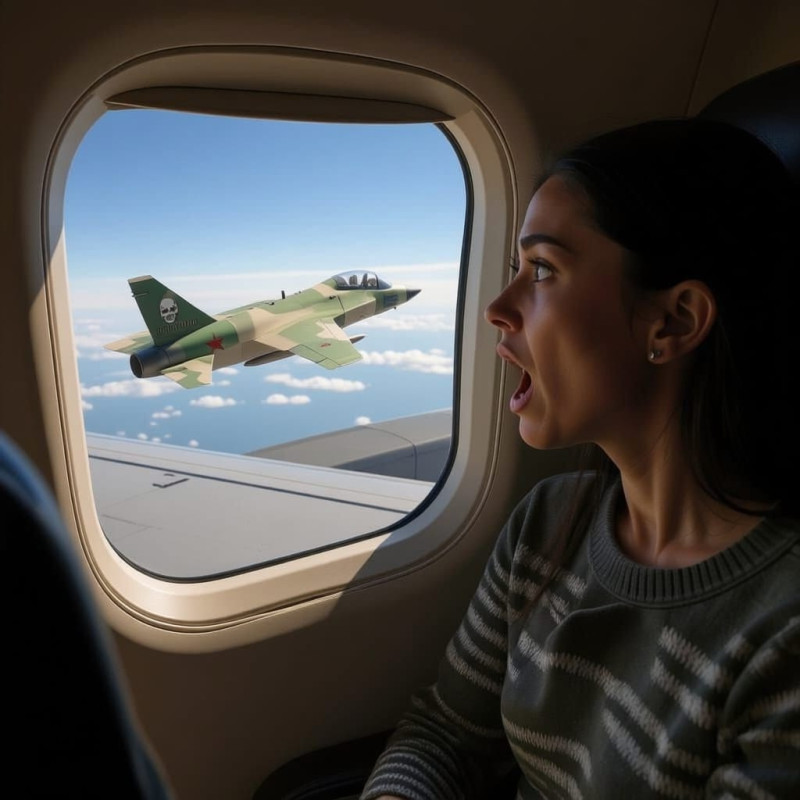
It was a fighter jet sliding into position off the port wing, its silhouette cutting a sharp line against the night, wings angled with military precision, engines pulsing in measured breaths, a presence announcing danger with cold practicality. Gray, angular, close enough to cast a shadow over the fuselage and make the cabin feel smaller than it was, the craft glided with a menace of alloy and purpose that could not be mistaken for any benign aerial visitor.
Too close, hovering at a distance that felt dangerously intimate, as if the pilots on that machine were leaning into the thin breath between his canopy, peering into the souls of every passenger on the eastbound jet.
Then the details began to resolve, the airframe revealing its true silhouette—larger, broader, heavier—on the wing, and the canopy opening like a slow, predatory mouth that suggested more than sport or speed.
And something wasn’t right, Demi sensing that the thing outside did not obey the same laws as ordinary aircraft, that threat had found a new, dissonant shape.
The fighter looked wrong from the moment Demi focused on it. Its fuselage was broader than expected, giving the aircraft a heavy, almost predatory presence that seemed to compress the space around it. The nose was slightly flattened and more substantial than that of most fighters, built less for elegance than for endurance and control. Behind it, a long, dark canopy stretched farther back than she expected, its near-black tint suggesting a tandem cockpit hidden beneath the glass.
Beneath the wings, hardpoints bristled with ordnance. Long, angular missiles hung in rigid symmetry, their faceted surfaces catching the sunlight in dull metallic flashes. Nothing about them looked ceremonial or defensive. They gave the aircraft the appearance of something already configured for action.
The longer she stared, the more unsettling the details became. The missiles seemed to absorb light rather than reflect it, their dark surfaces broken by seams and panels that hinted at complexities no civilian observer could understand. They remained perfectly motionless beneath the wings, as though waiting for a command.
Twin engines sat widely spaced along the fuselage, leaving shimmering heat distortions in their wake. The rippling air warped the sky behind the aircraft, blurring the horizon into wavering bands of blue and white. It was a subtle effect, but unsettling nonetheless—as if the fighter carried its own distortion field, pulling the world slightly out of alignment wherever it flew.
“They’re Russian…” someone whispered, the words barely carrying, more an attempt to impose familiarity than a statement of fact.
“Couldn't be,” another voice answered, quieter, tighter.
The jet edged closer. Not quickly. Not aggressively. Deliberately. Precision without drift. No visible correction. No micro-adjustments, the way a normal aircraft would hold formation. Holding a position as if it had been placed there, the airliner was sliding relative to it rather than the other way around.
Demi leaned forward despite herself, one hand rising to the glass for something solid to hold onto. The fighter was close enough now that she could see more than its shape. Yet it was unlike any airplane she'd ever seen before. Or, for that matter, anything anyone else in the cabin had ever seen before.
It looked modified.
Extensively modified.
She could see the tight panel seams running along the fuselage with an almost unnatural precision. Every line appeared deliberate. Every surface concealed function. Nothing looked accidental. Access points interrupted the surface in places that didn't resemble standard maintenance hatches. The markings were unmistakable: red stars, stark against the gray: Russian; a carrier of the identity, but not the history. Portions of its skin looked cleaner, newer—smoother. That suggested composite materials rather than traditional metal skin, broken only by darker panels along the intakes and wing edges that blended into the airframe rather than standing apart from it. Along the nose, clusters of recessed sensors interrupted the metal—small apertures, dark lenses, and flush-mounted housings integrated so cleanly they were easy to miss at first glance. They seemed less like add-ons than part of the aircraft's design philosophy, as though the jet had been rebuilt around the watch, track, follow movements across space, and reduce them to data. To control outcomes before anyone even understood what was happening.
“They’re not MiGs—” someone said, voice rising.
“Not Sukhois either—” another answered, more quietly, as if saying it softer might make it less true.
The alien jet slid closer still, close enough now that distance stopped meaning anything. Close enough that the idea of separation—the safety of space between aircraft—collapsed entirely. And then—the cockpit aligned for just a second. A perfect angle that was too precise to feel accidental.
She saw the pilot. Helmeted, visor down, no face, no features. His head turned. Not to scan the sky, to check his instruments, or to search for threats.
He was looking---directly at her!
Another aircraft moved into position on the far side. Then a third, higher, offset just enough to complete the geometry. Not circling, not escorting. Positioning. Not to guide the aircraft along a route, not to monitor it from a distance. To fix it in space. Contain it.
Murmurs spread through the cabin, low at first, then building as recognition failed to resolve into certainty.
Demi didn’t speak. She couldn’t, because the longer she watched them hold that perfect, impossible formation, the clearer the truth became—not through logic, but through instinct, absence, and a mismatch.
Off the starboard side, another one locked into place, completing the structure. They had made a box. A precise, mechanical, and intentional box.
And somewhere beneath the noise, beneath the rising fear and confusion, a thought settled in—quiet, cold, and impossible to dislodge:
These weren’t just escorts.
They were something new.
Something that wasn’t supposed to be here, something that didn’t belong to any framework the people inside this aircraft understood. The name would come later through briefings, intelligence, and analysis in an effort to contain what this was. But for now, they were unknown to everyone staring out those windows. And that made them more frightening.
Demi didn’t realize she’d been holding her breath until the fighter shifted again, edging closer, just enough to erase the last illusion of open sky. The space between them collapsed into something intimate and suffocating.
The jet no longer felt like it was moving through the air, more like suspended in it.
Across the aisle, someone whispered, “They’re too close…”
The plane itself remained steady—level, controlled, but the stillness no longer felt natural. It felt imposed, maintained. As if something outside the jumbo jet had decided exactly how it would move....and nothing inside it had any say in the matter.
Then—a burst of static. Loud, violent, and wrong.
The overhead speakers crackled, and a voice cut through the cabin. It was male, harsh, commanding, not broadcasting, in Russian.
The cabin froze.
“I—I speak Russian.”
This, from a man three rows back, leaning forward, gripping the seat in front of him.
“Estonian,” he said quickly. “I understand him.”
The voice came again—shorter, sharper.
The man swallowed.
“He’s addressing the pilots… demanding confirmation.”
A pause.
His expression shifted—tightened.
“He wants them to confirm there is a specific passenger on board.”
Another pause, quieter now.
"The transmission identified a passenger by name."
He swallowed.
"Demi Lovato."
The effect was immediate. Not loud or explosive, but worse than either.
People were turning now. Looking. Recalculating.
“No…”
“That’s her—”
“Oh my God—”
The voice returned over the speaker, colder now. More deliberate. It was making another demand, a final one.
The Estonian man hesitated this time, then forced it out.
"There is no misunderstanding."
His voice faltered.
"The Russian pilot specifically wants confirmation that Ms. Demi Lovato is aboard this aircraft."
The cabin went silent.
"And from the wording he used..."
He hesitated.
"They are not conducting a routine intercept."
The aircraft jolted violently. Not turbulence---force! A sharp lateral kick slammed bodies against restraints and sent loose objects crashing across the cabin. Screams cut through the air. A cracking sound. External. Too close for comfort.
The plane shuddered, then stabilized. The aircraft had not broken, but the illusion of safety had.
“They fired,” the Estonian man said hoarsely. “Warning shot… across us.”
No one questioned it.
Outside, the nearest fighter held position. Closer now. Aggressive and dangerous. Watching.
Demi felt the shift before she fully turned.
The cabin had changed. Everyone's fear was given a new direction. Panic. Pressure. Scapegoating.
“Is this because of you?”
“You need to tell them—”
“Say something—!”
The Russians were closing in. They were demanding a resolution. They were out for blood---hers!
And then—movement. Above. Fast. Impossible. One streak cutting across the sky at an angle too sharp, too controlled to belong to anything already out there. A second. A third. Clean. Fast. Decisive.
The nearest Russian fighter reacted instantly, breaking formation for the first time. Or was it shifting? Or was it correcting? No answers. Only uncertainty.
Demi leaned toward the window.
The newcomers didn’t circle. They didn’t hesitate. They cut directly through the geometry of the Russian formation and took position forward of the airliner. Assertive. Uncompromising. One rolled slightly as it locked into position. Markings flashed in the light. Blue. A Star of David!
A ripple moved through the cabin. Not relief. Not yet.
Recognition.
“Israel…?”
The sky changed. Not visually.
Structurally.
The Russian formation loosened. Subtle at first—fractions of distance opening where none had existed before. One fighter climbed. Another drifted outward, no longer willing to hold the same proximity.
The Israeli jets didn’t fire. Didn’t signal. Didn’t announce. They took space, and made the Russians understand they were going to keep it!
For several long seconds, both forces held position—layered over the Mediterranean in a silence that felt louder than combat, a line drawn without words.
Then, one of the Russian fighters banked away. Not abruptly. Not in panic. But with a decision. Another followed. Then another. The box dissolved. Precision unraveling into distance. Control giving way to separation.
The last Russian fighter lingered off Demi’s window. Close enough to see the cockpit again. Close enough to feel watched.
Then, someone gasped. Not at the fighter. Past it.
Demi followed the line of sight. At first, she saw nothing. Just distance. Heat haze. Sky stretched thin over the Mediterranean.
Then—a shape. Far back. So large it didn’t resolve properly at first, as if distance itself were hiding its scale.
“Is that… another one?” someone whispered.
“No,” another voice said, already shaking. “No, that’s—too big—”
It moved differently. Not like the fighters. Not sharp. Not reactive. Slow. Deliberate. As it banked, the light caught it, and the illusion broke.
The aircraft was enormous. A long, tubular fuselage with swept wings set farther back than seemed natural, engines slung beneath them in a configuration that looked both familiar and wrong at the same time. The nose was glazed—dark, opaque—and beneath it, a bulging forward section suggested sensor arrays or targeting systems far more complex than anything designed for simple navigation. It didn’t look like a passenger aircraft. It didn’t look like anything civilian at all.
“What is that…?” someone said, voice thinning.
Demi leaned closer to the glass. And then she saw it!
It was mounted beneath the wing. Not a fuel tank. Not an auxiliary pod.....A missile! Long, heavy, set forward on its pylon, aligned. Ready.
Silence fell over the section of the cabin nearest the windows. There was no confusion, but recognition.
The bomber continued its slow bank, its massive frame turning just enough to reveal more of its underside. More hardpoints.More payload.
And then—it began to turn away. Not reacting, not fleeing. Simply… disengaging.
As the Israeli fighters settled into position ahead of the airliner, the bomber rolled further, its vast shape angling off into the distance, shrinking slowly but never losing its presence.
“Oh my God…”
The words came from somewhere behind Demi, barely a voice.
More breath than sound.
“They weren’t escorting us…”
No one answered because they were all seeing it now. The size of the hideous aircraft. Its positioning. The way it had held back outside the immediate view.
 (Demi Lovato explained how frightened she was when she saw the Russian pilot actually seeming to look at her from her cabin during the flight from LA to Nairobi to journalist Hector Ntshoni)228Please respect copyright.PENANAHIdhKt0xJs
228Please respect copyright.PENANAztaQYVNWpg
Then a different voice—closer, sharper. A man leaning into the aisle, eyes fixed on the window.
“I—I was Air Force,” he said, almost to himself. “Not Russian, just—training, NATO briefings, recognition profiles…”
He didn’t look away.
“That’s a strategic bomber. And that—” he pointed, hand trembling slightly, “—that’s an air-to-air mount.”
A ripple moved through the cabin.
“Air-to-air?” someone repeated, not understanding.
The man swallowed.
“It’s not for ground strike,” he said quietly. “It’s not for targets on the ground. It’s for aircraft.”
The meaning didn’t arrive all at once.
But when it did, it locked into place. The demand for confirmation. The warning shot. The positioning. The sequence. Not improvisation.
“Good Lord,” the first voice said again, louder now, breaking completely. “They were going to—”
The sentence collapsed under its own weight. No one finished it. No one needed to.
Demi didn’t move. Didn’t speak. Because now the shape of it was clear—not just fear, not just pressure—but intent.
And outside, already turning away under the silent challenge of the Israeli fighters, the massive aircraft continued its slow bank into the distance as if nothing had been interrupted. As if all was in readiness.
Inside the cabin, sound returned all at once. Voices. Breathing. Someone was crying openly now. A burst of laughter that collapsed almost immediately. The structure had dissolved. People were no longer looking outward. They were looking inward.
Demi leaned back slowly, her pulse still hammering, her hand slipping from the window as if the glass itself had become unstable. For a moment, no one spoke to her. Not directly. But the distance had closed. She could feel it.
Then there was movement from the aisle. .A woman—mid-thirties, maybe—dark hair pulled back, a child balanced against her hip. The girl couldn’t have been more than two, her small hand clutching the woman’s collar, eyes wide, unfocused, overwhelmed by everything she didn’t understand.
She stopped beside Demi’s row. Not hesitant. Not uncertain. Deliberate.
Up close, the fear was still there—but it had changed shape; hardened and given direction.
“You,” she said. Not loudly, but clearly enough that the surrounding voices began to fall away again.
Demi looked up.
“You little bitch.”
The words landed flat. Not shouted. Not theatrical. Personal.
“They were after you, weren’t they?”
The child shifted against her shoulder, beginning to whimper. The woman didn’t look down. Didn’t soften.
Louder now. Breaking.
“Weren’t they!"
A beat.
“You almost got us killed.”
Her voice cracked—not with weakness, but with the strain of holding something back too long.
“Killed.”
No one intervened. No one contradicted her. No one could.
The accusation didn't echo. It settled into the space that had already been waiting for it.
Demi opened her mouth, but nothing came out. For a moment, she held herself still—like she had through the drop, through the fighters, through the voice on the speaker, through the realization of what had almost happened.
And then—she broke. Not loudly. Not all at once.
Her breath caught first—sharp, uneven—before her shoulders followed, the tension collapsing inward as if something structural had finally given way. She turned slightly toward the window, but it didn’t help. There was nowhere to look that wasn’t still inside it.
The tears came without warning. No attempt to stop them. No effort to hide them.
Around her, the cabin held in a fragile, uncertain quiet. Not sympathy. Not forgiveness. Something more complicated than either.
Outside, the sky remained unchanged.
Endless. Empty. Indifferent.
For a long time, Demi didn’t look back out. When she finally did, something had shifted.
Not in the air. Below. A faint break in the endless blue—something warmer, muted, spreading outward beneath a thin veil of haze. Then shape. Lines. Patterns.
Land!
The coastline came into view gradually, resolving from abstraction into something unmistakable—a pale, irregular boundary where sea gave way to earth; beyond it lay geometry. Green, dense, branching outward in intricate patterns that resembled nothing natural at altitude. Veins. Arteries. A system spreading out beneath them in quiet defiance of the surrounding desert, a vast, ordered network carved into an otherwise indifferent landscape. Life imposed on emptiness. Structure imposed on chaos. No one announced it. Nobody pointed.
But Demi saw it.
The Nile Delta! Egypt! Africa!
Not distant anymore. Not theoretical. Not a cause, or a decision, or an argument across a table.
Real.
She held her gaze there longer than she meant to. Because for the first time since the fighters appeared—since the voice, the demand, the realization—something else entered the space alongside the fear.
Not relief. Not yet.
But something that hadn’t been there before.
Presence.
And the knowledge that, whatever had just happened in the sky above the Mediterranean—this was where she had been going all along.


 and then Add to home screen.