

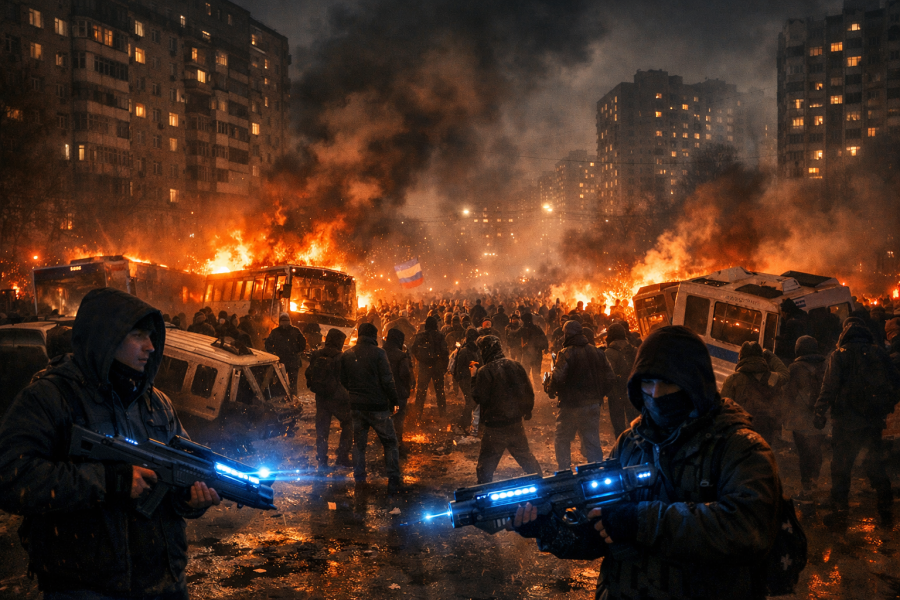
By 2025, the war had led to many unexpected consequences, but none shocked the Kremlin more than the eruption of anger within Russia itself. For years, state media had depicted the conflict as a defensive struggle against Western aggression, a necessary campaign fought in the name of national security. However, that narrative depended on strict control of information, perception, and belief—and by early October, that control had begun to dissipate.
The government had disastrously underestimated the deep affection that Russian youth once held for Demi Lovato. Her music had been streamed throughout the country for more than a decade, and her lyrics about mental health and resilience resonated profoundly with a generation raised in the uncertain aftermath of the post-Soviet era. When fragments of the truth about her assassination started leaking through foreign broadcasts, encrypted messaging channels, and underground journalists, the reaction among Russia’s draft-age population was immediate and explosive.
Students and young conscripts began to perceive the war in a manner that contrasted sharply with the narrative presented by the state. Initially, they had been led to believe that the conflict was a necessary defensive struggle for national survival. However, this perception started to shift dramatically when they learned about the assassination of an individual whom many of them greatly admired—Demi Lovato. This pivotal moment forced them to reconsider the motivations behind the war.
As more information came to light, it became apparent that the Russian government had not just turned a blind eye to this tragedy; instead, it had played a central role in orchestrating the assassination. This unsettling revelation spread with remarkable speed across encrypted messaging networks, where it was dissected, shared, and transformed into various narratives. Users reposted snippets of information, translated messages into different languages, and reframed the story to fit their own perspectives.
The sheer volume of discussions made it increasingly irrelevant which version of events was the most accurate. What truly mattered was that a significant number of people had come to believe this unsettling truth. The impact of this shift in perception began to resonate deeply among the youth, instigating a growing sense of disillusionment and questioning of the government’s motives in the ongoing conflict.
Within just a few days, a wave of demonstrations erupted across several major Russian cities, including Moscow, St. Petersburg, Yekaterinburg, and Novosibirsk. Large crowds filled the streets, united by a common cause, carrying an array of homemade signs that varied widely in their messages. Some of the signs featured poignant lyrics from Lovato’s songs, while others showcased faded photographs from concerts held years earlier. These images, once tokens of admiration and fandom, were now transformed into powerful symbols of accusation and protest against the current state of affairs.
The atmosphere during the protests was charged and surreal, marked by a striking contrast between the joyful memories captured in the photographs and the weighty anger expressed in the protests. This imagery struck a dissonant chord that was difficult for authorities to suppress effectively. Initially, the police employed their usual tactics to control the unrest. They utilized strategies such as dispersing crowds, making targeted arrests, and selectively detaining the most prominent organizers of the movement. However, the sheer scale and rapid tempo of the demonstrations quickly exceeded these traditional methods of crowd control.
Instead of the protests escalating in a gradual manner, they multiplied almost spontaneously, with new gatherings springing up in adjacent districts even as security forces worked to clear others. This unexpected dynamic forced law enforcement into a reactive stance they had not prepared for, highlighting the widespread discontent and the movement's ability to adapt and grow in the face of repression.
Throughout the entirety of the university sectors, campuses transformed into vibrant epicenters of ongoing demonstrations. Students took to the streets, fervently occupying plazas and effectively blocking major transit routes, while even draft offices—once efficient administrative hubs—found themselves encircled by anxious families. These families were desperate for answers regarding their sons, who had already been sent to the front lines of the conflict. In numerous towns and cities, local officials faced mounting pressure and, in some instances, chose to delay or quietly suspend conscription activities. This decision was driven not by any formal policy change but by the immediate necessity to address the concerns of a worried populace.
The state’s response to these developments remained robust, yet it increasingly displayed a lack of uniformity. The reactions varied significantly across different regions, heavily influenced by the willingness and capability of local authorities to escalate their measures in response to the unrest. What initially began as a series of protests, passionate yet focused, was gradually evolving into something far more expansive and unsettling. The initial sense of unity and purpose among the demonstrators began to erode, giving way to a broader disarray. This fracture in cohesion emerged at a critical juncture, precisely when the demands of the ongoing war called for the strongest sense of solidarity and collective resolve.
The riots rapidly escalated into an unprecedented crisis, one that Russia’s internal security forces had not encountered in decades. Starting in key urban centers, the situation spiraled out of control, with armored police vehicles being violently overturned and then set ablaze by fervent protesters. Throughout the night, clashes between demonstrators and riot troops unfolded with a ferocity that engulfed entire neighborhoods, no longer confined to isolated areas but spreading like wildfire across urban landscapes.
What initially began as peaceful demonstrations quickly transformed into organized and sustained confrontations. Groups of protesters, driven by a shared sense of urgency and purpose, erected barricades using whatever materials they could find—trash cans, wooden planks, and even more formidable objects to block police advances. They communicated and coordinated their movements through encrypted messaging apps, outpacing traditional state responses and utilizing the very information networks that the government had attempted to suppress.
As the violence escalated, videos documenting the clashes poured onto social media platforms at an astonishing rate, often before state censors could react to contain them. Even when authorities succeeded in removing some content, those videos resurfaced in varied forms—altered, mirrored, or subtitled—making it nearly impossible for the state to eradicate all traces of the unfolding chaos. The stark visuals carried their own powerful momentum: images of vehicles ablaze, sending glowing embers spiraling into the darkened sky; crowds of defiant young people pushing against lines of riot police, who were forced to retreat under the relentless pressure; the cacophony of chants erupting defiantly above the turmoil.
Among the cries of indignation, one particular phrase resonated deeply in the thick of the unrest: “Мы не будем умирать за убийц!”—“We will not die for murderers!” The voices of the protesters rang out sharply through the smoke-filled air, infused with anger and determination as flames from the burning vehicles cast flickering shadows across the packed streets. In that moment, the spirit of resistance was palpable, and the determination of the protesters was unwavering, echoing well into the night.
For the first time since the onset of the ongoing conflict, the Kremlin found itself confronted with a stark and troubling reality: the gravest threat to its war efforts was emerging not from external forces, but from within its own borders. This internal threat was not a singular or easily identifiable issue; rather, it was a complex and rapidly intensifying phenomenon, marked by widespread discontent and a growing sense of dissent among various sectors of society.
Orders dispatched from Moscow were now met with a troubling inconsistency in their execution; many local officials and regional authorities exhibited hesitance, recalibrating their responses based on local sentiment or opting to limit the implementation of directives altogether. This hesitance highlighted a disconnect between central command and regional enforcement, revealing a fissure in what had once been a more cohesive governance structure.
The security forces, while still retaining a degree of capability, were increasingly seen as unreliable in a uniform manner. Many of these forces found themselves caught in a precarious balancing act—charged with maintaining public order while grappling with growing internal doubts regarding the legitimacy and purpose of the orders they were being compelled to carry out. The mechanisms of control that had previously upheld the Kremlin's authority had not entirely disintegrated, but they were far from functioning in harmony.
As public unrest started to escalate, the responsibility for addressing this turmoil became concentrated at a singular point of decision-making. This situation introduced a new level of urgency for the Kremlin’s leadership, as hesitation could lead to detrimental consequences. Inaction was no longer a viable option, and the central question shifted dramatically: it was no longer a matter of how the state would exert its power to suppress the growing wave of unrest, but rather how to effectively respond to and manage the complexities of this internal crisis.
The question of who would shape future events became significant, igniting debates among the group about the implications of their decisions and the weight of responsibility that lay upon them.76Please respect copyright.PENANA701evamrES
76Please respect copyright.PENANAJ6Ke2Qofy1
76Please respect copyright.PENANA4Cvgptqv7x
What unfolded in Russia during the final months of 2025 astonished historians and intelligence analysts alike. The protests, which began as demonstrations by students and conscripts, did not subside; instead, they intensified, spreading rapidly and suggesting deeper underlying issues rather than mere spontaneous unrest. By mid-October, the vast nation was descending into the most significant internal turmoil it had experienced since the Russian Revolution. Entire districts of major cities descended into cycles of protest, repression, and renewed confrontation, with each wave growing larger and more chaotic than the last. Factories halted production as workers joined the demonstrations, university campuses evolved into organizing centers, and crowds repeatedly obstructed rail lines that transported military supplies to the front.
What made the situation especially dangerous was not just the scale of the unrest, but its timing. It occurred at a moment when the state could least afford to experience internal fractures. Military operations were ongoing, supply chains were already strained, and command cohesion was increasingly reliant on uninterrupted control from the central authority. However, that control was eroding in real time. Regional authorities hesitated to enforce directives, local security units felt overwhelmed or uncertain, and information—previously tightly managed—was circulating faster than it could be contained. The pressure that had been building throughout the system was no longer external; it had turned inward.
By early November, the crisis had escalated beyond the capabilities of routine internal security measures. Decisions that were once managed at the ministerial level now required direct intervention from the highest authorities. The unrest had shifted from being a matter of public order to a question of state continuity. As the divisions deepened, the responsibility for responding to the situation fell to a single office, where each option carried consequences that extended far beyond the streets.
At that moment, the war ceased to be the main concern.
The question was no longer about how Russia would engage in battle.
The question was no longer about how Russia would engage in battle.
The symbolism driving the unrest in 2025 was unlike anything Russia had experienced before. In 1917, revolutionaries rallied behind the ideas of Vladimir Lenin—an ideology centered on class struggle, power, and the promise of a new political order. In contrast, the emotional heart of the 2025 upheaval was not rooted in ideology but rather centered on a person: Demi Lovato. Her image appeared on banners throughout Moscow, St. Petersburg, and Yekaterinburg, drawn from old concert posters, social media snapshots, and grainy screenshots. These images were often paired with handwritten slogans accusing the government of sending young Russians to fight for the very men responsible for her death. The resulting effect was disorienting and deeply unsettling for the authorities. This movement was not based on a set doctrine or organized leadership; instead, it was fueled by shared emotions and a collective sense of betrayal that required no central coordination to sustain it.
For older officials within the Kremlin, the symbolism was nearly incomprehensible. They had anticipated dissent stemming from political, economic, or nationalist issues, but not from something so personal and culturally pervasive. A foreign pop singer had become, for millions of young Russians, a sort of moral reference point, and her death was interpreted as evidence of a larger deception. In this context, the war was no longer seen as abstract or strategic; it became immediate, human, and fundamentally wrong. The state’s messaging apparatus, which was designed to counter arguments and suppress opposition, struggled to respond to a sentiment that did not engage in traditional debate. It simply spread, conveyed through images, lyrics that were remembered and repurposed, and the quiet yet persistent belief that something crucial had been hidden—and that those responsible expected the public to fight regardless.
Then the violence escalated in ways few authorities had anticipated. Russia's modern weapons had long surpassed traditional firearms, and the war had filled military depots with advanced equipment designed for a very different type of battlefield. Amid the chaos of several large demonstrations, groups of protesters took advantage of security lapses, raiding inadequately protected storage facilities and making off with army-issued Monlinya-12s. What had started as unrest crossed an invisible threshold. These were no longer crowds reacting in anger; they had become armed actors capable of inflicting precise, deliberate harm.76Please respect copyright.PENANA4sg8MGXf8p
76Please respect copyright.PENANAAqGpcf8CxQ
What had initially begun as a wave of discontent among the people began to cross an invisible threshold, transforming the situation dramatically. These gatherings of individuals, once merely expressing their anger and frustration, were evolving into organized groups equipped and willing to engage in violence. They had become armed actors—individuals and factions with the capability to inflict precise and deliberate harm on their targets, marking a significant shift from passive protest to active aggression.76Please respect copyright.PENANAfUSsreDzGm 76Please respect copyright.PENANAn4I70dEVcq
In the aftermath of the initial chaos, a new and profoundly disconcerting pattern began to take shape. As thick plumes of smoke billowed from burning vehicles and debris from obliterated storefronts littered the streets, an invisible menace emerged. Coordinated attacks were launched against security forces, who fell victim to ambushes from carefully concealed positions—perched on rooftops, hidden within the shadows of narrow alleyways, and lurking in abandoned transit corridors that had long been forgotten.
Militamen and Federal Security Service troopers, once confident and alert, suddenly found themselves at the mercy of an unseen assailant. They collapsed without warning, their bodies hitting the ground with a sickening thud, weapons slipping from their grasp as if they had been struck by an unseen force. Strangely, there were no visible injuries to signal the cause of their sudden incapacitation.
The air crackled with tension as the onslaught continued, each strike executed with deadly precision. It soon became apparent that concentrated electromagnetic pulses were the weapon of choice, silently disrupting motor coordination and rendering even the most trained personnel helpless before they could react. The psychological impact was immediate and bewildering: panic rippled through the ranks of the security forces, who were used to maintaining order and controlling crowds.
Now, however, they found themselves vulnerable and exposed, with uncertainty gnawing at their resolve. Every corner held the potential for an ambush, each shadow a possible threat. The atmosphere was thick with fear, as no one could predict where the next, possibly lethal strike would come from—or if they would even have the chance to anticipate it before it was too late.
The psychological impact of the situation proved to be as severe as its tactical consequences. Fragmentary videos—often grainy and incomplete, yet nonetheless clear in their content—spread across various platforms at a staggering pace, far outstripping the efforts of censors to contain them. These visuals fostered an increasingly widespread perception that the state’s monopoly on the use of force was deteriorating. Consequently, some military units began to withdraw from their posts more swiftly than they had been ordered to do, driven by an urgency that reflected their faltering confidence. Meanwhile, other units reacted in stark contrast; fueled by a heightened sense of threat, they escalated their use of force, inadvertently intensifying the existing unrest and making the situation even more volatile.
As these dynamics unfolded, the crucial coordination among various state entities began to unravel. In multiple cities, command structures that had once operated cohesively fractured into a series of isolated responses, each responding independently to the chaos. These responses were often based on incomplete intelligence, leading to a cycle of confusion and further diminishing the perceived control that the state had over the situation. While the state maintained significant resources and capabilities, its actions were no longer characterized by unity and coherence. Instead, they became marked by fragmentation, leaving a palpable sense of disorder and uncertainty in the wake of this crisis.
At that point, the crisis ceased to be a matter of public order. It became a question of authority—of whether the government could reassert control before fragmentation became irreversible. Responsibility for that decision no longer rested with regional commanders or interior ministries. It narrowed, rapidly and unavoidably, to a single man.
And the question before Putin was no longer how to contain the unrest.
It was how far he was willing to go to stop it.76Please respect copyright.PENANAtJZqWeXqjP
76Please respect copyright.PENANAeVViLvZ9DS
76Please respect copyright.PENANAfVhI58Yrib
As the riots spread through Russia’s major cities in 2025, the crisis did not remain confined to the streets. Across the vast federation, long‑suppressed regional tensions resurfaced with startling speed—but for the first time, they were shaped not only by internal forces, but by subtle pressures from beyond Russia’s borders. Neighboring states, wary of both instability and opportunity, began to move cautiously along the periphery. Officially, these actions were described as defensive: expanded patrols, reinforced checkpoints, and the establishment of “temporary security zones” in areas where federal control appeared uncertain. Unofficially, they signaled something more deliberate—a recognition that the Russian state was no longer fully able to assert authority across its outer regions.
In the North Caucasus, where unrest had already taken root, the situation grew more complex. In Chechnya and Dagestan, underground political groups found themselves operating in an environment increasingly shaped by outside influence. Weapons, funding, and logistical support began to appear through channels that could not be easily traced. No government acknowledged involvement, yet the pattern was difficult to ignore. What had once been localized dissent now carried the hallmarks of something more organized, more sustained. Security forces faced not only protesters and insurgent networks, but actors whose capabilities suggested quiet backing from beyond Russia’s borders—support carefully calibrated to remain deniable, yet effective enough to shift the balance on the ground.
Farther east, the dynamic took on a more strategic character. In Sakha (Yakutia) and neighboring regions, where resource wealth had long been a source of tension, external interest focused less on territory than on infrastructure. Rail corridors, extraction facilities, and port access points became the quiet center of attention. Disruptions to these systems—whether through protest, sabotage, or administrative paralysis—created openings that outside actors were quick to exploit. Agreements were discussed informally, local officials courted discreetly, and economic relationships hinted at that bypassed Moscow altogether. Similar patterns emerged in Buryatia and along the Pacific approaches, where the question was no longer who governed in name, but who controlled the flow of resources in practice.
In the Volga region, particularly in Tatarstan, political positioning became the dominant feature. Regional leaders, long constrained by federal authority, began receiving indirect signals of support from abroad—diplomatic, economic, and informational. None of it amounted to recognition or endorsement of independence, but it was enough to encourage hedging behavior. Local elites explored expanded autonomy not as an ideological goal, but as a contingency, a way to prepare for outcomes that now seemed increasingly plausible. Student movements and political organizations, sensing this shift, pushed more openly for referenda and structural change, aware that their position was no longer defined solely by Moscow’s response.
Taken together, these developments did not amount to a coordinated effort to dismantle Russia—but they did create a landscape in which fragmentation became easier to imagine and harder to prevent. Pressure at the edges, deniable incursions within, quiet alignment with regional actors, and the selective securing of critical infrastructure all pointed in the same direction: a slow, opportunistic shaping of outcomes in a weakening state. No single move was decisive. But in aggregate, they eroded the cohesion that had held the federation together. And as these forces converged, the question facing Moscow was no longer how to restore order.
It was whether the state could withstand not just internal unrest, but the growing realization that others were already preparing for what might come next.
However, none of these movements, taken in isolation, guaranteed the breakup of the Russian Federation. There was no single declaration of secession, no unified opposition leadership, no moment that could be identified as the point of irreversible fracture. Yet taken together, they signaled something far more alarming for the central government: a cumulative weakening of cohesion across political, military, and economic systems that had once operated in alignment. The riots in Moscow and St. Petersburg had exposed the regime’s vulnerability at its core, demonstrating that even the capital was no longer immune to sustained internal pressure. At the same time, the resurgence of regional autonomy movements suggested that this vulnerability was not confined to the center. Entire sections of the country were beginning to question—not rhetorically, but practically—whether the federation itself could survive the war in its existing form.
What made this moment uniquely dangerous was the convergence of pressures that, in earlier eras, had unfolded more slowly and often separately. Public unrest, economic disruption, military strain, and regional ambition were now reinforcing one another in real time. A disruption in one sphere quickly translated into instability in another: protests interrupted logistics, logistical failures weakened military confidence, and that weakening, in turn, emboldened regional actors to test the limits of federal authority. The system was not collapsing outright, but it was losing its ability to respond coherently. Decisions made in Moscow were delayed, diluted, or quietly ignored at the periphery, while local authorities increasingly acted in anticipation of outcomes rather than in obedience to directives.
To many historians and analysts observing events as they unfolded, the parallels to the political fragmentation that preceded the Dissolution of the Soviet Union were becoming increasingly difficult to dismiss. But there was also a critical difference. The Soviet collapse had been driven, at least in part, by ideological exhaustion and structural reform. What was emerging in 2025 was less orderly, less predictable—a fragmentation shaped by crisis, accelerated by modern communication, and influenced by external pressures operating just beyond visibility. It carried with it not the slow unraveling of a system, but the risk of sudden, uneven rupture.
For the first time in a generation, the possibility of a second great Russian disintegration no longer seemed unthinkable. It had entered the realm of contingency planning—discussed not only in academic circles, but within governments, intelligence services, and military commands across the world. And as that possibility gained traction, the question facing both Russia and the international community shifted in tone and urgency. It was no longer a question of whether the federation might weaken.
It was whether it could be prevented from coming apart.76Please respect copyright.PENANAUQpuZ3d7Xq
76Please respect copyright.PENANAmJiaaMEuGT
76Please respect copyright.PENANA1X6o3qxUk8
76Please respect copyright.PENANApTiqL4kUGV
By the time the reports reached the Oval Office, the situation had become impossible to ignore. Satellite imagery, casualty summaries, and intelligence briefings spread across the long conference table in the White House Situation Room all pointed to the same conclusion: the war in Africa had expanded beyond any single front and now stretched across the continent in a continuous arc of conflict. What had once been described as regional engagements had fused into a sprawling, interconnected battlespace—north to south, coast to interior—where no position remained isolated or untouched. Entire regions cycled between occupation, bombardment, and abandonment in patterns that analysts increasingly compared to the trench systems of the First World War: movement limited, progress fleeting, destruction constant. There were no decisive breakthroughs, only temporary advantages measured in hours or days before the balance shifted again.
Supply systems had broken down under the strain of that scale. Rail lines, ports, and inland corridors were repeatedly cut, restored, and cut again, creating a logistical environment in which no advance could be sustained for long. Convoys moved under constant threat; airlift capacity was stretched beyond safe limits; entire units found themselves stranded between objectives, unable to push forward or withdraw cleanly. Refugee columns moved in every direction—not away from a single front, but across multiple overlapping zones of danger—stretching humanitarian response far beyond its limits. Cities that had once served as administrative or economic centers became temporary strongholds, then targets, then ruins.
What gave the destruction its most haunting dimension was the slow, dawning realization that something far more ominous lay behind it—an evolution in the war that echoed, in a modern and far deadlier form, the first use of chemical weapons in the First World War. Early reports had described the strikes as tactical, limited, and contained—battlefield tools intended to break hardened positions. But as data accumulated, that assumption began to collapse. Atmospheric readings, satellite signatures, and the eerie absence of conventional blast patterns pointed instead to strategic nuclear detonations. Delivery systems consistent with Iskander platforms—and, more chillingly, Sarman‑class ICBMs—had been used. The total number remained unknown. Like mustard gas a century earlier, the weapons had not simply killed; they had altered the nature of the battlefield itself, introducing a form of fear that spread beyond the immediate point of impact. Entire zones were not just destroyed, but rendered unapproachable, their silence more terrifying than ruin. The realization did not come all at once—it seeped in, report by report—until it became impossible to deny that a threshold long thought unthinkable had already been crossed.
Infrastructure collapsed not all at once, but in layers, each failure compounding the next. The war no longer had a clear geography. It existed everywhere at once, diffused across distance yet unified in effect—and now shadowed by a form of destruction that, like gas in the trenches a century before, could not be contained, unseen, or undone.
Even senior commanders, in closed briefings, acknowledged what few were willing to state publicly: the conflict had settled into a continental stalemate defined by attrition rather than maneuver. Gains were measured in ground briefly held before being lost again; losses accumulated steadily, indifferent to tactical success or failure. The terrain itself—vast, varied, and unforgiving—offered little strategic clarity, yet demanded continuous reinforcement across thousands of miles. No single theater could be abandoned without risking collapse elsewhere, and no concentrated effort could achieve decisive results without exposing vulnerabilities along the periphery. The war had reached a point where every option carried equal cost. It could not be decisively won. It could only be prolonged.
For Kamala Harris, the burden was no longer simply strategic—it was existential in scope. Each report represented not just casualties, but the steady consumption of an entire generation across multiple nations, drawn into a conflict whose origins had become increasingly distant from its reality. Names blurred into numbers, but the pattern remained unmistakable: escalation without resolution, sacrifice without direction. The scale stripped away abstraction. This was no longer a campaign that could be managed, adjusted, or contained.
It was a system consuming itself.
And the question confronting her was no longer how to achieve victory on any one front.
It was whether the war, in its current form, could be allowed to continue at all.
It was during one of these late‑night strategy sessions—hours deep, the room dim except for the glow of screens and projected maps—that Professor Albrecht finally spoke. Until then, he had largely observed, listening as generals argued for expanded operations while diplomats warned of escalation with other major powers. When the room fell quiet, he laid out an alternative with deliberate calm. The war, he argued, had entered the most dangerous phase of any conflict—the point at which none of the participants could win, yet none believed they could afford to withdraw. History offered a consistent lesson: wars like this did not end through battlefield success. They ended when someone created a path out that all sides could accept without appearing to surrender. That required not a combatant, but a mediator.
At first, the proposal seemed almost naïve. Several advisors pointed out that the battlefield now involved overlapping national forces, private militias, and competing foreign interests, many of them operating outside formal command structures. Others warned that any pivot toward diplomacy would be interpreted as weakness after so much destruction had already occurred. But Albrecht did not argue emotionally. He walked Harris through the underlying reality with methodical precision: the compounding cost of continued operations, the accelerating humanitarian collapse, and the growing probability that the conflict could trigger confrontation between nuclear powers. Each additional month, he explained, narrowed the space in which the war could still be contained.
The turning point came when he displayed a series of casualty projections compiled by defense analysts. The numbers were staggering—not speculative, but extrapolated from current rates of loss. If the fighting continued for another year, the death toll among conscripts and irregular forces alone could climb into the hundreds of thousands. Agricultural zones would become unusable, wildlife reserves damaged beyond hope of repair, and fragile regional systems pushed beyond recovery. Entire populations would be displaced with no viable path home. What was unfolding was no longer simply a war. It was the systematic degradation of a continent.
For Harris, the conclusion settled with a clarity that left little room for hesitation. Continuing along the same trajectory did not preserve stability—it guaranteed collapse on a scale that would define not only the war, but her presidency.
Albrecht then made his request plainly. He asked to step forward not as a strategist, but as a neutral emissary—someone who could approach each side without being seen as an extension of American military power. His credibility, he argued, rested not in authority, but in perception: a scholar, an architect of policy, a figure who might still be trusted where governments were not. If the United States supported a mediation effort framed through the international community, it might open a narrow window for negotiations before the war expanded further.
The proposal hung in the room longer this time. Harris understood the risks. Sending a senior figure into the center of a global crisis could fail—and fail publicly. Yet the alternative, allowing the war to continue unchecked, carried consequences that were no longer theoretical. Finally, she gave a quiet, measured approval. If the world required a mediator, then someone had to assume the role. Albrecht would go.
But not without legitimacy.
Within days, the administration moved through diplomatic channels to secure international backing. At United Nations headquarters, delegates recognized the opportunity with unusual speed. Many governments had been searching for a path out of the conflict, but lacked a credible mechanism to begin. A resolution was advanced—carefully worded, deliberately restrained—authorizing a special mediation mission and granting Albrecht status as an internationally recognized envoy empowered to initiate talks among the warring parties.
When he departed Washington, the symbolism was unmistakable. A war that had begun in violence and escalation was now forcing the world to attempt something far more uncertain: restraint. The shift was subtle, almost fragile, but real. For the first time since the conflict had spread across the continent, there existed—not a solution—but the possibility of one.
Whether Professor Albrecht could succeed where armies had failed remained an open question.
But for the first time in months, the trajectory of the war was no longer defined solely by how it would continue.
It was defined by whether it could be stopped.76Please respect copyright.PENANAoTwey9VfnU
76Please respect copyright.PENANAPdZFZwW9u4
76Please respect copyright.PENANA7xwOqUHQe8
76Please respect copyright.PENANA3TAOrye7k1
When Professor Albrecht accepted the role of international mediator, the mission he presented publicly appeared straightforward enough: stop the war before it consumed even more of the African continent. Speaking before delegates at the United Nations, he outlined a series of immediate objectives that sounded practical and humanitarian. First would come a ceasefire across the major fronts, enforced by international observers. Second would be the reopening of humanitarian corridors so that food, medicine, and refugees could move safely through devastated regions. Finally, Albrecht proposed an international stabilization conference aimed at restoring governance, infrastructure, and economic continuity across territories that had effectively ceased to function as states. Diplomats praised the proposal as pragmatic and achievable—a rare attempt to impose structure on a war that had long since slipped beyond conventional control.
Yet even as these formal discussions unfolded inside the General Assembly chamber, a second, quieter process was taking shape elsewhere within the UN complex. In a secured conference suite far removed from the press and official delegations, Albrecht began a series of closed-door meetings with figures rarely given voice in international diplomacy: tribal kings, regional chiefs, and traditional authorities from across the African continent. They arrived not with prepared statements, but with lived accounts—descriptions of land rendered unusable, of populations displaced not once but repeatedly, of conflicts layered atop older rivalries now reignited under the pressure of war. Many spoke not in terms of geopolitics, but survival. Borders drawn on maps meant little compared to grazing routes, access to water, and ancestral territories now lying within active combat zones or contaminated beyond recovery. Albrecht listened more than he spoke. What emerged from these sessions was a picture far more fragmented—and far more human—than anything contained in official briefings.
Running parallel to these discussions were briefings that carried a different kind of weight. Teams from the World Health Organization presented findings that transformed the understanding of the war’s long-term consequences. Radiation patterns mapped across multiple regions suggested not isolated incidents but sustained exposure zones expanding with seasonal winds and water systems. In other areas, tungsten particulate contamination—residue from high‑velocity kinetic strikes—had entered soil and groundwater, raising the prospect of chronic health effects that would persist long after the fighting ended. Agricultural collapse was no longer hypothetical; it was measurable. Entire ecosystems showed signs of irreversible damage.
At one point, the technical briefings were interrupted by testimony that carried a different kind of gravity. An Egyptian regional representative, speaking not from prepared notes but from visible strain, described the loss of cultural and environmental anchors that had endured for millennia. The Aswan High Dam had been critically damaged in a series of strikes, sending uncontrolled surges downriver. The Giza Pyramid Complex—long considered untouchable even in war—had suffered direct impacts, with structural collapses reported. In the south, sections of the Valley of the Kings had been destabilized or buried under shockwaves and debris. Most devastating of all was the condition of the Nile itself. Tungsten rod impacts upstream had introduced dense particulate contamination into the river system, turning what had been a lifeline for millions into a slow-moving hazard. Filtration systems failed almost immediately; irrigation networks carried the contamination into farmland; entire communities along the riverbanks faced the prospect of abandoning land that had sustained continuous civilization for thousands of years.
The room, accustomed to numbers and projections, fell into a different kind of silence. The language used in the formal briefings remained clinical, precise—but the implications were no longer abstract. Even a complete cessation of hostilities would not restore what had already been lost.
Privately, however, Albrecht’s thinking reached much further than the carefully worded statements distributed to the press. In confidential conversations with advisers in Washington and several trusted European diplomats, he argued that the war’s deeper instability did not originate in Africa at all. The battlefields in Kenya, South Sudan, and along the Indian Ocean were symptoms—visible manifestations of a larger geopolitical condition. As long as leadership in Moscow remained unchanged, any negotiated peace would remain fragile, vulnerable to collapse the moment pressure shifted. The war had become tied to the political survival of the man who had helped set its chain of events in motion: Vladimir Putin.
Albrecht never framed the idea in the language of regime change. That would have been diplomatically untenable. Instead, he spoke in more abstract terms—“strategic de-escalation through political transition.” What he meant was simpler, and far more consequential: the war could only truly end if the leadership structure sustaining it evolved. The unrest already spreading across Russian cities suggested that such a shift, once unthinkable, was no longer impossible. If a negotiated settlement coincided with a change in leadership in Moscow, it might allow Russia to disengage without the appearance of defeat—an outcome Albrecht believed was essential for any durable peace.
This objective remained unwritten, unspoken in formal settings. Even within the administration of Kamala Harris, many assumed his mission was limited to halting the immediate bloodshed. Yet in his private notes, the pattern was unmistakable. Again and again, he returned to the same conclusion: the war was no longer sustained by strategy alone, but by political necessity at the highest level. Remove that element, and the conflict might begin to unwind with surprising speed.
For Albrecht, the logic was not ideological but historical. Wars rooted in territory or resources could end in compromise. Wars tied to the authority and legacy of a single leader rarely did. They persisted until that authority changed—gradually, abruptly, or under pressure from forces beyond the battlefield.
Thus, when Professor Albrecht boarded the aircraft that would carry him to begin his mediation effort, the world believed he was traveling as a peacemaker tasked with halting a brutal and sprawling conflict. In reality, his mission operated on two levels at once. Publicly, he would attempt to impose order on chaos—to secure ceasefires, reopen corridors, and bring adversaries to the table. Privately, he carried a far more ambitious hope: that somewhere within the shifting balance of unrest, diplomacy, and pressure, an opening might emerge—not for victory, but for transformation.
And if that moment came, he intended to recognize it—and act—before the war consumed what little remained to be saved.76Please respect copyright.PENANA77qtKsdzHv
76Please respect copyright.PENANAJDVQ9rw6MC
76Please respect copyright.PENANAPNyDf88EhQ
76Please respect copyright.PENANAlMvFcJ9ois
Albrecht’s route to Moscow was neither direct nor ceremonial. At his insistence, the journey carried him first through Europe, across regions that had become something closer to aftermath than battlefield. From the air, the damage appeared abstract—patches of scorched terrain, fractured infrastructure—but on the ground it resolved into something far more unsettling. Entire agricultural zones lay stripped bare, their soil reduced to inert dust by the passage of what survivors described only as “the swarms.” The Russian nanolocust deployments—initially dismissed as experimental or localized—had spread far beyond their intended zones, consuming crops, insulation, wiring, even organic building materials before dissipating into inert residue. What they left behind was not destruction in the conventional sense, but absence. Villages stood intact but empty, their interiors hollowed out, their function erased.
In administrative centers that still operated in name, Albrecht met officials who governed little more than maps. Mayors spoke of cities whose populations had dispersed or vanished, their authority reduced to coordination of aid that never fully arrived. In rural regions, he sat with hereditary leaders—kings in title, custodians of lands that no longer sustained life—who described not defeat, but erasure. Borders had lost meaning. Governance had become provisional, contingent on resources that no longer existed. The war, in these places, had not been won or lost. It had simply passed through, leaving systems behind that could not recover.
By the time Albrecht reached Moscow, the contrast was stark but not reassuring. The city still functioned—lights on, traffic moving, ministries operating—but the strain was visible beneath the surface. Security presence had increased, but so had signs of fatigue: longer response times, quieter streets, and an absence of the controlled confidence that had once defined the capital. Within the Kremlin, that strain was even more apparent.
Vladimir Putin received Albrecht without ceremony. Those present would later remark not on what was said initially, but on what was visible: a leader still composed, still deliberate, but visibly worn in ways that could not be concealed by posture or protocol. The years of conflict, the accumulating pressures—military, political, personal—had taken their toll. This was not the figure who had entered the war with calculated certainty. This was a man managing consequences.
Their first conversations were cautious, almost formal. Albrecht did not confront; he observed. He allowed Putin to frame the conflict in familiar terms—security, necessity, resistance—while quietly introducing contradictions drawn from what he had seen firsthand. Not accusations, but realities: regions that could not be stabilized, systems that could not be restored, populations that would not return. Each meeting built incrementally on the last, shifting from external conditions to internal pressures—unrest, fragmentation, the erosion of centralized control.
What emerged between them was not negotiation in the traditional sense but closer to a strategic dialogue—a contest of interpretation. Putin argued continuity: that the state could endure, adapt, and outlast. Albrecht argued for the trajectory: that certain processes, once set in motion, did not reverse. He spoke not of defeat, but of limits. Not of blame, but of consequence.
And gradually, the focus narrowed.
Albrecht never demanded resignation. He made no explicit proposal, issued no ultimatum. Instead, he constructed a framework in which the conclusion became increasingly difficult to avoid. He outlined the narrowing set of outcomes available to Russia: prolonged instability, internal fracture, or controlled transition. He emphasized the one variable still within Putin’s control—the manner in which his leadership would end. History, Albrecht suggested, would not judge the war solely by how it was fought, but by how it was concluded.
The turning point came not in a single exchange, but in a shift of tone. In one of their final meetings, Putin—who had until then spoken in the language of state and strategy—began to speak more personally, more reflectively. The questions changed. Not how to continue, but what would remain. Not how to win, but how to be remembered.
Albrecht recognized the moment immediately.
He did not press. He did not need to.
Within days, preparations began quietly within the Russian leadership structure—framed publicly as an administrative transition, understood as something far more significant. The announcement, when it came, was controlled, measured, and deliberately restrained. Vladimir Putin would step down, citing the need for national stabilization and continuity of governance during extraordinary strain.
For the outside world, it was a geopolitical shock.
For those who had followed the war closely, it was something else: an inflection point.
For Albrecht, it was both a strategic breakthrough and something more personal. He had come to Moscow as a mediator, carrying the weight of a war that had consumed continents. He left having done something far less visible, more consequential—he had confronted, face to face, the man whose decisions had helped set that destruction in motion, and guided him—patiently, deliberately—toward an end he had once seemed unwilling to consider.
It was not a victory in any conventional sense.
But it changed the course of the war.
76Please respect copyright.PENANADcR8oBjPLN
76Please respect copyright.PENANAIOwvNtEB1E
The chamber of the State Duma was already on edge by the time Vladimir Putin entered, the low murmur of conversation fading almost instantly into silence.
He did not linger before the podium.
“For many years,” he began, his voice steady but noticeably lower than in past addresses, “I have spoken to you in moments of confidence, and in moments of trial. Today, I speak to you at a moment that demands clarity.” He paused briefly, scanning the chamber. “The Russian Federation has endured extraordinary pressure—military, economic, and internal. We have preserved the state. We have maintained our sovereignty. And we have done so under conditions designed, quite deliberately, to test our limits.”
There was no applause.
“In such moments,” he continued, “leadership is not measured only by resolve. It is measured by responsibility.” His hands rested lightly on the edges of the podium, his posture composed but no longer rigid. “The responsibility to ensure that the state remains stable—not only today, but in the years to come.”
Albrecht did not move. He recognized the structure now—the narrowing frame, the controlled descent toward inevitability.
Putin’s voice did not rise. “We are entering a period in which new challenges will require flexibility, cohesion, and renewal at every level of governance. It would be a mistake—” he allowed the word to settle “—to assume that continuity means immobility.”
A shift passed through the chamber—subtle, but unmistakable.
“The Russian state,” Putin said, more deliberately now, “has always been greater than any one individual who serves it. Its strength lies in its ability to adapt, to endure, and when necessary, to change course to preserve itself.”
In the gallery, Albrecht’s gaze did not waver.
“For that reason,” Putin continued, “and with full awareness of the responsibilities entrusted to me, I have made a decision.” A pause—long enough now that no one in the chamber could misinterpret what was coming. “I will step down from the office of President of the Russian Federation, in accordance with the constitutional procedures governing the transfer of authority.”
The words did not echo. They landed.
No one spoke. A few members shifted in their seats; others stared forward, motionless. The system had not broken—but something fundamental had just been released.
Putin went on, his tone returning to the language of order. “The transition will be conducted in a manner that ensures continuity of governance, stability of institutions, and the security of the Russian state. I expect all branches of government to act with discipline and unity in this process.”
Then, more quietly:
“This decision is made not in retreat, but in the interest of Russia’s future.”
From above, Albrecht finally exhaled—barely perceptible, but real. There was no triumph in it. Only recognition. The conclusion he had worked toward had been reached not through force, but through acceptance.
Putin’s final words were almost restrained.
“Russia will endure. It always has. And it will do so again—not because of any one leader, but because of its people, its history, and its will.”
When he stepped away from the podium, the chamber remained silent.
And in that silence, an era ended.
From the spectators’ gallery, Professor Albrecht remained seated for several seconds after Vladimir Putin stepped away from the podium. Around him, the chamber was still suspended in a kind of institutional disbelief—officials frozen between protocol and reaction, unsure whether the moment called for applause, objection, or silence. None came. The system, so carefully constructed to project continuity, had no script for what had just occurred.
Albrecht did not look at the delegates immediately. His gaze lingered instead on the now-empty lectern below. For weeks, he had worked toward this outcome through conversation, inference, and pressure applied so subtly it rarely registered as such. Yet now that it had happened—now that the decision had been spoken aloud—it did not feel like victory. It felt like weight. The removal of one man had not ended the war. It had only opened the narrowest possible path through it.
He rose only when an aide approached and spoke quietly at his shoulder.
There was a brief exchange at the front of the chamber—procedural, almost hurried—and then, with a formality that could not fully mask its uncertainty, the presiding officer recognized him. A foreign national. An academic. A mediator. Now, suddenly, the only figure in the room who seemed to understand what came next.
As Albrecht descended from the gallery and crossed the chamber floor, the eyes of the Duma followed him—not with hostility, but with something more complex. Appraisal. Suspicion. And, in some cases, a reluctant curiosity. He was not one of them. But he had just altered the course of their state.
When he reached the lectern, he did not begin immediately.
He placed his hands lightly against the wood, steadying himself—not from nerves, but from the magnitude of the moment. When he finally spoke, his voice was calm, measured, and deliberately free of triumph.
“I am aware,” he began, “that I stand before you at a moment that few in this chamber—or outside it—expected to witness.”
A pause. Not for effect, but for acknowledgment.
“What has just occurred is not the end of a conflict. It is the beginning of a possibility.”
The phrasing drew attention. Not resolution. Not peace. Possibility.
“I did not come to Moscow to dictate outcomes,” Albrecht continued. “Nor to assign blame in a war whose consequences have already exceeded the intentions of those who began it.” His eyes moved across the chamber now, meeting the gaze of several members in turn. “I came because the trajectory we are all on—Russia, the United States, and much of the world beyond—leads to a place from which recovery may no longer be possible.”
There was no mention of his role in what had just transpired. No claim.
“What President Putin has done today,” he said carefully, “creates space. Nothing more—and nothing less. Space in which decisions can be made that were not available yesterday.”
He let that settle before continuing.
“The question before you is how that space will be used.”
The chamber remained silent, but it was no longer the stunned silence from before. It had shifted—become more focused, more intent.
“You can choose continuity without change,” Albrecht said. “You can choose reaction without direction. Or you can choose something far more difficult: a controlled transition that stabilizes this state, reduces the pressures now building within it, and allows Russia to step back from a conflict that is consuming not only others—but itself.”
He did not raise his voice. He did not need to.
“I am not here as an adversary,” he added. “And I am not here as a representative of any single government.” A slight pause. “I am here because the alternative to dialogue, at this point, is not victory. It is collapse—managed or otherwise.”
That word landed differently.
Albrecht straightened slightly, his tone narrowing to something more precise.
“There is still time to prevent that outcome. But not much.”
He stepped back from the lectern then, not waiting for applause, not inviting response. The moment did not belong to him—it belonged to what would follow.
As he turned away, there was still no immediate reaction from the chamber. But the stillness had changed. It was no longer disbelief.
It was a calculation.76Please respect copyright.PENANA3orbyK9l9T
76Please respect copyright.PENANAsx9t5k4vez
76Please respect copyright.PENANAfr00oyp2N4
In the weeks following his resignation, the question of Vladimir Putin’s fate became one of the most delicate issues facing negotiators. Publicly, there were calls—some quiet, some unmistakably direct—for accountability. The scale of the war, the devastation across continents, and the revelations surrounding the chain of decisions that had led to it all suggested that some form of reckoning was inevitable. Privately, however, a different calculation prevailed. Those now guiding the fragile transition in Moscow, along with key international actors, reached a conclusion grounded less in justice than in stability: forcing a prosecution risked fracturing what remained of the Russian state.
The solution, when it emerged, carried a striking historical echo.
Rather than trial or imprisonment, Putin would be removed from political life entirely and relocated under tightly controlled conditions to a secluded state residence along the Black Sea coast—far from Moscow, far from the machinery of power, yet unmistakably comfortable. The estate, once a restricted presidential retreat, was expansive and self-contained: manicured grounds, private security, controlled communications, and limited but carefully managed contact with the outside world. Official statements described the arrangement as a “security necessity” designed to ensure continuity during the transition. Unofficially, it was something else entirely—a modern exile, executed with the quiet understanding that peace, however fragile, sometimes demanded compromise with principle.
To many observers, the parallel was unavoidable. Just like Napoleon had been sent to a Mediterranean island, Putin had been removed from the center of power without being publicly humiliated or physically confined in any conventional sense. He was no longer a ruler—but neither was he a prisoner. He existed in a carefully constructed space between consequence and protection, where his presence could be contained without provoking the instability his prosecution might have unleashed.
The decision was received with a mix of relief and unease across the international community. Markets stabilized. Diplomatic channels reopened. Negotiations that had once seemed impossible began to take shape. Yet beneath that fragile progress lay an unresolved tension: the sense that something essential had been deferred rather than resolved.
For Demi Lovato's family, that tension was not abstract.
It was personal—and it was intolerable.
In a joint statement released by a U.S. publication, Dianne de la Garza did not attempt diplomacy. “He gets a seaside estate,” she said bluntly. “(Demi) got a grave. If that’s what the world calls justice, then something is very wrong.”
Her younger daughter, Maddie de la Garza, was more direct, her words carrying the anger of a generation that had grown up in the shadow of the loss. “They’re calling it stability,” she said in an interview. “It looks like protection to me. He doesn’t have to answer for anything. Not to us. Not to anyone.”
Dallas Lovato echoed the sentiment, but with a quieter intensity. “People keep telling us this is necessary—that it prevents something worse,” she said. “Maybe that’s true. But it doesn’t make it right. It just means the world decided to move on without asking the people who were hurt the most.”
Their reactions spread quickly, amplified across media and social platforms already saturated with debate over the terms of the peace. For many, their words crystallized a truth that had been difficult to articulate: the end of the war, if it came, would not be clean. It would not balance its own scales. It would leave behind not only ruined cities and fractured states, but moral debts that no agreement could fully repay.
And in that sense, Putin’s exile—quiet, controlled, and undeniably comfortable—became more than a political solution.
It became a symbol.
Not of victory, or even of closure.
But of the cost of ending a war that had gone too far to be resolved on just terms alone.76Please respect copyright.PENANAtroyDgBED3
76Please respect copyright.PENANAw2a2N8X8Lh
76Please respect copyright.PENANAsEQHT4tQwq
The house in Albuquerque was modest, quiet, and deliberately removed from the noise that had followed the name Demi Lovato across the world. When Professor Albrecht arrived, there was no press, no announcement—only a simple greeting at the door from Dianne de la Garza, who studied him for a moment before stepping aside to let him in. Grief had long since settled into something steadier in the household, but it had not softened into acceptance.
“I’ve heard about you,” she said quietly. “You’re the one trying to end this.”
Albrecht inclined his head slightly. “I’m trying to make it possible,” he replied.
He was shown the guest room—small, functional, a desk by the window—and it was there, within hours of arriving, that the scale of what he intended began to reveal itself. He did not leave to attend summits. He did not summon delegations. Instead, he opened his laptop.
What followed seemed, at first, almost implausibly simple.
Secure channels—assembled through months of preparation—came alive one by one. Encrypted lines connected across continents, governments, and competing spheres of influence. On one screen appeared Xi Jinping, his expression measured, his interest unmistakable. China had paid a price in the African campaigns—particularly in North Africa, where the unexpected resistance led by Masrour Barzani had disrupted carefully laid plans and forced a strategic withdrawal that Beijing had never publicly acknowledged. The humiliation lingered, and with it, a desire to reassert influence—this time, through peace rather than force.
A second channel opened.
Kamala Harris appeared from the White House Situation Room, the same setting where months earlier she had confronted the scale of the war spreading across Africa. Her expression carried none of the hesitation that had marked those earlier briefings. The war had run its course. Now she wanted it ended.
The third connection took longer.
The Russian line stabilized with a flicker before resolving into the face of the acting president—Sergei Volkov—a former security council figure elevated in the aftermath of Vladimir Putin’s resignation. He looked older than his years, his posture rigid with the awareness that he now held together a state still under immense internal strain. Unlike his predecessor, there was no illusion of permanence in him—only urgency.
Albrecht spoke to them not as adversaries, but as participants in the same narrowing window.
“The war has exhausted its logic,” he said evenly. “No one here can achieve what they originally intended. But all of you still have something to lose.”
There was no argument.
He moved quickly, methodically—less a negotiator than an orchestrator. Terms were not finalized; they were aligned. Conditions were not imposed; they were made mutually unavoidable. Ceasefire frameworks, observer mechanisms, phased withdrawals—each element introduced, adjusted, and tentatively accepted in real time. What would have taken months in traditional diplomacy compressed into hours under the pressure of shared necessity.
From the hallway, Maddie de la Garza and Dallas Lovato watched in near disbelief, the glow from the laptop screen casting shifting light across the room. This was not what they had expected when they offered him a place to stay. Not speeches. Not ceremony. Just a man at a desk, speaking calmly as the most powerful figures in the world listened.
At one point, Dianne stepped into the doorway, her voice low but firm.
“This is really happening here?” she asked.
Albrecht did not turn from the screen. “Yes,” he said. “This is where it begins.”
The final question—the one that had eluded every prior attempt at negotiation—was location.
It came from Xi.
“Neutral ground,” he said. “Symbolically and operationally viable.”
Albrecht did not hesitate.
“Hong Kong.”
There was a pause—brief, but decisive.
For China, it was an opportunity to reframe a city whose global identity had shifted in recent years. For the United States, it was acceptable—visible, accessible, and internationally recognized. For Russia, it offered distance from Moscow without the appearance of capitulation to Western venues.
One by one, they agreed.
The Hong Kong Accord had not yet been written. No documents had been signed. But the framework—the place, the participants, the willingness—had been established.
And it had happened not in a capital, not in a fortified conference hall, but in a quiet guest room in Albuquerque, where the family of the woman whose death had helped set the world on fire stood just outside the door, listening as the first real steps toward ending that fire were finally set in motion.
ns216.73.216.208da2

 and then Add to home screen.