

“Kid, wars have been fought over women.”192Please respect copyright.PENANAhRIMIfRYr3
— Voyagers! (1982)
The parallels were immediate, and everyone in the room at 10 Downing Street knew it: Crimea, the quiet emergence of so-called “local self-defense units,” and the careful theater of plausible deniability—all elements of a doctrine the West had already seen once before, now returning with unsettling familiarity. It was not simply the tactics that unnerved them, but the sequencing—the way ambiguity was introduced first, facts blurred at the edges, and only later hardened into something irreversible. Intelligence briefings laid out the pattern with clinical precision: deniable actors establishing control, information channels flooded with conflicting narratives, and official statements calibrated to delay consensus just long enough for reality on the ground to solidify—no formal declaration, no clear threshold crossed—only a gradual shift from uncertainty to fait accompli. Around the table, advisers did not need to speak the implication aloud; they had studied this playbook before, watched it unfold step by step, and understood that its effectiveness lay precisely in its ability to stay just below the level that would trigger an immediate, unified response. What made it dangerous now was not that it was new, but that it was being used again—with greater confidence, sharper timing, and the knowledge that hesitation, once introduced, could be as decisive as force.
The wide screen mounted along the far wall of the Prime Minister’s office at 10 Downing Street filled the room with the pale diplomatic light of the United Nations General Assembly chamber. The image flickered slightly as cameras shifted among the rows of delegations, cutting from attentive diplomats to impassive aides, from tightly composed ambassadors to whispered exchanges behind translation headsets. At the podium stood Vladimir Putin, speaking in the slow, legalistic cadence that had become one of his trademarks—measured, mournful, almost judicial in tone. Each sentence seemed constructed less to persuade than to establish record, as if he were not addressing the assembly so much as documenting a position for history to interpret later.
Behind him, the green marble backdrop of the chamber lent an austere permanence to his words, while the translation earpieces scattered across the hall ensured that his voice, filtered through a dozen languages, arrived softened but no less deliberate. He paused often—not out of hesitation, but control—allowing each clause to settle, each implication to take root before moving on. In the Downing Street office, no one spoke. Advisers watched for what was said, but more intently for what was not: the omissions, the careful framing, the subtle reframing of sequence and responsibility. It was a performance of restraint that masked assertion, a familiar choreography in which grievance was recast as justification and action preemptively framed as necessity. By the time the camera tightened slightly on his face, the effect was complete—the transformation of a contested reality into something that sounded, at least in form, like inevitability.
Behind the cabinet table, the portrait of Winston Churchill looked down over a government that had long since stopped pretending to take notes. The folders lay open, pens resting idle in the margins of half-finished briefings, but no one was writing anymore. Attention had shifted entirely to the screen, to the cadence of the speech, to the implications unfolding in real time. The room had taken on a different kind of stillness—not the disciplined quiet of routine governance, but the heavier, more uncertain silence of recognition.
Churchill’s gaze, fixed in oil and shadow, seemed almost accusatory in that moment, a reminder of a different era when threats had announced themselves more plainly, when lines—once crossed—were unmistakable. Now, the danger arrived dressed in ambiguity, in careful language and deniable movements, in actions that stopped just short of clarity. Around the table, ministers sat rigid, aware that whatever decisions followed would not be recorded first in their notes, but in consequences. The old rhythms of policy—debate, drafting, revision—felt suddenly outpaced, replaced by the pressure of events moving faster than process could contain.
No one needed to say it aloud: history was no longer something they were studying. It was something that had entered the room and taken a seat among them.
Vladimir Putin spoke in the language of distance and deflection—of unverified chains of custody, of non-state actors operating within complex security environments, of the necessity for an impartial investigation—and the phrasing was familiar enough in both structure and intent to make several people in the room exchange knowing glances. It was a vocabulary designed not to clarify, but to diffuse; each clause introduced just enough uncertainty to erode the force of any direct accusation without ever fully denying it.
He lingered on procedural details—who had handled what evidence, which jurisdiction held authority, how easily narratives could be manipulated in the absence of verified data—until the substance of the event itself seemed to recede behind a curtain of technicalities. The effect was deliberate: by shifting the focus from action to process, from responsibility to ambiguity, he recast the crisis as something unresolved, contested, and therefore premature to judge.
To those listening closely, the pattern was unmistakable. This was not the language of a man responding to an event; it was the language of someone reshaping its meaning in real time. The emphasis on neutrality carried its own implication—that any conclusion reached too quickly would be political rather than factual, biased rather than objective. It was a preemptive argument against certainty itself.
Around the room, the reaction was subtle but decisive. Shoulders stiffened, eyes narrowed, and the quiet exchange of glances carried a shared recognition: they had heard this cadence before, in other crises, in other theaters, where ambiguity had not been a byproduct of confusion but a tool of strategy. What was being presented as caution felt, to them, more like choreography—an effort to slow the moment just long enough for competing narratives to take root, to blur the line between what had happened and what could be proven.
Boris Johnson stood with his back to the fireplace, jacket unbuttoned, tie loosened slightly as though the room had grown warm under the pressure of what they were watching. The familiar dishevelment—usually a kind of political armor—now seemed incidental, stripped of its usual theatricality. One hand rested against his mouth, fingers pressed lightly against his lips as his eyes remained fixed on the screen, absorbing each word and implication without interruption. “Little green men,” he muttered, the phrase slipping out almost reflexively, a reference that required no explanation in that room. It carried with it the memory of Annexation of Crimea—of uniforms without insignia, of denials delivered with a straight face, of facts contested even as they unfolded in plain sight.
He let the words hang for a moment, then exhaled through his nose, the gesture faint but telling. Around him, aides and ministers shifted almost imperceptibly, recognizing that the remark was not flippant but diagnostic—a shorthand for a playbook they had all studied and, perhaps more troublingly, one they suspected was being reopened in real time. Johnson’s gaze did not leave the screen. “We’ve seen this before,” he added quietly, more to the room than to anyone in particular, his voice lower now, stripped of its usual bluster. “Ambiguity first. Attribution later—if ever.”
The fire behind him crackled softly, a low, steady sound that seemed almost indifferent to the gravity of everything else in motion, the only element in the room not tethered to the unfolding crisis or the tightening web of implications, and as it burned on—unchanging, unhurried—the realization settled over him with a slow, unmistakable clarity: this was not improvisation, not a sequence of isolated decisions made under pressure, but something far more deliberate, more structured, and far more dangerous—it was a method.
Boris Johnson’s eyes flicked back to the screen and narrowed as he leaned forward, studying Putin’s expression for a moment before speaking. “This time, he’s practically confessing—and daring us to prove it, the bastard.” The comment landed less as an outburst than as an editorial verdict, a blunt assessment of what had just unfolded before the world. Around the room, several ministers shifted in their seats, not because the conclusion was shocking, but because it gave voice to what many were already thinking: that Vladimir Putin was no longer trying particularly hard to hide behind ambiguity. Instead, he seemed to be exploiting it—offering explanations just plausible enough to avoid direct culpability while leaving critics unable to establish certainty, transforming doubt itself into a strategic shield.
Johnson exhaled slowly, lowering his hand from his mouth as if the gesture had been holding back something sharper. “He knows exactly where the line is, he added, quieter now, almost to himself. "Far enough across it to send a message, never quite far enough to leave a fingerprint. That’s the game. He wants everyone in this room to understand what happened while preserving just enough uncertainty to argue that nothing happened at all.” His gaze remained fixed on the broadcast, but his posture shifted, tension settling into his shoulders. “It’s not denial anymore," he went on. “It’s the political equivalent of a magician’s flourish—drawing attention to the hand he wants us to watch while daring us to prove what the other one is doing. The objective is no longer innocence; it is uncertainty.”
No one interrupted. The implication was clear. Demi Lovato's death was no longer being viewed merely as the murder of a celebrity, but as something far more consequential. If the intelligence assessments were correct, a state military force had crossed into a neutral country, violated its sovereignty, and deliberately killed one of the most recognizable women on the planet. Kenya had played no part in the dispute now engulfing the great powers, yet its territory had been used as the stage for an act that threatened to redefine the limits of state behavior. The question before governments was no longer simply who had done it, but what precedent would be established if such an act went unanswered.
Around the long and polished table sat the central figures of his government, drawn together by the quiet tension that precedes a decision no one wants to make too quickly. Dominic Raab leaned forward, fingers steepled beneath his chin; Sajid Javid watched a tablet displaying a live intelligence brief scrolling beside the UN broadcast; Priti Patel was already annotating a security report with the quick, precise strokes of someone accustomed to crisis; Ben Wallace, the Defense Secretary, sat half-turned in his chair, studying not Putin but the Russian military attaches visible behind their delegation in the chamber; Michael Gove watched the screen with the sharpened attention of a man assembling arguments in real time.
.And standing near the windows, arms folded, was Dominic Cummings, who technically had no seat at the cabinet table but was nonetheless very much present.
Further down the table sat others drawn into the meeting as events accelerated: Mark Sedwill, the Cabinet Secretary and National Security Adviser; Penny Mordaunt, representing the international development brief; Alex Younger, the outgoing chief of MI6; and Richard Moore, the man soon to replace him.
"Enough evasion. I want a clear account—by what chain of decisions and failures did those troops cross into Kenya undetected?" ” Johnson demanded. “Spare us the rehearsed talking points and the procedural fog. Start at the beginning, identify every decision-maker, and explain exactly how an armed foreign force managed to enter a sovereign country without setting off alarms at every level.”
Defense Secretary Ben Wallace adjusted the folder again, this time pulling a satellite image closer, his expression tightening as he traced the flight path with a fingertip.
“Not South Sudan,” he said flatly. “From an operational standpoint, it presents significant disadvantages: extensive monitoring coverage, a comparatively high probability of detection, and limited opportunity for covert staging. A more plausible model places the launch point farther west, most likely within the Central African Republic. Russian-linked infrastructure in that environment has historically extended beyond advisory functions into security, logistics, and access control. Among the candidate locations, Bangui M'Poko International Airport offers the most favorable characteristics—a runway capable of supporting heavy transport operations, relatively constrained external oversight, and sufficient operational flexibility to accommodate multiple transport aircraft movements with a reduced likelihood of attracting immediate scrutiny. When geographic position, logistics, airfield capability, and detection risk are evaluated together, it emerges as the most probable departure point.”
He flipped the page.
“The available evidence is most consistent with a multi-aircraft transport operation involving three fixed-wing platforms,” he said, in the measured cadence of an aviation analyst presenting a working assessment. “Based on known payload and range requirements, the personnel component would likely have been carried by aircraft in the Antonov An-26 class, while heavier equipment would have required a platform with substantially greater lift capacity, such as the An-72 or a larger strategic transport. The flight profile itself appears to have been designed to minimize detection risk: staggered departures to reduce signature concentration, conventional transit through regional airspace, and a transition to lower-altitude routing during the latter stages of the operation. Such a profile would allow aircraft to blend in with routine civilian traffic patterns before descending beneath the effective coverage of some surveillance systems during final ingress. Equally noteworthy is the absence of any acknowledged flight-plan record corresponding to the operation. Whether that absence reflects non-disclosure, incomplete reporting, or deliberate concealment remains an open question, but it is a significant data point in reconstructing the event.”
A brief pause.
“With respect to political authorization, there is no requirement to assume the existence of a formal written directive,” he said, maintaining the detached tone of a technical assessment. “Operations of this nature can function within environments where access is facilitated through limited oversight rather than explicit approval. In analytical terms, the critical variable is not active participation but the absence of intervention.” He tapped the dossier again before continuing. “The estimated force structure is consistent with approximately two reinforced companies, yielding a personnel strength in the range of 150 to 220 individuals. The configuration suggests a light-infantry organization optimized for mobility, rapid deployment, and a reduced logistical footprint. Available evidence indicates the use of conventional small arms consistent with standard Russian military inventory, particularly AK‑74-pattern platforms. From an operational perspective, that choice is unsurprising. Covert or deniable missions generally favor mature, reliable systems with well-understood performance characteristics. The objective is not technological novelty but predictability, maintainability, and the minimization of distinctive forensic signatures.”
Another page turned.
“The mobility component is particularly noteworthy,” he said, in the measured tone of an analyst highlighting a key variable. “The force appears to have been equipped with a limited but carefully selected vehicle package: a single armored personnel carrier supplemented by several lightweight three-wheeled all-terrain vehicles. From an operational standpoint, such platforms offer a favorable balance between range, fuel efficiency, and terrain accessibility, allowing movement across scrubland, unimproved tracks, and semi-arid environments where heavier vehicles would be constrained by both mobility and detectability. The configuration suggests an emphasis on operational flexibility rather than sustained territorial control. In doctrinal terms, this is not the profile of a force designed to seize and hold ground. It is more consistent with a unit optimized for rapid dispersion, decentralized maneuver, periodic concentration of force, and the ability to exploit fleeting opportunities while maintaining a minimal logistical and observational footprint.”
Wallace looked up, voice tightening just slightly.
“The operational profile indicates an emphasis on low observability, limited logistical burden, and high mobility,” he said, maintaining the detached tone of a technical assessment. “The force appears to have entered the theater with a minimal signature, sustained a lightweight footprint, and prioritized rapid movement over prolonged occupation. If such a unit was able to penetrate as far as Kenya without detection or interdiction, the implication is that the regional surveillance architecture—including airspace monitoring, border intelligence collection, and threat-warning mechanisms—was either circumvented through effective operational planning or confronted with limitations that reduced its ability to identify and respond to the intrusion promptly.”
Johnson frowned, the pen in his hand striking the table in short, controlled taps as he processed Wallace’s assessment. “It wasn't a failure of the system,” he said. "It was the deliberate suspension of it. Somewhere along that route, an individual or institution chose not to see what was plainly there—whether through inducement, pressure, negligence, or calculation. Three Antonov transports do not simply drift unnoticed across monitored airspace. Aircraft of that size generate signatures, paperwork, and questions. For them to move through the region without provoking a meaningful response, the safeguards designed to detect anomalies had to be rendered ineffective at precisely the right moment. The system did not collapse; it was persuaded, for a brief and highly consequential interval, to look the other way.”
Across the table, Penny Mordaunt sat very still for a moment, her hands clasped tightly together, knuckles whitening as she struggled to steady herself against the weight of what she had just heard. When she finally spoke, her voice came low at first, unsteady, as if she were choosing each word carefully and failing to keep the emotion out of it. “Two hundred men,” she said, almost to herself. “Two hundred and more… inserted, coordinated, moved across borders… for one woman.”
She looked up then, the restraint slipping, something sharper breaking through. “Demi Lovato,” she continued, her voice tightening, the disgust unmistakable in it. “Tracked, flushed, cornered—until there was nowhere left to run, and then executed as if it were sport rather than murder.”
A brief, disbelieving shake of her head. “It wasn't a strategy. It wasn’t even warfare.” Her gaze moved between them, anger now overtaking the shock. “They weren't soldiers conducting an operation,” she said. “They were beasts.”
The words hung in the room for a moment before Wallace answered, his tone measured, almost instructional—less shock than recognition. “I’m afraid that’s not far from the truth,” he said quietly. “What you’re describing aligns very closely with Russian operational doctrine. They don’t plan for success—they plan for failure and then layer redundancy on top of it. Primary element, secondary element, tertiary contingencies. Each one is capable of completing the objective independently if the others collapse.”
He glanced down briefly at the folder, then back up.
“In Western terms, we’d call it disproportionate. In their framework, it’s considered prudent. You don’t send what’s necessary—you send what guarantees the outcome, even if everything begins to go wrong. So no, this isn’t improvisation. It’s overmatched. Deliberate, structured overkill.”
He shifted the document slightly, tapping a page marked with multiple intelligence flags.
“MI6 has been examining the matter through established liaison channels,” he said, his delivery precise and unemotional, resembling the summary portion of an intelligence briefing. “Early reporting from Israeli and Polish partner services produced several independent fragments of information which, when fused with subsequent collection, allowed analysts to construct a coherent operational profile. The resulting assessment indicates a high degree of coordination and centralized control. Available indicators do not support the conclusion that the operation originated as a localized initiative or a field-level decision. Rather, the command signatures, planning characteristics, and execution pattern are consistent with direction from a significantly higher level of authority.”
“Whose level of authority, precisely?” Johnson asked.
Wallace didn’t hesitate.
“General Alexander Orlov.”
He let the name settle before continuing.
“Spetsnaz by origin. Later absorbed into conventional command, but he never abandoned the underlying doctrine. Control the environment, remove variables, and eliminate the possibility of deviation.”
Wallace glanced down at the file, then back up.
“In 2008, during the advance into South Ossetia, he commanded elements operating near the Georgian frontier town of Akhalgori. The objective, officially, was to secure the corridor. In practice, he turned it into a containment zone.”
Penny leaned forward slightly. “Containment, how?”
“Total,” Wallace replied. “Ingress sealed. Egress denied. Communications cut. Movement inside the perimeter is tracked and constricted in real time. When resistance persisted—scattered and uncoordinated—he escalated, not selectively, but comprehensively. Artillery saturation, followed by ground sweeps, followed by aerial overwatch. Not to defeat a position to collapse the space itself.”
“That’s not containment. That’s eradication,” Johnson snapped, the words carrying the anger of a man who had seen similar euphemisms deployed during the wars in the Balkans and had no patience left for sanitizing what was plainly being described.
Wallace gave a small, humorless nod.
“It removed uncertainty.”
He turned another page.
“There are also corroborated reports—still disputed publicly, but consistent across sources—that he authorized the ignition of a section of pipeline running just outside the town.”
Penny frowned. “Why?”
“To close the last variable,” Wallace said evenly. “Smoke, fire, environmental hazard—combined, they eliminated any remaining viable exit routes. Anyone still inside was either forced inward… or exposed. And that is the pattern you’re looking at in the Mara operation.”
He looked directly at Penny.
“Multiple insertion points. Airlifted units, mobile ground teams, overlapping search grids. Movement corridors preemptively closed. Each layer is not dependent on the success of the last—but designed to compensate for its failure. He didn’t deploy forces to find her. He deployed them to make the environment itself hostile to escape. To ensure that no matter what she did—where she moved, how she adapted—the outcome converged on the same point.”
Wallace’s voice dropped slightly.
“He didn’t intend to locate the target. He intended to remove every possible version of a world in which she wasn’t found.”
Johnson didn’t look at the file this time. He let it rest on the table, unopened, as though whatever it contained had already exhausted its usefulness.
“What I don’t understand,” he said at last, sounding less angry than genuinely bewildered by the sequence of events, “is how she ever found herself in that position to begin with.” His gaze rose to Wallace, searching for an explanation that seemed stubbornly absent. “An illegal fight venue in Mosul. Not a public appearance. Not a controlled environment. A deniable space populated by individuals who, for all practical purposes, don’t officially exist.” He shook his head slightly. “And then she walks in and publicly challenges a senior Russian intelligence officer?” The question lingered in the air, carrying the bafflement of someone who could reconstruct the consequences with ease but still could not comprehend the decision that had set them in motion.
He shook his head once.
“That’s not naïveté. That’s something else entirely. At some point, we have to stop treating this as an unfortunate misunderstanding and start examining the judgment involved. So tell me—what exactly was she thinking?”
Wallace didn’t answer immediately. He adjusted the folder by a fraction of an inch, not opening it, just aligning it with the edge of the table as if the motion itself bought him time.
“She wasn’t thinking in terms you or I would recognize as risk,” Wallace said at last, sounding faintly astonished by his own conclusion. “The more we examined the record, the clearer it became that there was a side of her—even her most devoted admirers never fully saw—that approached danger, authority, and consequence through an entirely different lens. What looked reckless from the outside appears, in retrospect, to have made perfect sense to her.”
Johnson’s eyes narrowed for a moment, then widened as the implication fully registered. “This wasn't an isolated incident?” he asked, the question carrying unmistakable shock. For the first time since the briefing had begun, he sounded less like a politician interrogating a witness than a man abruptly realizing that what he had assumed was a single extraordinary event might instead be part of something far larger and far more disturbing.
Wallace exhaled once, quietly.
"No."
A brief silence followed—not confusion, but recalibration.
“She’s done this before,” Wallace said, and for a moment, even he seemed taken aback by the weight of what he was revealing. The words landed with the force of an unexpected discovery, as though the conclusion still surprised him despite the evidence sitting in front of him. “Not once. Not accidentally. Before.” His expression hardened into disbelief. “The deeper we dug, the more apparent it became that this wasn't an isolated lapse in judgment—it was a pattern. And frankly, that was the part none of us expected to find.”
Penny looked up from the file, her expression shifting from surprise to reluctant recognition. “Ms. Lovato apparently had a remarkable tendency to flirt with danger,” she said.
Wallace opened the folder only halfway, as though even now he found the contents difficult to believe. “2013—Venezuela. A closed-door economic forum attended by several government-aligned industrial figures. She wasn’t on the schedule. She gained access through a cultural delegation and, within forty minutes, had forced a live-streamed confrontation with a minister linked to paramilitary financing. Security moved to arrest her almost immediately. She avoided detention by the narrowest of margins, but not before the footage had spread across the world.” He glanced around the room. “At the time, most people treated it as another celebrity controversy. Looking back, it reads rather differently.”
The briefing room fell silent.
“She actually confronted him in person?” Penny said, visibly stunned.
“At a government event?” Another minister shook his head in disbelief. “And she nearly got herself arrested doing it?”
Wallace turned the page. The answer was already there.
Wallace looked down at the file for a moment, as if confirming that he was reading it correctly. “Two months later—Rabat, Morocco. A private youth dance hall on the edge of the city, nominally apolitical but quietly frequented by student organizers and diaspora networks. She wasn’t scheduled to speak. She wasn’t even announced.” He looked up, still sounding faintly incredulous. “Yet by midnight she had somehow acquired a microphone, gathered a crowd, and taken control of the room. What started as an unplanned appearance became something else entirely. She delivered a series of statements on Israel that went far beyond the language most public figures would ever consider using—explicitly pro-Palestinian, direct, uncompromising. No qualifiers. No diplomatic cushioning. References to occupation, direct accusations, and an open appeal for international cultural figures to suspend cooperation until conditions changed.” He shook his head slightly. “The reaction inside the hall was divided—applause from some, outright disbelief from others. But what continues to astonish me is not what she said. It’s that she said it there, under those circumstances, apparently without the slightest concern for who might be listening beyond the room.”
He tapped the page lightly.
Wallace fell silent for a moment before continuing, as though the next part still struck him as difficult to process. “Within forty-eight hours, Israeli intelligence flagged the incident. Not because celebrity speeches are unusual—they aren't. Not because criticism of Israeli policy is unprecedented—it isn't. The concern was who was delivering it, where it was happening, and how completely unscripted it was. A high-profile American entertainer, operating outside any official framework, standing in an uncontrolled environment and advancing positions that Israeli analysts believed overlapped with themes historically associated with Palestinian political movements.” He glanced around the room. “She was quietly placed on a watch list.”
Several heads lifted. “A watch list?” someone repeated in disbelief.
Wallace nodded. “No public response. No diplomatic protest. Nothing visible. But internally, there was concern that she might eventually move beyond advocacy and begin lending her influence, resources, or legitimacy to actors they regarded as hostile.” He hesitated before adding the final detail. “The comparison that surfaced repeatedly in the reporting was Vanessa Redgrave.”
That produced genuine shock. Even those unfamiliar with the intelligence assessment understood the significance: Redgrave's political activism had once generated international controversy, and the fact that analysts were invoking her name at all suggested they were viewing Lovato not merely as an outspoken celebrity, but as someone they feared could become a consequential political actor in her own right.
“Because once you cross that line,” Wallace continued, “you stop being a commentator. You become a variable.”
Another page.
Wallace stared at the page for a moment before reading from it, as though he still found the entry difficult to reconcile with the public image he thought he knew. “Early January 2014, Chicago, U.S.A.” He looked up briefly. “Not a summit. Not a controlled event. Not even a political conference. A labor demonstration that, by every indication, was already showing signs of becoming unstable.” He turned the page slowly. “And she arrived without warning. A dockworkers’ rally on the North Side—officially centered on contract disputes, but with a second layer that the organizers were making no effort to publicize. Several participating groups were already under scrutiny for suspected connections to organized crime. Nothing chargeable, but enough to attract ongoing attention from law enforcement.” He shook his head in visible disbelief. “She knew none of that could end well. And yet she walked straight onto the stage anyway.”
He tapped the file lightly.
Wallace stopped reading for a moment, visibly unsettled by what came next. “What followed wasn’t really a speech,” he said. “It was a provocation—and an extraordinarily specific one.” He looked around the room as if expecting someone to tell him the report was mistaken. “She began naming corporate entities. Not broad accusations—actual subsidiaries, logistics networks, corporate relationships. At one point, she even alluded to routing mechanisms that, if her information was accurate, overlapped with matters already attracting federal investigative interest.” He shook his head in disbelief. “That's the part I still struggle to understand. Most people wouldn't even know those details existed. Yet somehow she walked onto a public stage and started discussing them in front of a crowd.”
The room fell silent. The more the incident was described, the less it sounded like an impulsive celebrity appearance and the more it resembled something nobody expected her to know anything about.
“She had that level of detail?” Johnson said, the question escaping almost before he could stop it.
“Enough to be uncomfortable,” Wallace said. “Enough that people listening—people who weren’t part of the rally—started paying very close attention. The crowd surged. Counter-protesters showed up within the hour. Chicago police officers lost control of the perimeter. It didn’t turn into a riot—but it got close enough that federal observers on site filed it as a potential flashpoint.”
He closed the folder partway.
“The FBI reviewed the footage afterward, not for what she said publicly, but for what she seemed to know. She wasn’t interviewed. Not formally. But her name was flagged across multiple case files—counterintelligence, financial crimes, domestic security. From that point forward, any time she appeared in proximity to a sensitive network, someone in Washington was paying attention. Not because she broke the law.”
Johnson’s expression didn’t change, but something in it hardened.
“She provokes,” he said.
“She selects,” Wallace corrected. “Very carefully. And then she escalates in a way that makes disengagement impossible without consequence.”
Alex Younger leaned forward slightly. “That’s not activism. That’s… pressure engineering.”
Wallace gave a faint nod. “It borrows from it. The tactics are older than they look: high visibility disruption. Moral framing. Force the opponent into a position where any response damages them. It’s effective—until it isn’t.”
Johnson’s voice was quieter now. “And Mosul?”
Wallace’s gaze dropped briefly to the file, then lifted again.
“She didn’t go in looking for him,” Wallace said. “That’s the part that matters. She entered the arena without a defined target. Standard for her in environments like that—observe first, map the room, identify pressure points. Then Boyle briefed her and explained who Lyagushov was. Russian. Arms facilitator. Indirect supply lines feeding groups she was already there to confront. That’s when the pattern engages.”
He tapped the folder once.
“She doesn’t plan the confrontation. She reacts to a trigger—something that reframes the room morally. Once that happens, the process is the same: identify the symbolic center, force it into the open, and escalate until disengagement becomes impossible.”
Penny leaned forward slightly. “So Lyagushov wasn’t preselected.”
“No,” Wallace said. “He became the focal point the moment she understood what he represented. And from that point on, the outcome was predictable.”
Johnson let out a short breath through his nose. “In a room like that, that’s not symbolic. That’s suicidal.”
Wallace didn’t disagree.
“No,” he said. “It isn’t symbolic. It’s coercive. She wasn’t trying to win a fight,” Wallace continued. “She was trying to create a moment—one that couldn’t be contained. Cameras. Witnesses. A Russian intelligence officer refuses her or engages her directly. Either outcome has value.”
“But he accepted,” Younger said.
“Yes.”
Another silence—this one different.
Johnson’s eyes sharpened. “That is the part that doesn’t fit.”
Wallace inclined his head slightly. “Correct.” He closed the folder. “Because in every prior instance, the target attempts to avoid engagement. Deflect, deny, and remove themselves from the situation. That’s the standard response. Lyagushov didn’t.”
Penny frowned. “Why would he?”
Wallace held her gaze for a moment.
“Because he wasn’t reacting. He was waiting.”
Johnson straightened slightly. “He anticipated her?”
“It's quite possible,” Wallace said carefully, “that her presence in that arena was not a surprise to him.”
"Walk me through that,” Johnson said.
Wallace’s voice remained even.
“If Lyagushov had prior knowledge of her pattern—her tendency to insert, identify, and confront—then her arrival becomes predictable. Not in timing, perhaps, but in behavior.” A pause. “You don’t need to control the subject. You need to understand them well enough to know what they will do when presented with the right conditions.”
“You build the stage,” Younger said slowly.
“And let her walk onto it,” Wallace replied.
Johnson’s jaw tightened slightly. “And Boyle?”
“No indication he was aware,” Wallace said. “Same for Lyagushov’s immediate circle. If this was premeditated, it was compartmentalized. Which would be consistent with tradecraft at that level.”
Johnson turned away a fraction, pacing once toward the fireplace before stopping again.
“So she wasn’t reckless,” he said, almost to himself.
Wallace didn’t respond.
Johnson looked back.
“She was consistent. And this time, she ran into someone who understood that consistency better than she did.”
Wallace met his gaze.
Johnson straightened. “Set the politics aside for now,” he said, gesturing once. “If the Russians had eyes on Ms. Lovato the entire time, I want to know how.”
Wallace leaned forward slightly, folding his hands on the table before speaking.
“What we’re looking at didn’t begin in Mosul,” he said. “It predates it by years. We believe Ms. Lovato was under intermittent surveillance tied not to her career, but to her humanitarian travel. The earliest anomaly we’ve been able to substantiate comes from 2012—the Falkland Islands visit. Publicly, it was a goodwill engagement. Routine optics. Cultural outreach, veterans’ acknowledgments, the usual choreography.”
Wallace's fingers rested lightly on the edge of the folder.
“But when we went back through the photographic record—raw, not the curated press sets—we found a recurring figure. Same man. Different positions. Different days. Always just outside the focal plane. Behind a barrier in one frame. Reflected in glass in another. Partially obscured by a vehicle door in a third. Never centered. Never acknowledged. But present. Facial recognition couldn’t confirm identity. No match in immigration logs, no credentialing through local security, no press registration. He doesn’t exist in any official capacity tied to that visit.”
Johnson’s brow tightened slightly.
“At the time,” Wallace continued, “it was written off. Large public event, overlapping jurisdictions, incomplete records—plausible noise in the system. It wasn’t noise. When we expanded the search parameters, the pattern didn’t disappear—it propagated.”
He turned a page.
“Christmas Day, Beirut Lebanon, also 2012—NGO roundtable, then a site visit outside the city. Different environment, different security profile. But again—unaffiliated male presence. Not the same individual this time, but the same behavioral signature. Distance maintained. Lines of sight preserved. No engagement.”
Another page.
“Jordan, February 2013. Transit stops en route to a refugee corridor visit. Airport surveillance picked up a man loitering outside the expected movement pattern—arriving early, leaving late, never intersecting her directly. Cross-checks show no ticketed travel tied to his presence.”
Younger leaned forward slightly.
“You’re saying multiple individuals, same tradecraft.”
Wallace gave a small nod.
“Consistent enough to suggest coordination, not coincidence.”
He continued.
“Coastal West Africa—Senegal, then Sierra Leone, 2013-2014. Humanitarian tour. Open environments, less rigid perimeter control. You’d expect noise—locals, volunteers, press overlap. But even there, the pattern holds. Individuals who don’t belong to any layer of the operation—local, international, or private—yet maintain visual continuity across multiple appearances. They’re not approaching, not signaling. Not interfering. They’re observing.”
Penny’s voice was quieter now. “Tracking her?”
Wallace didn’t answer immediately.
“Monitoring,” he said finally. “But not in a way that triggers a defensive response. That’s the distinction.”
He turned another page.
“Northern Greece, August 2014. Refugee site visits during peak inflow periods. High chaos environment—fluid populations, minimal identity control, constant turnover. And still, the same anomaly. Faces that recur across days where they shouldn’t. Men who appear in background footage at Site A, then reappear—without documented transit—at Site B.”
Johnson exhaled slowly. “That’s not casual interest.”
“No,” Wallace agreed. What’s notable is what they don’t do. No contact. No messaging. No attempt to recruit, influence, or disrupt. No escalation. They watch—and they leave.”
Younger frowned slightly. “That’s not how most services operate.”
“It is,” Wallace said, “if the objective isn’t action, but assessment. Long-term patterning. Behavioral mapping. Identifying triggers, responses, and thresholds. Not who she is publicly—but how she moves through environments, how she reacts under pressure, what causes her to engage.”
Johnson’s eyes narrowed.
“They were studying her.”
“Yes. And not briefly.”
Wallace closed the folder halfway, but didn’t remove his hand from it. “This spans years. Multiple continents. Different operational conditions. The only constant is the subject. Which raises the question---if this level of attention was being applied patiently, consistently, without interference, at what point does it stop being observation and become preparation?"
.He paused briefly, then added:
“There was even an incident in the Arctic Circle, in March 2015—during a private environmental visit. Photographs show Ms. Lovato on the ice, interacting with a group of seals. In the background, partially obscured by broken shelf ice, analysts later identified what appears to be the conning tower of a Russian Akula-class submarine.”
A flicker of disbelief crossed the room.
“The working theory,” Younger continued evenly, “is not that she was a target in that moment—but that coverage was being maintained regardless of geography. A demonstration of reach. If she traveled somewhere remote enough to fall outside conventional surveillance grids… they extended the grid. And it doesn’t stop there.”
A pause.
“Greenland. Interior ice sheet—scientific outpost visit. Limited personnel, controlled access. Satellite review later picked up an unidentified overflight—high altitude, no transponder, adjusting course twice to maintain visual range before exiting into restricted airspace. The Atacama Desert in northern Chile. One of the driest places on Earth—astronomy outreach event. Sparse population, minimal cover. Ground footage shows a vehicle parked on a ridge line well beyond the designated perimeter. No record of who it belonged to. It remained there for the duration of her visit, then disappeared before local authorities could investigate.”
He turned slightly, voice still level.
“Patagonia. Southern Argentina—glacial survey tour. Helicopter support reported intermittent radar shadowing during transit. At the time, it was attributed to interference. Later analysis suggests controlled tracking from beyond line-of-sight—something actively pacing their movement.”
Another pause.
“The Himalayas. Nepal—high-altitude education initiative. Limited access routes, weeks of planning required to reach the site. Yet local guides reported a foreign climber shadowing the approach trail at a distance—never closing, never interacting, but maintaining parallel movement across multiple days.”
Penny’s expression had shifted now—less skepticism, more unease.
“That’s not a coincidence,” she said quietly.
“No,” Younger agreed.
Wallace picked it up from there.
“Namibia. Deep desert conservation corridor. Drone footage—civilian—captured a second aerial platform briefly entering frame at extreme altitude before pulling away. No registered flights in the area.”
A beat.
“Pacific—open water. Charter vessel en route between island chains during a mental health outreach project. Crew logs note a vessel appearing intermittently on the horizon—never approaching, never identifying, but matching course changes over a period of sixteen hours.”
Johnson exhaled slowly.
“You’re describing global persistence.”
“Yes,” Wallace said.
Another pause.
“Antarctica as well,” he added. “Brief visit—logistical stopover tied to a climate initiative. Highly controlled environment, multinational oversight. Even there, discrepancies in personnel logs—an extra presence accounted for in visual records but not in any official manifest.”
Silence settled in again.
“What you’re looking at,” Wallace continued, “is not surveillance in the conventional sense. It’s not tied to a single theater, a single agency, or even a single objective we can define. It’s continuity. Across terrain, across jurisdictions, across years. Whoever was responsible didn’t just want to know where she was. They wanted to know where she would go next—and whether there was anywhere on Earth she could go… where they couldn’t already be waiting. We now think the Russians were logging her movements, particularly where they intersected with humanitarian networks, NGOs, and politically sensitive regions. And she wasn’t the only one. Alex? If you would be so kind.... ”
Johnson looked up.
“There was a comparable case involving Hilary Duff,” Younger said. “During her humanitarian work in Guatemala. At the time, it was reported as an isolated incident—a lone attacker attempting to approach her with an explosive device. That individual was later identified through back channels as having ties to the FSB—specifically a tactical unit, what we would broadly classify under Spetsnaz FSB, likely Alpha Group–adjacent. It was written off publicly, but internally, the conclusion was different. It fit the same pattern—proximity, escalation capability, deniability. And that brings us to the United States.”
His tone sharpened.
“Our colleagues in the United States—particularly investigators working around Los Angeles—believe the surveillance campaign there was extensive, beginning with the drone sighting over Ms. Lovato's residence. At the time, it appeared incidental—an oddity, nothing more. Then the human layer. Reports across the city—young Russian hooligans approaching individuals who might plausibly have contact with her. Booksellers, nightclub owners, lifeguards, department-store managers. The questioning was persistent, often aggressive.”
Another beat.
“American investigators also uncovered a modified television set delivered to her residence. It functioned normally—but transmitted audio and video whenever connected to the home’s wireless network.”
Johnson’s jaw tightened.
“Offshore surveillance formed another layer,” Younger continued. “Fishing trawlers—commercial in appearance—lingered off the coast whenever she visited the beach or went out on the water. Likely signals interception platforms.”
He paused briefly.
“In Kenya, we now assess that personnel attached to the Russian diplomatic mission in Nairobi acted as a regional coordination node—aggregating electronic surveillance and maintaining continuity once she entered East Africa.”
The room had gone completely still.
“And finally,” Younger said more quietly, “we have unresolved suspicions of informants somewhere within the broader structure of the WE charitable organization. However, at present, we do not have sufficient proof to name anyone.”
Silence settled.
This hadn’t started as a hunt.
It had been a pattern—geographic, patient, and years in the making.
Boris Johnson slammed his hand down, the sound echoing across the room. “The dogs!” he said, voice rising. “Stalking her—relentlessly, from every direction. It’s vile. Absolutely vile.”
Wallace spoke again, his voice low but steady. “It’s the Salisbury poisoning again,” he said quietly. “Different target, different continent—but the same method: layered operations, deniable intermediaries, and just enough chaos around the edges that Moscow can shrug and pretend it had nothing to do with it.”
Raab broke the silence. “The difference,” he said carefully, “is scale.” His gaze drifted briefly toward a briefing photograph lying on the table—an image taken hours earlier on the grasslands of the Maasai Mara. “She wasn’t merely a performer.” He paused, searching for language that would not sound faintly absurd in a room devoted to statecraft. “She was… a parallel instrument of state capacity.”
Johnson nodded sharply. “Quite.”
Gove picked up the thread immediately.
“Take our country, for instance. Her foundation’s youth mental-health initiatives were already supplementing services in areas where NHS waiting lists were measured in months,” he said. “Not replacing them—but relieving pressure where the system was visibly strained. There were early-stage partnerships—Manchester among them. Private endowment funding began accelerating projects that would otherwise have taken years to clear Treasury approval. And her apprenticeship grants—modest at first, but expanding. Technical placements, pilot schemes—enough to prove viability before departments had even aligned on funding. And we’re not unique in that.”
He glanced around the table.
“Canada saw measurable reductions in youth absenteeism tied to similar programs. Australia linked regional mental-health outreach to improved workforce retention. In Northern Europe, her initiatives increased early intervention rates—keeping people in education and employment who might otherwise have fallen out of both.”
He spread his hands slightly.
“That’s the point. This isn’t abstract wellbeing—it translates. Fewer absences. Higher retention. Lower long-term care costs and a more stable labor pool. When private capital begins moving into that space—when outcomes are demonstrated before governments can react—you create something unusual. You create a parallel delivery mechanism. Faster. More adaptive. And trusted. When public need, private funding, and personal credibility converge like that—when an individual begins closing gaps the state acknowledges but cannot immediately address—it stops being philanthropy and becomes economic influence. That, my friends, is where it becomes a problem for Moscow.”
Silence edged back into the room.
“Because even where she’s made no formal inroads—Russia included—the effect still bleeds through.” He leaned forward slightly to explain that Russian youth consume the same media and follow the same figures. "Her advocacy—her language around mental health, autonomy, self-worth—it doesn’t stop at the border. It circulates online, through unofficial channels, and peer networks. And it resonates.”
Johnson frowned slightly. “In what sense?”
“In the most destabilizing one,” Gove replied. “Expectation. Young people begin to expect support structures that don’t exist domestically. They begin to question why they don’t exist, why stigma persists, and why access is limited. Why the state isn’t delivering what they can plainly see being delivered elsewhere. The gap between expectation and reality is where pressure builds. From the Kremlin’s perspective, that’s not cultural influence. That’s erosion.”
He sat back.
“You don’t need her operating inside Russia for her to be a problem. You only need her to be visible. Once that visibility starts changing how a generation thinks—what it demands, what it tolerates—you’ve lit the fuse.”
Patel added quietly, “The young know it.”
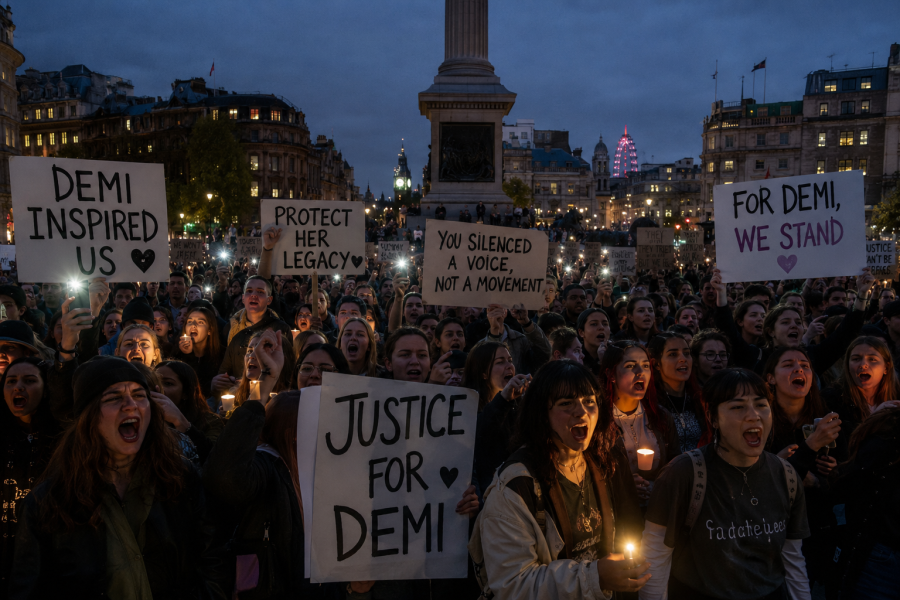
She slid a tablet across the table. Video clips filled the screen: crowds gathering outside universities, candlelight vigils giving way to organized marches, banners already printed and held high.
“These aren’t fan vigils,” she said. “They’re demonstrations—and they’re spreading.”
Footage flickered past—London, Toronto, Sydney, Berlin—different cities, same atmosphere. Anger, not grief. Purpose, not confusion.
“They’re not mourning her,” Patel continued. “They’re reacting to what was taken from them. Look at the messaging,” she added, tapping the screen. “Access. Support. Dignity. They’re framing this in terms of systems, not sentiment.”
Johnson watched in silence as another clip rolled—students locking arms, chanting in unison.
Patel’s voice lowered slightly.
“She wasn’t just a public figure to them. She was proof that someone could step in where institutions had stalled—and make it work. Now that she’s gone, they’re not stepping back. They’re stepping forward.”
Cummings gave a thin smile. “Of course they are,” he said. “He’s talking to them.”
Several heads turned.
Cummings nodded toward the television, where Putin continued speaking. “He’s not addressing governments,” Cummings went on. “He’s addressing the under‑twenties—the generation that lives on livestreams and thinks in viral timelines. If doubt spreads there, it spreads everywhere.”
Putin’s voice drifted through the room again:
“We call for a genuinely international inquiry—transparent and free from political choreography. Only such an investigation can honor the dead and protect the living.”
Javid finally looked up from his tablet.
“If we appear to do nothing,” he said quietly, “markets will read that as loss of sovereign will.” He met Johnson’s eyes. “And capital moves faster than diplomacy.”
A brief silence followed.
Then Wallace spoke—measured, deliberate, each word placed with careful precision as though he were assembling something fragile but consequential in real time, his tone controlled yet weighted with the quiet authority of someone who understood not only the facts before him, but the implications they carried, and who intended, with deliberate restraint, to ensure that every person in the room grasped exactly how serious the situation had become.
“We should be clear about the other side of that equation,” he said, his voice steady but carrying a quiet insistence, as though what followed was not merely a clarification but a necessary correction to the way the room had begun to frame the situation—an acknowledgment that whatever conclusions they were drawing remained incomplete without confronting the implications they had not yet fully allowed themselves to consider. “Any action we take—overt or otherwise—will be read in Moscow as confrontation.”
He let the words land with a deliberate weight, as though he were forcing the room to acknowledge not just the immediate consequences of their decisions but the broader interpretation that would follow, where even the smallest movement—diplomatic, military, or covert—would be scrutinized, reframed, and potentially escalated by a state already primed to see intent where there might once have been ambiguity.
“We are not dealing with a regional actor. We are talking about a nuclear state,” he said, letting the distinction settle with deliberate emphasis, as though forcing everyone in the room to recalibrate their assumptions—because this was no longer a matter of localized instability or deniable proxies, but an engagement, however indirect, with a power whose capabilities, doctrine, and tolerance for escalation existed on an entirely different scale, where miscalculation carried consequences that extended far beyond any single theater.
“But then, what sort of Prime Minister,” Johnson said, his voice tightening just enough to betray the strain beneath the bluster, “would I be if I allowed Russia to murder a young woman who had done more for the cohesion of this country than half the programs we’ve spent a decade announcing,” he added, the words carrying a sharper edge now—not just rhetorical, but personal—“and then stood at that dispatch box pretending it was a matter for quiet inquiry and careful language, as though the public wouldn’t see it for what it was: a failure not of intelligence, but of will.”
No one answered, the silence stretching just long enough to feel deliberate rather than uncertain, but the question no longer hung alone in the room as an isolated challenge; it lingered instead with a growing weight, settling into the shared awareness of everyone present as something that demanded reckoning, even if no one was yet willing to give it voice.
It sat beside another question—unspoken, unacknowledged, yet fully understood by every person in the room—taking shape in the quiet space between them, its implications sharper and more dangerous precisely because no one had dared to articulate it, and because once spoken, it would force a confrontation none of them could easily step back from.
On the screen, Putin concluded a sentence about cooperation, his voice maintaining that same measured, almost judicial cadence as he framed it in the language of mutual interest and shared responsibility, the phrasing careful and deliberate in a way that suggested openness while revealing nothing, leaving the impression not of genuine partnership but of a position already decided, now being presented as something the rest of the world was expected to accept.
Johnson stared at him, saying nothing for a moment, his expression fixed in a way that suggested not indecision but calculation, as though he were weighing not just the words he had heard but the consequences that would follow from accepting them, his silence stretching just long enough to make it clear that whatever response came next would not be casual, nor easily undone.
Then he spoke again, almost conversationally, the shift in tone so subtle it might have been missed if not for the tension already in the room, as though he were deliberately lowering the temperature of the moment even as the substance of what he was about to say carried implications that would only deepen it.
“Fool me once,” he said softly, the words delivered with a quiet, almost reflective calm that stood in contrast to the weight they carried, “shame on me,” the phrase lingering just long enough to suggest that whatever came next would not be shaped by hesitation, but by a memory that had already hardened into resolve.
Several ministers looked up, almost in unison, their attention snapping toward him with a mixture of curiosity and unease, as though the shift in his tone had signaled that something more consequential was about to be said, something that would demand not just acknowledgment but decision.
Johnson’s voice hardened, the easy cadence dropping away as something firmer took its place, the shift subtle in sound but unmistakable in effect, as though the room itself registered that whatever came next would not be open to debate.
“Fool me twice—” he continued, the words trailing just long enough to draw the room’s full attention, his tone no longer light or proverbial but edged with something harder, more deliberate, as though what followed would not be a saying at all, but a warning.
He turned from the television, the movement unhurried but decisive, as though he had already taken what he needed from the broadcast and found nothing more in it worth watching, his attention shifting fully back to the room where the real decisions—immediate, consequential, and far less controlled—were waiting to be made.
“—shame on you,” he finished, the words landing with a quiet finality that carried far more weight than their simplicity suggested, his tone no longer reflective but resolute, as though the phrase had ceased to be a proverb and had instead become a line being drawn—clear, deliberate, and not intended to be crossed again.
The room stilled.
Wallace shifted slightly and looked toward the uniformed naval liaison standing at the back wall.
“The First Sea Lord has prepared operational options,” he said.
The title carried weight.
Tony Radakin had spent months planning maritime responses to precisely this sort of escalation.
Wallace opened the briefing folder.
“Increased Royal Navy patrol presence along the entire African littoral,” Wallace read from the briefing. “Primary Atlantic staging from Ascension Island, with patrol groups pushing south along the West African coast. Secondary logistics at Souda Bay Naval Base in Crete to anchor the Mediterranean approach and maintain watch over the Gibraltar–Suez corridor. Forward maritime support from Naval Support Facility Diego Garcia for sustained operations down the East African seaboard and across the Indian Ocean. For the southern reaches, Admiralty planners recommend extending the network into the South Atlantic—staging detachments from South Georgia and the naval and air facilities at Port Stanley, enabling patrol sweeps across the extreme southern shipping lanes and constant surveillance of vessels rounding the Cape approaches along the coast of Cape Province.”
He turned a page.
“Diplomatic approaches prepared for access at the port of Haifa in Israel, and rotational logistics at Trincomalee Harbour and Bandaranaike International Airport in Sri Lanka.”
Johnson’s head came up. “Which ministries in Colombo have we contacted?”
“They’ve cleared preliminary discussions through the Sri Lanka Ministry of Defence and the Sri Lanka Ministry of Ports and Shipping,” Wallace said. “Foreign Ministry looped in for diplomatic cover. Rotational logistics only—no permanent installation.”
Johnson considered that.
“That sounds exactly like the sort of arrangement they’d prefer,” he said.
On the screen, Putin finished speaking.
A restrained ripple of applause moved through the General Assembly hall.
In Downing Street, no one clapped.
Johnson watched the television for another long moment.
Finally, he spoke.
“He thinks this is Crimea,” the Prime Minister said quietly.
He gestured toward the image on the screen.
“He thinks ambiguity is still a weapon.”
Johnson turned back toward the room.
“It isn’t,” he said.
Not now.
Not when a dead young woman lay on the grasslands of the Maasai Mara.192Please respect copyright.PENANAjeAPChfDda 192Please respect copyright.PENANA7aOeNxIZYl
Not when millions of young Britons were watching the story unfold in real time.
And not when the British state had already learned—once—what happened when hesitation met deniability.
“We proceed,” Johnson said. “Activate Ascension, Souda Bay, South Georgia, Gibraltar, Port Stanley, and Diego Garcia. Begin formal approaches to Israel and Sri Lanka. Increase patrols. Stop and search where the law allows. Let them see how well ambiguity works when the sea itself is watching.”
192Please respect copyright.PENANAOmzcPAEu3w
192Please respect copyright.PENANAyHzReYuNMs
192Please respect copyright.PENANAU0Bm5LVqfw
Friday, 15 March 2019.
Emergency meetings of the Commonwealth were not supposed to feel like this.
Marlborough House had been built for durability—for the long tempo of communiqués, for patient delegations, for the careful afterlife of empire recast as voluntary association. The corridors still carried portraits of men who had administered continents by cable and steamship. Now the same rooms were threaded with encrypted fiber, the doors guarded, the clocks on the wall no longer ceremonial but operational: London, Abuja, Nairobi, Canberra, Ottawa.
Within hours, the Secretariat had ceased to be an office and become a command chamber.
Heads of government were not seated in alphabetical comfort but in lines of sight. The briefing folders were thin and stamped IMMEDIATE. Secure screens stood open for the leaders who could not reach London in time, their delayed audio giving every sentence a faint echo, as though the past itself were buffering.
This was how the modern Commonwealth had always worked in theory—consensus, consultation, equal voices—but never at this speed, and never with the implication that it might become something harder than a network of memory.
Twenty‑one African flags stood among the fifty‑three.
That arithmetic altered the room.
The Secretary‑General, Patricia Scotland, finished the formal invocation of unity and shared values. She had just begun the formulaic transition—“I now open the floor”—when a chair moved.
It was not Britain.
It was South Africa.
Cyril Ramaphosa rose without haste, placing both hands on the polished table as if steadying the institution before he spoke.
“Madam Secretary‑General, Prime Ministers, colleagues,” he said, his voice low, the cadence that of a trade‑union negotiator who had learned patience as a weapon, “Africa will take the floor at the outset, because the death that has brought us here occurred on African soil, and the consequences—economic, military, and political—will move first through African space.”
The translation headsets seemed to settle.
“We are twenty‑one member states in this association,” he continued. “We are its largest regional bloc. Our ports, our air corridors, our extractive infrastructure, our civilian populations in conflict‑adjacent zones—these are no longer technical matters. They are strategic exposure.”
Around the table, pens stopped.
“For our young people,” Ramaphosa said, “the Commonwealth is no longer a historical sentiment. It is a question: can it protect?”
That word—protect—did more to change the atmosphere than any accusation.
Across the room, the British delegation felt, for the first time, the gravitational shift.
Ramaphosa turned slightly toward the smaller flags.
“We are already in receipt of formal inquiries,” he said. “The government of South Sudan has asked what accelerated accession would require under emergency conditions. Zimbabwe has inquired what benchmarks remain for readmission should the Commonwealth assume a security dimension.”
Zimbabwe.
The name opened an old door—the 2003 rupture, the years of suspension, the unfinished reconciliation.
“And others,” he added, “are watching this meeting not as members, but as potential alignments.”
A screen brightened at the far end.
Addis Ababa.
Abiy Ahmed appeared beneath the Ethiopian tricolor, the feed sharp, the lighting almost austere.
“Our country has no colonial history within this association,” he said. “But we host the African Union. We are the diplomatic capital of the continent. If this body is evolving from a historical network into a framework for coordinated stability, Ethiopia requests observer status in these deliberations.”
The shift in the room was physical.
This was no longer about grief.
This was accession politics.
From the Lusophone and Francophone world came quieter signals—Angola, Senegal, Côte d’Ivoire, Morocco, Egypt—represented by observers and senior diplomats who had not expected to speak and now began drafting notes. Their question, not yet voiced, moved through the aides like an electrical current:
Is this still a memory, or is this an alliance?
Ramaphosa spoke once more, not to elaborate but to define the axis.
“This is no longer a matter of legacy,” he said. “It is a matter of function. If the Commonwealth can guarantee maritime security, intelligence coordination, and financial stabilization in the face of state‑level coercion, you will see applications—rapidly, and not only from Africa.”
A pause, continental in its patience.
“And if it cannot,” he finished, “we will pursue those guarantees elsewhere.”
The old building absorbed the sentence in silence.
The portraits along the walls—viceroys, colonial secretaries, governors‑general—seemed suddenly to belong to a different institution, one that had governed territory rather than negotiated alignment.
Outside, Pall Mall traffic moved in its usual rhythm.
Inside, something had crossed a threshold.
What had been founded as an afterlife of empire was being asked, in real time, to become a security architecture.
And Africa had taken the first word.
That realization settled over the British delegation by degrees, like a pressure cooker in a sealed room.
Until that point, they had been operating on the habits of Commonwealth diplomacy—agenda notes, carefully neutral language, the assumption that London would convene and others would respond. But as the interventions from Africa gathered weight, the geometry of the chamber altered. The flags along the table no longer marked old relationships; they marked potential theatres, shipping lanes, voting blocs, basing rights.
In the second row behind the Prime Minister, a Foreign Office adviser stopped annotating the communiqué and began a new page entirely, writing in block capitals: ACCESS / LIFT / RULES OF ENGAGEMENT.
Boris Johnson felt it before he named it. The tone had shifted from condolence to capability. When Ramaphosa spoke of maritime guarantees, when Kenya referenced air‑corridor control, when the inquiries from Juba and Harare were described not as political aspirations but as accelerated accession under emergency conditions, the meeting ceased to be about association and became about alignment.
This is what NATO councils sounded like in the archival recordings just before deployments, he thought—everyone speaking in the language of procedure while quietly committing to force.
Around him, the signals multiplied. The Defense Secretary was no longer listening through his earpiece; he was watching the African leaders directly, calculating distances and port depths. The Cabinet Office liaison slid a note forward that contained no words at all, only a list of locations underlined twice: Ascension – Mombasa – Simon’s Town – Diego Garcia.
At the far end of the table, the Commonwealth Secretary‑General stopped trying to shape a summary, allowing the interventions to stand on their own, as if aware that history was now drafting the communiqué.
Johnson leaned back, the chair creaking softly, and for the first time since the session had opened, he did not prepare a line of response. He understood the new reality with an almost physical clarity: this was no longer a political gathering over which Britain presided; it was a coalition forming in real time, one that would measure London not by its words but by the protection it could extend.
“They’re not asking for statements,” he murmured, just loudly enough for the Defense Secretary beside him to hear. “They’re asking which side of the line we’re on.”
And in the pause that followed—while an African finance minister spoke about currency stabilization mechanisms in the same breath as naval patrol corridors—the British delegation recognized the true nature of the room.
Marlborough House had become, without vote or proclamation, a wartime conference.192Please respect copyright.PENANA8b2xBOBDhd
192Please respect copyright.PENANACDwS8mw6El
192Please respect copyright.PENANAnsf90ZaELc
192Please respect copyright.PENANAojw83YdU81
192Please respect copyright.PENANAPYjNPXsbmr
It happened fast enough that, at first, London read it as coincidence — three separate European reactions to the same shock — and only gradually understood that a continental pattern was forming and that the map point at its center was Africa, the briefings beginning to use a darker historical shorthand, analysts invoking Sarajevo in 1914 and the death of Archduke Franz Ferdinand — the single shot that rearranged alliances and made a world war thinkable.
Paris moved first and did so in a way the British immediately recognized as the reflex of a power that never really left the continent. The crisis cell at the Élysée shifted the incident from a cultural‑diplomatic file to the Africa–security portfolio within hours. The French already had the architecture: forward bases in Djibouti, air assets in N’Djamena, special‑forces rotations through the Sahel, and a naval presence in the Gulf of Guinea. What changed was the legal framing. The operation was no longer counter‑terrorism or stabilization — it became protection of European nationals, air corridors, and maritime trade routes. In French, that was a pre‑war vocabulary.
A communiqué followed — careful, multilateral, European in tone — but the deployments began under existing bilateral defense agreements with African states. That was the tell. France didn't ask whether Africa was the theater; it behaved as if it always was.
Dublin’s shift was quieter but, to London’s surprise, more emotionally charged.
The Irish government didn't speak first about strategy. It spoke about identity.
Within hours of the confirmation of Demi Lovato's slaying, the Irish dimension ceased to be a footnote and became a narrative of its own. Genealogists were on the air before the evening broadcasts, tracing parish records and emigration lines, the graphics glowing in green across studio screens; by nightfall, the phrase “one of our own” had migrated from social media into the language of the national papers. Candles gathered in the damp spring light outside Leinster House, their reflections trembling against the railings as if the city itself were keeping vigil.
Then came Colin Farrell, his voice instantly recognizable to audiences who knew him from films like In Bruges, The Banshees of Inisherin, Minority Report, and The Batman. He appeared first on RTÉ, not as an actor promoting a film but as a private citizen, visibly shaken, saying with a rough, almost embarrassed candor that somewhere back in the lattice of emigrant families and vanished townlands he had discovered they were “seventh cousins, if you go far enough and believe the old women who kept the records in their heads.” He laughed once, softly, and then did not laugh again. Farrell spoke of meeting her in passing years earlier in Los Angeles, of her asking about Ireland with what he called “that particular hunger the diaspora has for a place it hasn’t yet stood in the rain.”
By the next day, he was standing, not on a set, but beneath the chamber lights of the Dáil, invited in an extraordinary suspension of protocol that told its own story about the national mood. The galleries were full; several deputies who had planned to oppose the government’s motion for external deployment were present purely to be seen listening. “I’ve played Ray hiding from his sins in Bruges, Bullseye throwing knives for a white-collar criminal, Alexander trying to conquer half the world, and even the Penguin running Gotham’s underbelly,” he said, his voice rough but steady, “but I’m here because this young woman—Mexican‑American, global, modern in every way we’re told makes identity complicated—carried the same inheritance we do. The same leaving, the same memory of a place that calls you back, whether you’ve stood on it or not. If being Irish means anything in the world, it means we do not abandon our own when they are struck down beyond our shores.”
The phrase that followed was on every front page by the afternoon:192Please respect copyright.PENANAr6ihRLOxVP
“A real daughter of Erin, and the world knew it before we did.”
From that moment, the vigils were no longer only about grief. They became a mandate. The pressure on the government shifted from sympathy to action because the argument had been reframed in a way no policy paper could answer, not alliance, not strategy, but kinship.
Colin Ferrell's words altered the temperature of the chamber. What had been, until that morning, a measured debate about legal authorities and European procedure hardened into something morally declarative, and it was Sinn Féin that moved first, its front bench rising almost in unison to argue that Ireland’s response could not be calibrated in the language of alliance management but had to be framed as an obligation of conscience to “one of our own in the wider world,” the actor’s testimony having turned genealogy into a political fact. Ireland could not project power in the French sense; it could do three things that mattered enormously in a European crisis: invoke EU mutual‑assistance mechanisms, open its airspace and ports to coalition movement, and commit its highly regarded peacekeeping and special operations units to an African security mandate. And because Irish troops had served for decades in UN missions across Africa, the justification was ready‑made: the protection of UN‑linked personnel, the stabilization of a partner region, and the defense of international law. That's why the Irish mobilization was framed not as war—never as war—but as an emergency reinforcement of UN and EU security structures in Africa. That was when London understood the scale.
France moved through its African command network.
Ireland moved through the UN and the EU.
Britain moved through the Commonwealth and maritime control.
Three different historical relationships with Africa.
Three different legal justifications.
One converging theatre.
And the realization in Whitehall was cold and precise: It was no longer a reaction to an assassination. It was the European powers re‑entering Africa under the language of protection, alignment, and justice — and doing so not in parallel, but in coordination.
Which meant the conflict was not spreading outward from Europe. It was formed where the event happened. In Africa, where air corridors, rare‑earth routes, naval choke points, UN missions, Chinese infrastructure, Russian contractors, and Commonwealth logistics all overlapped.
Most likely there.
And everyone knew it.192Please respect copyright.PENANABcBbfuE21J
192Please respect copyright.PENANA93WKWMNivD
192Please respect copyright.PENANAQgQaeqVeyC
192Please respect copyright.PENANANrlIbyyHgE
192Please respect copyright.PENANA3Dyuts6avx
The shock radiated outward unevenly, each capital translating it into its own strategic language.
In Berlin, Chancellor Olaf Scholz resisted every attempt—domestic and foreign—to describe what was happening as a march to war. The emergency session of the Bundestag produced a doctrine of Rahmenfähigkeit—framework capability. Transport aircraft were reassigned to long‑range lift, satellite time was pooled with British and European partners, and the Bundeswehr’s medical and engineering commands were placed on twenty‑four‑hour readiness. “Germany will not move first in anger,” Foreign Minister Annalena Baerbock told a late‑night press scrum in Brussels, “but we will ensure that when Europe moves, it can move lawfully.” At the United Nations, the German mission began drafting texts before there was even agreement on what those texts should say. It was mobilization through procedure, the construction of a legal architecture that could carry force without ever appearing to demand it.
Warsaw moved at a different speed entirely. Prime Minister Donald Tusk, flanked by President Andrzej Duda, treated the African crisis as confirmation of a European one. Reserve formations were quietly called up, rail corridors recalculated for military transit, and Polish diplomats pressed NATO for expanded readiness language. “You still think this is about geography,” a Polish security adviser remarked to a German counterpart in a corridor meeting. “We think it is about sequence.” In the Baltic capitals, the response was sharper still: cyber‑defense protocols were activated in Tallinn, air‑policing rotations extended over Riga and Vilnius, and civil‑defense messaging pushed to populations that required no explanation. For them, the map’s center of gravity was not Africa but Moscow.
In Budapest, Prime Minister Viktor Orbán slowed everything he could slow. Hungarian representatives in Brussels insisted on the words de‑escalation and dialogue in every draft communiqué, threatening vetoes that forced night‑long renegotiations. Publicly, he spoke of protecting Hungarian energy security; privately, his diplomats warned that Europe was allowing a cultural shock to become a military one.
Rome translated the crisis into maritime terms. Prime Minister Giorgia Meloni authorized an expanded naval presence in the central Mediterranean, officially for migration control and infrastructure protection. The Italian admiralty spoke in charts: sea‑lane vulnerability, LNG routes, the geometry of ports. “Italy will secure the middle sea,” Defense Minister Guido Crosetto told parliament, “because every other conversation depends on it.”
In Madrid, Prime Minister Pedro Sánchez insisted on alliance legitimacy at every step. Spanish participation moved through NATO planning cells and UN liaison offices, never through bilateral channels. The Spanish permanent mission in New York became a drafting engine for humanitarian mandates and stabilization language. A senior diplomat, asked why Spain was moving so carefully, replied: “Because process is sovereignty by other means.”
Neutral Europe became suddenly essential. Vienna and Bern were filled with delegations that could not meet anywhere else. Austrian and Swiss diplomats carried identical slim folders from hotel suite to hotel suite, each containing proposed formulas for investigations, cease‑fires, monitoring missions—documents that might never be signed but that kept lines of communication open.
Across Asia, the tone cooled.
In Tokyo, Prime Minister Fumio Kishida approved maritime intelligence sharing, fuel logistics, and a financial package for African stabilization, all phrased within the familiar limits of Japan’s constitutional order. “The security of distant sea lanes is the security of Japan,” he said in the Diet, linking the crisis not to Europe but to energy flow.
New Delhi chose the older vocabulary of non‑alignment. Prime Minister Narendra Modi offered evacuation support for foreign nationals, field hospitals, and mediation. “India speaks to all sides,” External Affairs Minister Subrahmanyam Jaishankar said, a line repeated so often it became a signal in itself. Indian diplomats appeared in every capital and committed to none.
Beijing moved with the calm of a power that had assets on the ground and time on its side. President Xi Jinping called for an “independent international investigation,” while Chinese naval deployments around East African commercial ports were described as routine security rotations. At the United Nations, Ambassador Zhang Jun warned against “the transformation of a criminal act into geopolitical confrontation.” Behind the language, Chinese envoys worked with the African Union and the Gulf states, building a blocking coalition against any Western‑defined mandate.
Ankara saw an opportunity. President Recep Tayyip Erdoğan, already deeply embedded in African defense partnerships, offered drones, training missions, and talks. “Turkey speaks with everyone,” he announced, positioning himself as the indispensable intermediary between Europe’s urgency and Africa’s sovereignty.
In Latin America, alignment became a referendum on global identity.
Brasília, under President Luiz Inácio Lula da Silva, convened an emergency summit with South Africa and India and proposed a Global South stabilization initiative. “We will not return to a world where the North intervenes, and the South absorbs,” he declared, while Brazilian officers quietly studied UN command structures for a possible multinational force that would not be Western‑led.
Mexico City, led by President Claudia Sheinbaum, returned to the language of the Estrada Doctrine—condolences, humanitarian aid, absolute non‑intervention. The cultural connection that filled the streets did not cross into security policy. “Mexico does not send troops for symbolism,” a senior official said flatly.
In Buenos Aires, President Javier Milei offered political backing to the European position and forensic assistance—investigators, legal teams, intelligence analysts—framing Argentina as a contributor of expertise rather than force.
Santiago, under President Gabriel Boric, pushed relentlessly for an international legal mechanism: a war‑crimes monitoring body that would turn the crisis into a test case for global justice rather than military alignment.
By the end of the first week, diplomats began to describe the pattern in technical briefings. There were operational states, framework states, mediation states, and neutrality hubs. Air corridors were being negotiated over countries that had not issued public statements. Port access was granted in memoranda that never used the word military. Intelligence flowed through five‑nation channels that officially did not exist.
“It’s not blocs,” a weary EU official insisted during a background briefing in Brussels.
“It is,” his Polish counterpart replied quietly. “You just build yours with footnotes.”
And everywhere—Berlin, Warsaw, Tokyo, Brasília, Ankara, New Delhi, Beijing—the same private conclusion took hold. The event that had begun as an isolated shock was now reorganizing the behavior of nations. Some were moving forces, some were drafting law, some were offering mediation, some were perfecting the language of neutrality. But all of them were repositioning themselves around the same distant center of gravity in Africa, calculating not only what they would do, but what kind of world would exist when the movement stopped.192Please respect copyright.PENANARLe0VjLlug
192Please respect copyright.PENANAuYVfomtJaa
192Please respect copyright.PENANAJwhTylEari
192Please respect copyright.PENANAJrdfaMKANv
192Please respect copyright.PENANAqxXRZwPNXu
The transition from crisis to pre‑war condition was not marked by ultimatums but by production curves. Research establishments that had spent a decade demonstrating single‑shot feasibility were ordered to calculate monthly output. Procurement law was rewritten under emergency clauses from Washington to Warsaw, from Beijing to Ankara, and the decisive metric ceased to be innovation and became deliverability. Parliamentary oversight committees were briefed in the vocabulary of infrastructure protection and industrial resilience, yet annexes described hardened assembly plants, dispersed microelectronics fabrication, and the reopening of strategic metals reserves. What had been experimental became programmatic.
Directed‑energy systems moved first because they required the least doctrinal explanation. Anglo‑German high‑energy laser projects, previously justified as counter‑drone defenses, shifted from static range testing to mobile integration on expeditionary transport platforms, their power modules redesigned for continuous firing cycles rather than laboratory bursts. In the United States, budget lines for “counter‑swarm saturation” concealed the fielding of containerized laser batteries with independent targeting queues and networking capacity. Chinese deployments along East African commercial corridors were formally categorized as infrastructure‑protection units. But their thermal‑management architecture and beam‑control assemblies revealed endurance and tracking capabilities far beyond civilian requirements. The technology remained legally defensive while its operational geometry expanded into offensive space.
Electromagnetic launch and rail systems re‑entered planning documents under the argument of treaty‑compliant long‑range strike. Kinetic projectiles, deprived of explosive payloads, avoided classification under existing missile regimes while achieving comparable terminal effects through velocity alone. Maritime powers funded electromagnetic launch for carrier aviation and, in parallel, for shore‑based artillery capable of reaching hypersonic speeds without rocket signatures. Russia’s Arctic test footage, India’s coastal batteries, and Turkey’s truck‑mounted prototypes all pointed to the same objective: a strike system that was strategically decisive yet diplomatically deniable. The legal architecture of arms control lagged behind the physics of acceleration.
Armored warfare underwent a conceptual reversion to mass and endurance. Franco‑German future combat platforms re‑centered on crew survival inside isolated capsules, autonomous reconnaissance swarms, and active protection envelopes capable of defeating top‑attack munitions in dense urban terrain. Polish and Korean production emphasized logistical longevity—engine hours between overhaul, modular armor replacement, and battlefield manufacturing of spare components. Russian urban‑assault variants integrated thermobaric support and remote weapons stations for sustained operations. These vehicles ceased to be instruments of maneuver and became mobile fortifications: networked strongpoints able to hold ground under continuous surveillance and precision attack. The tank returned not as a spearhead but as a node.
Nuclear signaling advanced through procedure rather than declaration. Storage facilities were modernized, dual‑capable aircraft rotated forward under the label of training, and civil‑defense publications were quietly reissued in updated digital form. Consultation mechanisms within nuclear alliances shifted from periodic to permanent sessions. Early‑warning radars in both Europe and Asia adopted continuous high‑readiness cycles, compressing decision times and normalizing launch‑sequence rehearsals. No new warhead was announced; instead, the tempo of readiness itself became the message. Intelligence services measured the change in maintenance schedules, convoy frequencies, and encrypted command traffic.
Radiological denial capabilities appeared only in the negative space of preparation. Specialized units trained for contaminated‑zone maneuver, rapid emplacement of mobile shielding, and long‑duration exclusion perimeters in major urban grids. Emergency‑management agencies stockpiled decontamination polymers and autonomous construction equipment designed to seal transit corridors. The implication was strategic rather than tactical: the capacity to render critical infrastructure unusable without physically destroying it. The objective was the weaponization of absence—territory that existed but could not be entered.
Naval doctrine extended inland through amphibious heavy platforms and hover‑logistical fleets able to traverse littoral shallows, river deltas, and seasonal floodplains without port infrastructure. Chinese and Turkish designs combined armored protection, vertical‑launch cells, and drone command facilities on hulls capable of transitioning from sea to river systems. Brazilian modular craft for the Amazon basin demonstrated the same dual‑use principle: disaster‑relief configuration in public documentation, distributed force‑projection capability in military analysis. Strategic geography was redefined as continuous between the ocean and the interior.
The financial record provided the most unambiguous evidence. Emergency appropriations were distributed through ministries of industry and energy rather than defense; funding rare‑earth processing, satellite‑redundancy constellations, synthetic‑fuel plants, and protected transport corridors. Ammunition production, measured in years of consumption rather than months, returned to levels not seen since the mid‑twentieth century. Training cycles across alliances synchronized into common operational calendars, creating interoperability in time as well as in equipment. The distinction between civilian and military industry eroded into a single mobilization base.
What emerged was not an accumulation of weapons but a transformation of the international system into a condition of sustained readiness. Prototypes disappeared; serial numbers multiplied. The decisive threshold was crossed not when a state demonstrated a new technology, but when it ordered that technology in quantities sufficient to outlast diplomacy. In the bitter arithmetic of mobilization, the death of a woman who had once stood before cameras and crowds to denounce the culture of gun violence in her own country became the catalytic myth of an age that answered her with weapons beyond the scale of her darkest warnings—systems designed not merely to kill but to paralyze cities, contaminate landscapes, and sever the human body from its own nervous command. At that point, the arms race ceased to be a competition of arsenals and became a competition of endurance. And the world understood—without any formal declaration—that the machinery required for a long war had already begun to turn.


 and then Add to home screen.