
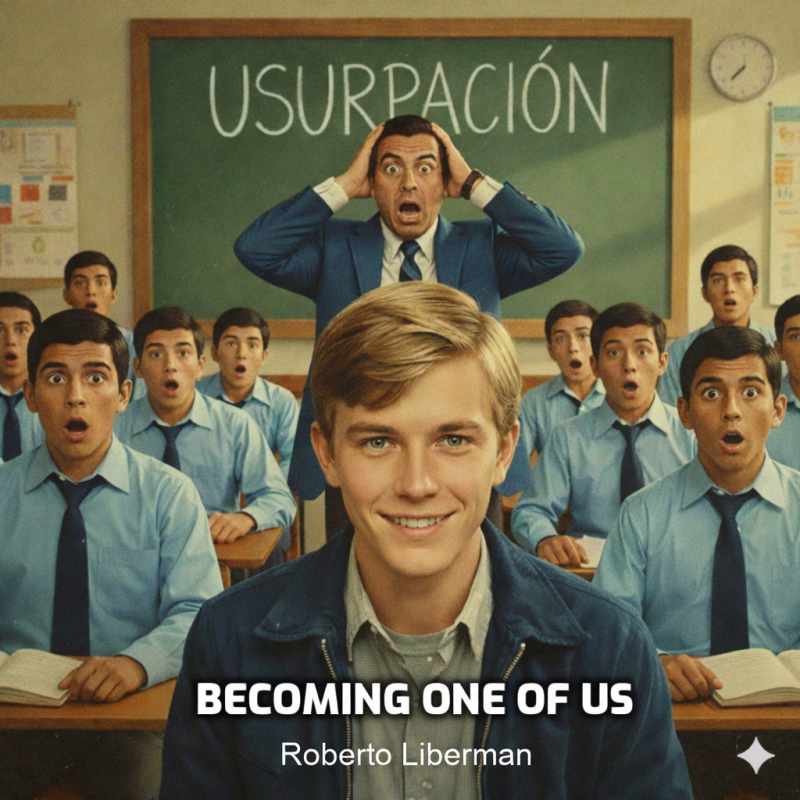
In Santiago, we didn’t have buddies. We had compadres. We had huevones.
Friendships were forged in dusty schoolyards, on cracked sidewalks, and inside classrooms that smelled of chalk, sweat, and damp jackets. Americans existed only in movies, in embassies, in some parallel universe entirely detached from ours.89Please respect copyright.PENANAEsVordUlSV
Until that March, when one walked into our classroom. His name was Dustin.89Please respect copyright.PENANAdAPZROSBgl
Tall, gangly, pale — but with a surprising build — he carried himself like someone who had already decided he didn’t care what a bunch of high school kids thought.89Please respect copyright.PENANAh4f4KSHXIN
He introduced himself in spectacularly bad Spanish: tangled conjugations, invented words, impossible phrasing. Yet he delivered it all with such conviction that it stirred laughter, affection, and pity all at once.89Please respect copyright.PENANA3TiIxn94Ek
Our teacher explained that his father worked at the American embassy. And that was the key.89Please respect copyright.PENANAJz0btajNT9
He wasn’t any big boss or diplomat; he was just a security guard brought over from the States. The kids of high-ranking officials went straight to places like Nido de Águilas or Saint George’s — the fancy schools where English ruled and Spanish was just decoration.89Please respect copyright.PENANApOCE5REJRP
But Dustin — the son of a mere security gringo — was dropped right into the Instituto Nacional, among us: a pack of kids who laughed at everything and everyone.
At first, we figured he wouldn’t last a week.89Please respect copyright.PENANADjXnwLu20c
He didn’t know our slang, didn’t get our jokes, and had no idea the word huevón could mean fifty different things depending on tone and mood.89Please respect copyright.PENANAYqp6KdL0j1
But he had something else.89Please respect copyright.PENANAGpReAN1Ehm
A stubborn streak. Almost admirable.89Please respect copyright.PENANAVRnqVRRjmE
He listened more than he spoke. And when he did speak, he threw himself into every word, as if each one were a tiny Olympic victory — a tiny act of courage, a testament to his determination.89Please respect copyright.PENANAOXoGRz2Kvj
It was that relentless effort, that fearless willingness to fail publicly, that made Francisco Olivares — our class clown and natural leader — take him under his wing.
89Please respect copyright.PENANAerN2GDiOMJ
The First Humiliation
Their first real lesson didn’t come from a textbook. It came from the dangerous confusion between pride and desire.89Please respect copyright.PENANAtme8S6CpN3
One day, Dustin tried to tell the class how excited he was about an upcoming soccer match with the boys from Saint George’s.89Please respect copyright.PENANAzZ0JuHD6Hm
He stood up, chest out, beaming with pride, and announced in Spanish:
— “Estaré súper excitado con los muchachos del Saint George’s, jugando muy divertido con ellos este sábado.”
At first, we just blinked. Then it hit us. Excitado? In Chile — and much of South America — that doesn’t mean excited. It means… turned on. Completely.
So in our minds, Dustin had just said:
— I will be turned on with the boys from Saint George’s, playing very fun with them this Saturday.
There was a beat of silence so thick you could cut it with a knife. Then the classroom exploded. Laughter slammed against the walls, desks shook, notebooks tumbled to the floor.
Dustin froze, eyes wide, not understanding what he’d said wrong. Francisco, still doubled over with laughter, leaned in and whispered almost in his ear:
— Gringo… excitado is for girls, especially the cute ones. You meant entusiasmado, man — “looking forward.” That’s soccer talk.
From that day on, Dustin learned to fear innocent-looking words. And through those humiliations, he learned faster than anyone expected. Every stumble became a lesson. Every mistake, a scar and a medal all at once.
By the time winter arrived, something incredible had already started to unfold: his Spanish was flowing too fast for its own good.
89Please respect copyright.PENANAYCACHGel4t
History Class: A Minefield
Like a river breaking through a dam — wild, violent, full of rocks, but alive — the mistakes came flying out, but he no longer hid. He attacked the language like an unarmed soldier, running forward on pure nerve.
That was when Professor Silva — a man who had traded his old revolutionary fire for a shaky loyalty to the ruling Junta — assigned the presentation. This wasn’t homework. It was a minefield. The topic: The “Military Pronouncement” of September 11.
“I want eloquence,” Silva said, rigid and solemn.89Please respect copyright.PENANAfYLZjPNCz1
“Respect. Gratitude to His Excellency, to the Armed Forces… and don’t forget the Navy, or you fail. On the spot.”
When Dustin’s turn came, nobody expected greatness. Survival was the goal.89Please respect copyright.PENANAM3yUjDGq56
He stood up, took a breath, and started. His accent was pure gringo, his sentences twisted — but the seriousness in his voice surprised us.89Please respect copyright.PENANAgcu0Ju2tdd
Until he hit the word:
— “The… the… Military Usurpation…”
Silence. He tried to fix it:
— “The noble Military Usurpation of September Eleventh…”
The air thickened. Desks seemed louder. Breathing felt dangerous.
From the back, Francisco’s voice cut through, low and deadly calm:
— You’re dead, compadre… they’re sending you straight to Inspector General Ramiro Calderón… or worse.
All the color drained from Dustin’s face. He froze. Looked at Silva — who was whiter than he was. Then, in English, shaking but solid, he dropped the bomb:
— I’m an American citizen. My father works for the U.S. Embassy. I have diplomatic protection. I’m not going to any detention camp.
Silva didn’t understand a word.
— What… what did he say?
Francisco translated, simple and brutal:
— He says he’s American… and he’s not letting you send him to any detention center.
This silence was worse. Silva swallowed hard and painted on a smile that looked like chalk.
— Dustin… no one is sending you anywhere, son. This is just a small language problem. You’re a good boy. You’re just confused with the terms. That’s all.
He waved him off.
— Go sit down. Presentation over.
Dustin walked back to his desk in silence. Not pale. Not shaking. Just quiet. Before sitting, he raised his hand:
— Professor… what grade do I go back to my seat with? I worked hard preparing my dissertation.
Silva stared at him too long. Then, trembling:
— Young man… you return to your seat… with a six.
The whole room stopped breathing. Silva never gave sixes. A seven was for God. A six was for teachers. Everything else was for students. Dustin didn’t fully understand what had just happened. But we did.
After that day in History class — when Dustin learned that a single word could be more dangerous than a misplayed ball — he began to understand something deeper: surviving the Instituto Nacional wasn’t just about avoiding trouble. The real test of belonging lay ahead, not before a teacher, but on a field where every eye was watching.
89Please respect copyright.PENANAhzsKdsM1ZJ
The Match: Background and Pressure
Instituto Nacional had scheduled a match against Saint George’s. This was no ordinary game. There was diplomatic pressure behind it. Social pressure. Invisible pressure. The U.S. ambassador’s son played for Saint George’s, and the Embassy had made a personal request to the rector of the Instituto Nacional.
That meant Dustin would have to play. Dustin was a natural athlete — faster, stronger, more agile than any of us. But he had never played soccer. Our coach, Profe Fuensalida, knew putting him on the team was suicide. But orders were orders.
89Please respect copyright.PENANAcQLPBdfsbU
Clash of Worlds
This was the place where the story of Dustin being “one of us” would be tested — the field.89Please respect copyright.PENANAOISuFU2jtw
Saint George’s boys were wealthy, polished, perfect in Spanish, flawless in English.89Please respect copyright.PENANAWiY8ThWmOm
For the Instituto Nacional, this wasn’t just soccer. It was a class war.89Please respect copyright.PENANAivG8lCq7Kt
Dustin had no idea. To him, it was just a game. His first game.
89Please respect copyright.PENANAwT31OJXJHT
Disaster on the Field
The tension on match day was palpable. Parents, teachers, and two suit-wearing Embassy men followed every movement. Dustin was center-back, receiving clear instructions from Coach Fuensalida:
— Stay put. Don’t move. If the ball comes to you, give it to Francisco. Got it? Stay still!
For ten minutes, he obeyed. He looked like a tall, pale statue in the middle of the defense. Our best defensive play: the immobility of the gringo.
Then, in the twelfth minute, the inevitable happened. A low cross deflected. The ball rolled straight to Dustin’s feet. Francisco shouted:
— Leave it! Get it out!
Dustin, recalling a World Cup highlight he had seen on TV, tried a blind heel clearance. The ball didn’t go wide. It bounced. Spun. Crossed our own area. An easy goal. Goal for Saint George’s.
89Please respect copyright.PENANAMMCxiidXzn
The Turning Point
Silence. Then a roar — a mix of laughter and despair. Dustin froze, hands on his head, face white as chalk. He looked at Fuensalida, on the verge of collapse. At the Embassy men, scribbling.
Then something clicked. Francisco ran up, smacked him on the back of the head, and shouted:
— Shut up and run! Now we have to score two because of you! That’s how it’s done, gringo!
It wasn’t forgiveness. It was inclusion. He was now fully part of us. One of the team. Dustin laughed — nervous, loud — and kept running. He was no longer a political symbol. He was simply one of us. A guy who had messed up with his friends.
89Please respect copyright.PENANAIaxYl1npNm
Final Score
Saint George’s won 1–0. But the result didn’t matter. For Dustin, that match wasn’t about winning or losing. It was about belonging.
89Please respect copyright.PENANAnEiy1SHv8B
Epilogue — Beyond the Score
The year came to a close, and just as suddenly as he arrived, Dustin was gone. His father’s rotation at the Embassy ended, and with it, Dustin disappeared, taken back into the universe of diplomats and movies from which he had come.
We never saw him again. And truth be told, I don’t remember his face very clearly anymore — the pallor, the height, the awkward American confidence. Those details have faded like old chalk on a blackboard.
But one thing stayed with me: He was no longer the gringo in Room 32. He was, simply, one of us.
I remember the sound of his Spanish. Fast. Ugly. Alive.89Please respect copyright.PENANAhncsmYXIlj
He cursed correctly. He knew when cállate, huevón was an insult — and when it was affection.
I remember the way he closed his eyes before attacking the verbs that scared him most, running across the field, kicking air in perfect, terrible style, already finding his place without anyone showing him how.
I learned something with Dustin that no book ever teaches: the only way to truly belong is to risk everything, to fail loudly, to laugh at yourself while you do it — to persist when the world seems ready to knock you down.
Sometimes, when I think back, I don’t see a clumsy foreigner who got a lucky six. I see a friend who taught us something simple and brutal: the hardest way to belong is the only way. Persist. Laugh. Have the courage to fail out loud.
When we said goodbye that December, he didn’t hug us like a tourist. He hugged us like a Chilean — direct, strong, and genuine. And in that instant, I understood.
That was his victory. And I saw it.89Please respect copyright.PENANArtYb5HMJ2V
In the schoolyard.89Please respect copyright.PENANA4rBgnNwzym
In the corridors.89Please respect copyright.PENANA3B5pYYZgpV
During practice.89Please respect copyright.PENANAonx5PWnWs1
In the hallways.89Please respect copyright.PENANA94xPqSquaD
In the small gestures of his classmates.89Please respect copyright.PENANAHEtFaLDbB3
And finally, out on the field, breathing the same air, moving with the same effort, learning what it truly meant to be one of us.
89Please respect copyright.PENANAof9G5zXrRQ
Hasta Ser Uno de Nosotros (Original Spanish Version)
En Santiago no teníamos “amigos”. Teníamos compadres. Teníamos huevones.89Please respect copyright.PENANA09454SHhwr
Las amistades se forjaban en patios polvorientos, en veredas agrietadas y en aulas que olían a tiza, sudor y chaquetas húmedas. Los gringos existían solo en películas, en embajadas o en algún universo totalmente ajeno a nuestras vidas.89Please respect copyright.PENANArd794uvPSc
Hasta que, un marzo cualquiera, uno entró en nuestra sala. Se llamaba Dustin.
Alto, larguirucho, pálido —pero sorprendentemente fornido— se movía como alguien que ya había decidido que no le importaba lo que pensara un grupo de chiquillos de colegio.89Please respect copyright.PENANAahxg5VEAd3
Se presentó con un español desastroso: conjugaciones rotas, palabras inventadas, frases imposibles. Aun así, lo decía todo con tal seguridad que provocaba risa, ternura y compasión al mismo tiempo.89Please respect copyright.PENANABeX29OrSno
El profesor explicó que su padre trabajaba en la embajada americana. Y ahí estaba la clave.89Please respect copyright.PENANA94pbUaQwE7
No era diplomático. No era jefe. No era nadie importante. Era un simple guardia de seguridad traído desde Estados Unidos.
Los hijos de los altos funcionarios de la embajada iban directamente al Nido de Águilas o Saint George’s, donde el inglés era ley y el español solo un adorno.89Please respect copyright.PENANAdpqiUKBKHu
Pero Dustin —hijo de un simple guardia gavacho— cayó directo al Instituto Nacional, entre nosotros: una jauría de cabros que se reía de todo… y de todos.
Al principio, apostamos que no duraría ni una semana. No entendía nuestro slang. No captaba nuestros chistes. No sabía que “huevón” podía significar cincuenta cosas distintas según el tono, la cara y el contexto.89Please respect copyright.PENANABATWTSeaQ8
Pero tenía algo más: valentía. De esa fea. De esa admirable.89Please respect copyright.PENANAiGyNhQaVF8
Escuchaba más de lo que hablaba. Y cuando hablaba, se esforzaba con una intensidad casi heroica, como si cada palabra dicha correctamente fuera un pequeño gol olímpico —un acto diminuto de coraje, una prueba de su arrojo.89Please respect copyright.PENANA56P4QUeDd0
Fue ese esfuerzo implacable, esa valentía para equivocarse en público, lo que hizo que Francisco Olivares —nuestro bufón oficial y líder natural— lo tomara bajo su protección.
89Please respect copyright.PENANAP2Y8KkYoXC
La primera humillación
El aprendizaje no vino de los libros. Vino del deseo. Y del orgullo.89Please respect copyright.PENANAA8bgZoM90z
Un día, Dustin quiso decir que estaba muy entusiasmado por un partido contra los muchachos de Saint George’s, donde él también jugaría. Se paró al frente, pecho inflado y sonrisa orgullosa, y anunció:
— “Estaré súper excitado con los muchachos del Saint George’s, jugando muy divertido con ellos próximo sábado.”
Hubo un segundo de silencio tan pesado que se podía cortar con cuchillo. Después, la sala estalló. Las carcajadas golpearon las paredes, los pupitres temblaron, los cuadernos volaron.89Please respect copyright.PENANA0MU7Gl4NA5
Dustin quedó congelado, sin entender qué había dicho mal, hasta que Francisco, todavía muerto de risa, le explicó casi al oído:
— “Gringo… excitado solo con las muchachas, especialmente con las bonitas. ‘Entusiasmado’ —eso sí te creo cuando hablas de un ‘partido de fútbol’ que ya se nos viene encima.”
Desde ese día, entendió que algunas palabras no se podían usar a la ligera. Cada error se convirtió en una lección. Cada tropiezo, en una cicatriz y una medalla al mismo tiempo.89Please respect copyright.PENANAa5QWGX3lWI
Para cuando llegó el invierno, su español ya no caminaba: corría. Como un río rompiendo una represa: feo, sucio, violento… pero vivo. Ya no se escondía. Ya no pedía permiso. Atacaba las palabras como un soldado desarmado, con puro coraje.
89Please respect copyright.PENANAyJf7NO2Lbc
La clase de Historia: el campo minado
Ahí fue cuando el profesor Silva —el mismo que dos años antes coqueteaba con la izquierda y ahora marchaba derechito con la Junta— encargó una disertación obligatoria.89Please respect copyright.PENANAscLTSeJAqV
No era una simple tarea; era un campo minado: hablar sobre el Pronunciamiento Militar del 11 de septiembre.
— Quiero trabajos elocuentes —dijo Silva, rígido y solemne—. Con respeto. Con gratitud a Su Excelencia, a las Fuerzas Armadas… y no se les vaya a olvidar elogiar a la Marina, o los repruebo ahí mismo.
Cuando le tocó el turno a Dustin, nadie esperaba nada especial. Bastaba con que sobreviviera.89Please respect copyright.PENANANRUn6VSCd0
Se puso de pie, respiró hondo y comenzó. Hablaba con acento gringo, con frases torcidas, pero con una seriedad que nos dejó en silencio.89Please respect copyright.PENANAQoxiV2tn1u
Hasta que llegó a la palabra clave:
— El… el… Usurpamiento Militar…
Silencio total. Repitió, intentando arreglarlo:
— El noble Usurpamiento Militar del once de septiembre…
El aire se volvió espeso. Desde el fondo, se escuchó la voz de Francisco, baja pero clara:
— La cagaste, compadre… te van a mandar derechito donde el Inspector General… o peor.
A Dustin se le fue el color de la cara. Se quedó rígido. Miró al maestro Silva, que estaba listo para desmayarse.89Please respect copyright.PENANAAfwoU8W9jL
Y entonces, en inglés, con voz temblorosa pero firme, lanzó la bomba:
— I’m an American citizen. My father works for the U.S. Embassy. I have diplomatic protection. I’m not going to any detention camp.
Silva no entendió ni una palabra.
— ¿Qué… qué dijo? —balbuceó.
Francisco, siempre útil en el caos, tradujo:
— Dice que es ciudadano americano y que no se va a dejar mandar a ningún centro de detención.
El silencio fue peor. Silva tragó saliva y se forzó una sonrisa tensa y fingida.
— Dustin… nadie te va a mandar a ninguna parte, hijo. Esto es solo un pequeño problema de lenguaje. Eres un buen muchacho. Solo te confundes con las palabras. Nada más.89Please respect copyright.PENANAmX8XiMeqlp
Hizo un gesto con la mano:
— Ahora, vuelve a tu asiento. Gracias. Disertación terminada.
Dustin regresó a su banco en silencio, pálido, pero no derrotado. Antes de sentarse, levantó la mano:
— Profesor… mucho trabajado preparando mi dissertation. ¿Con qué nota vuelvo a mi puesto?
Silva lo miró fijamente, con voz temblorosa, y respondió:
— Vuelves… con un seis.
La sala entera dejó de respirar. Silva nunca ponía seis. El siete era para Dios. El seis, para los maestros. Todo lo demás, para los alumnos. Dustin no entendió del todo lo que había pasado. Pero nosotros sí.
Después de aquel día en la clase de Historia —cuando aprendió que las palabras podían ser tan o más peligrosas que balones mal pateados— Dustin empezó a entender que sobrevivir en el Instituto Nacional no era solo cuestión de gramática. La verdadera prueba de pertenencia estaba por llegar, y no sería frente a un profesor, sino en una cancha bajo el peso de todas las miradas.
89Please respect copyright.PENANAtoVb3CYXoH
El partido: historia y presión
El Instituto Nacional había programado un partido contra Saint George’s. No era un partido. Era diplomacia disfrazada. Todos lo sabían, aunque nadie lo dijera. El hijo del embajador jugaba ahí. La Embajada había pedido el partido. El rector había obedecido.
Y eso significaba una cosa: Dustin tenía que jugar. Y Dustin, aunque era una bestia física, no sabía jugar fútbol. El entrenador Fuensalida quiso morirse. Pero órdenes son órdenes.
89Please respect copyright.PENANA8GZDCsiItW
Choque de mundos
La historia de que Dustin era “uno de nosotros” se pondría a prueba justo donde más dolía: la cancha. Saint George’s no era un equipo. Era una clase social. Cabros limpios. Cuellos blancos. Español perfecto. Inglés de película.
Para nosotros no era fútbol. Era guerra de clases. Dustin no tenía idea. Para él era solo su primer partido.
89Please respect copyright.PENANADEExyUQiXQ
El desastre en la cancha
El día del partido, la tensión era palpable. Cancha llena. Profes. Apoderados. Y dos agentes de la Embajada mirando. Dustin estaba de defensor central, con instrucciones claras del entrenador Fuensalida:
— ¡Quédate quieto, gringo! ¡No te muevas! Si el balón te llega, se lo lanzas a Francisco. ¿Entendiste? ¡Plantado ahí!
Durante los primeros diez minutos, Dustin obedeció. Una estatua alta y pálida en medio de la defensa. Nuestra mejor jugada: que no se moviera.
Pero en el minuto doce, ocurrió lo inevitable. Saint George’s lanzó un centro que se desvió y la pelota cayó directamente a los pies de Dustin. Francisco gritó:
— ¡Dale, huevón! ¡Sácala lejos!
Dustin, recordando una jugada del Mundial que había visto en la tele, intentó un taco ciego. La pelota no salió al lateral: rebotó, giró y cruzó nuestra propia área. Gol fácil para Saint George’s.
89Please respect copyright.PENANAEHZePAsr66
El giro: aceptación
El silencio duró un segundo. Después, el estadio explotó: mezcla de burlas, rabia y risa. Dustin se quedó quieto, manos en la cabeza, rostro blanco como tiza. Miró al entrenador Fuensalida, al borde del colapso. Miró a los hombres de la Embajada, tomando nota.
Entonces algo cambió. Francisco, capitán y mejor jugador del equipo, corrió hacia Dustin, le dio una palmada fuerte en el hombro y gritó:
— ¡Cállate y corre, huevón! ¡Ahora tenemos que meter dos por tu culpa! ¡Así se juega, gringo!
No fue perdón. Fue adopción. Dustin se rió —nervioso y ruidoso— y siguió corriendo. Y en ese momento dejó de ser una visita política. Era simplemente uno de nosotros. Un huevón más del equipo.
89Please respect copyright.PENANAIC5loatIbi
Marcador final
Saint George’s ganó 1–0. Pero ese partido no fue de goles. Fue de pertenencia.
89Please respect copyright.PENANABVY68uQE20
Epílogo — Más allá del marcador
El año llegó a su fin, y Dustin se fue. Con la partida de su padre, desapareció también de la Sala 32, de los pasillos del colegio, de nuestras vidas y risas compartidas.
No hubo despedidas largas ni grandes palabras; apenas un “¡Chao, compadre!” con una broma a medio inventar, que parecía más un ritual que un adiós.
Para cuando partió, ya había dejado de ser el gringo, el extranjero torpe de los primeros días. Ya era uno de los nuestros, aunque fuese solo por unos meses.
Rápido. Feo. Vivo. A veces torpe, otras seguro. Lleno de energía y de fallos que hablaban más que cualquier corrección académica.
Lo recuerdo cerrando los ojos antes de atacar un verbo imposible, corriendo detrás de nada, pateando aire, pero encontrando su lugar sin que nadie se lo mostrara.
Aprendí con Dustin una lección que no se enseña en los libros: la única forma de ser parte de algo, de verdad, es equivocándote en voz alta, riéndote de ti mismo y perseverando mientras todo a tu alrededor parece desmoronarse bajo las miradas, risas y burlas de quienes te rodean.
Cuando llegó el momento de despedirnos, no hubo gestos formales ni afecto calculado; Dustin nos estrechó con fuerza, directo y sin vueltas. En ese instante comprendí que había triunfado. Su última medalla no fue un trofeo, ni una nota, ni un elogio: fue la pertenencia.
Y así lo recuerdo: corriendo torpemente, hablando con acento raro, cayéndose y levantándose, fallando unas veces, acertando otras.89Please respect copyright.PENANAhnETSROsch
Comprendí que a veces las victorias no se ven en el marcador, ni en los diplomas, ni en los aplausos de los demás. Están en la manera en que uno persevera, se equivoca y se ríe de sí mismo.
Esa fue su victoria: en el patio, en la cancha, en los entrenamientos, en los pasillos, en los gestos de los compañeros… y al final, desde el campo, Dustin, respirando como uno más, aprendiendo lo que realmente significaba pertenecer.
89Please respect copyright.PENANAGHsNu3L2zN
89Please respect copyright.PENANAIMNqAbpYH6


