
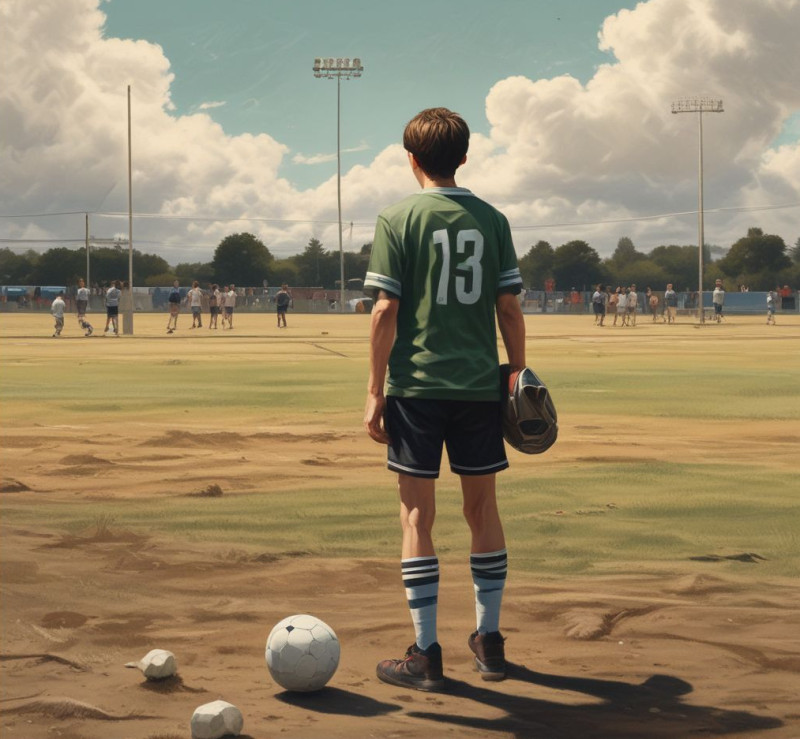
Part 1: Out of the Game764Please respect copyright.PENANAWRX86OWSed
September 14, 1972. I had just turned thirteen and felt like I was at the peak of my soccer game. I had the body of a fifteen-year-old, and I played defense near the goal with pride and discipline: never late to practice, shirt tucked in, my head fully in the game. Coach Fuensalida had trusted me with that position because he saw in me strength, spirit, and discipline.
That day, as always, I arrived ten minutes early at Holy Cross Academy’s training center. By 2:50, I was already changed and ready to head out of the locker room. Then Coach Fuensalida called me into his office. Not so unusual—but his somber look set off alarms: something serious was coming.
I knew Coach Fuensalida well. Unlike the priests, he was blunt and direct—he didn’t dress things up with fancy words or hide behind riddles. For us, he was the adult we could trust, the one who always spoke straight. That day, though, his honesty would cut deeper than any goal scored against us.
“Roberto, come in,” he said. “I need to talk to you before practice.”
I sat across from his desk. The first thing he said froze me in place.
Father Felipe, under orders from the Rector, had instructed him to make room on the team. Don Julio Gallo’s son, Sebastián, had to join the starting lineup. Coach Fuensalida repeated the order word for word:
“First, identify the boy who is to be sacrificed. Then, inform him—diplomatically but clearly—that he is no longer in the starting lineup. I shall speak with him later to provide the necessary spiritual comfort if needed.”
That phrase kept bouncing around in my head: the boy who is to be sacrificed.
I already knew Sebastián Gallo. Scrawny, uncoordinated, hopeless. In the locker room, without his shirt and padded vest, he looked like a bundle of bones. Up until then, he’d only been allowed to tag along in a few practices. Suddenly, he’d become a starting defender—in my spot.
Coach Fuensalida tried to explain it with his usual bluntness.
“Roberto, you have to understand my hands are tied. I fought this decision, but Don Julio leaned on both the Rector and Father Felipe. We have no choice, even if it means cutting you. It pains me to lose such a disciplined player with a future. But that’s how the hierarchy works.”
I tried to argue, stunned.
“You’re putting Gallo in defense to replace me? That bag of bones can’t survive a single tackle!”
He sighed, shaking his head.
“Believe me, I considered every position. Of all the bad options, replacing you was the least damaging. I’m sorry, Roberto. There’s no way around it.”
Rage surged through me. I thought of Eduardo Andrés, the other defender, and burst out:
“But Eduardo Andrés is much worse than me—take him out instead!”
Coach looked me dead in the eye.
“Impossible. He’s an Irarrázaval. He’s untouchable. My hands are tied.”
That day, on my thirteenth birthday, they ripped my spot away from me—for a weak, clumsy kid with a powerful last name. Tears burned in my eyes as I tried to reason one last time.
“I’ve been on time, disciplined, always committed! And you’re cutting me for a kid who can’t even control the ball?”
Fuensalida lowered his gaze but didn’t soften the verdict.
“I know. That’s why you’ll always be welcome at practice… but you won’t play official matches.”
“Not even as a sub?” I asked, stunned.
“Not even as a sub,” he said firmly. “That would just create pressure for substitutions. With Gallo in defense, it’s better not to have anyone waiting on the bench. But if you’d like, you can still train—or support the team from the stands.”
I walked out of that office feeling, for the first time, the raw weight of last names, the tangible injustice of hierarchy. I knew instantly I would never return, not even to watch: the whole point of practice was to prepare for competition, and my spot, my effort, my passion had just been erased.
That September 14, 1972, they took away my field… and with it, a piece of my childhood.
Part 2: History Class and Back Row Chaos
The afternoon dragged on in Mr. Morales’s history class. Sunlight streamed through dusty windows; most kids barely listened. In the back, the guys were messing around while I sat quietly. Juancho leaned toward me with a cocky grin.
“Hey, man… what’s the deal? Did Fuensalida kick you off the team ’cause you sucked?”
“Yeah!” Toño chimed in. “Tell us the truth, man! Did he drop you ’cause you couldn’t stop a ball if your life depended on it?”
Everyone burst out laughing, even though they all knew I’d been the brick wall in defense.
“Oh, screw off, you idiots.” I laughed. “Me, bad? I was the iron bar of that defense. Nobody—and I mean nobody—got past me.”
“Come on then, spill it,” Juancho pressed. “What really happened?”
“The old man called me into his office, his face like he’d just smelled something rotten, and dropped the line: ‘My hands are tied, Roberto…’”
“Hah!” Toño said. “There it is! Always some last-name drama behind it, huh?”
“Exactly. Freakin’ Gallo. That scarecrow. Old man Julio Gallo leaned on the school, and of course, his skeleton of a son got the spot.”
“No way!” Juancho nearly shouted. “Sebastián? That bony twig who looks like a clothes hanger?”
“That weak-ass twig couldn’t take a shoulder bump,” another classmate said. “You push him once and he’s out till Christmas break.”
“I told Fuensalida to his face: ‘Are you serious? You’re putting that bag of bones in defense to replace me? He’s gonna snap the first time someone kicks the ball!’”
Toño grinned. “That’s the spirit! What’d the old man say?”
I put on a goofy voice, imitating the coach.
“‘I’ve looked at all the possible positions… and out of all the evils, this is the lesser one.’”
The guys exploded with laughter, pounding the desks like drums.
Juancho grinned. “The ‘lesser evil,’ he says! So the team’s screwed anyway, but hey—could’ve been worse if he played striker!”
“I told him right there, ‘Then bench Eduardo Andrés instead. That guy’s worse than a mosquito bite.’”
Toño nodded. “Exactly! That Irarrázaval kid only plays ’cause of his fancy last name. Useless on the field!”
I imitated Fuensalida again.
“‘Can’t do that, Roberto. He’s an Irarrázaval.’”
The whole back row let out a long “Boooo!”—half laughing, half cursing.
“All these last-name princes, man,” another classmate chimed in. “If it weren’t for family names, you’d already be playing for the national squad.”
Juancho slapped me on the back.
“You’re a walking brick wall, dude! Tell Gallo to shove that position where the sun don’t shine!”
Toño raised his fist.
“Hell yeah! We’re with you, Roberto! That broomstick kid couldn’t defend a paper goal!”
The guys pounded the desks, chanting under their breath like a fan section.
“Ro-ber-to! Ro-ber-to! Ro-ber-to!”
Mr. Morales finally snapped from the front of the class.
“Hey! You in the back! Quiet down or you’re out!”
“Chill, old man,” Juancho muttered. “We’re just cheering for the school wall here.”
Muffled laughter spread around me. I sat there grinning like a hero. For a moment, the classroom felt like a miniature stadium.
Later, in the schoolyard, kids were yelling and a ball was bouncing across the asphalt. I was sitting on a bench when Lucho and Pepe approached.
“Yo, Roberto!” Lucho said. “What happened, man? Why aren’t you back in defense? Did they kick your ass off the team?”
Pepe laughed.
“Maybe Fuensalida told you, ‘Take off the jersey and go sell peanuts, bud!’”
“Get lost, assholes. I was the wall in front of that goal. Not even a bus got through me! But nooo, the coach had to pull a stupid stunt.”
Lucho leaned closer. “What stunt? Out with it, man.”
“He called me in, all serious: ‘Roberto, we’ve got to follow orders… even if it means taking you out of defense to make room for another kid.’”
“What kid?” Pepe asked.
“The Gallo twig, man. Skinny as a rake, son of a big shot. Fragile like wet cardboard. A total nightmare.”
“You’re kidding!” Lucho blurted out. “They dumped you for that bony freak?”
Pepe laughed so loudly that a few nearby kids turned toward us.
“That dude probably sleeps in his shin guards!”
“Exactly. And me—always on time, jersey soaked, giving it my all—they replaced me with a scarecrow.”
“That’s criminal, bro,” Lucho said. “You were tougher than the Berlin Wall!”
“Hell, this guy could take on a truck head-on!” Pepe added.
I grinned.
“All right, shut up, clowns. I know you liked me on defense. Fuensalida didn’t kick me out ’cause I sucked—he did it to kiss up to the big shot.”
Lucho turned toward the others and shouted:
“Yo, everyone! They dumped Roberto to put in the big shot’s skeleton kid! What a load of crap!”
“That Gallo guy won’t last a match!” another classmate called out with a laugh. “They’ll have to carry his broken ass off the field!”
Pepe raised both arms.
“Roberto’s the real defender! Not that limp noodle!”
The crowd howled, chanting and laughing like wild fans.
“Roberto! Roberto! The one and only defender!”
Epilogue: The Wall That Can’t Be Knocked Down
The days passed, and the team carried on without me. From time to time, passing the field on my way elsewhere, I’d catch sight of Gallo standing in my place—a loose, awkward shape moving through the area I used to command. I didn’t feel satisfaction when he messed up; I felt a cold distance, a hollow I couldn’t quite name. That was when I realized that the soccer I had learned to respect—the kind where sweat and discipline still counted—was gone from that field.
Fuensalida stopped meeting my eyes in the corridors. He didn’t have to. He was left with his “hands tied,” and I was left with mine clean. Don Julio Gallo secured a spot for his son, but there was one thing he couldn’t buy: the quiet respect of those who truly knew the game.
During recess, when the inspector wasn’t watching, the shout never changed:
“Pass it to the Wall!”
They weren’t shouting surnames. They were calling for the one who wouldn’t let anyone through. My teammates didn’t need explanations or spiritual comfort. They already knew.
Looking back now, I see that September 14, 1972, wasn’t an exception—it was a warning. Sometimes hierarchy weighs more than skill. Some people are untouchable. And there aren’t always shouts or tears strong enough to change that.
They took the field from me and ruined my birthday. Gallo kept the number four jersey. I walked away with something less visible and far more lasting: the certainty that nothing in my life had ever been handed to me.
And that wall—the only one that mattered—was mine, and no one was going to knock it down.
ns216.73.216.88da2


 and then Add to home screen.
